

Featured Courses
Previously trained hazardous waste workers complete required OSHA annual refresher certification training

2026 8 Hour HAZWOPER Refresher

Annual 8-hour HAZWOPER refresher meeting OSHA 29 CFR 1910.120(e)(8) requirements.
Comprehensive lithium battery safety safety training for workers and workplace for workplace compliance

Lithium Battery Safety

Covers what happens when lithium batteries fail and how to prevent fires and explosions.

View All OSHA Courses

image

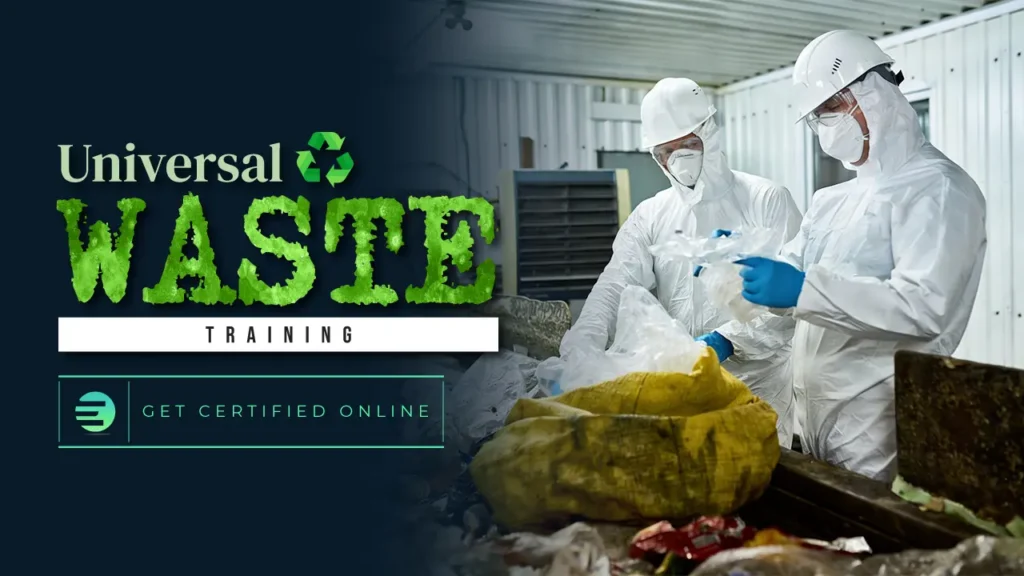
Universal Waste Training

4.8(9 reviews)
Universal Waste Training

Course Overview

Universal Waste Training is a six module online course on EPA's Universal Waste Rule. It covers the five universal wastes, handler duties for labelling, storage and accumulation, the split between small and large quantity handlers, and transport.

  • Learn the five universal wastes that 40 CFR 273.9 names, including the aerosol cans added to the list in 2019.
  • Work out whether you are a small or a large quantity handler under 40 CFR 273.9, and what 5,000 kg changes.
  • Know the one year accumulation clock at 40 CFR 273.15, and how to prove the day the clock started running.
  • 2 hours, self-paced
  • Instant certificate
  • Mobile friendly
$24.99

Per seat. One-time payment, no subscription.

Total (1 seats x $24.99)
$24.99
− +

30-day satisfaction guarantee. No hidden fees.

Course Clips

Everything You Need to Know
About This Course

The course runs six modules, each closing with a quiz, and finishes with a final exam.

  • What Universal Waste Is, and Why the Rule Exists
  • The Five Universal Wastes Under 40 CFR 273.9
  • Batteries, and the Spent Lead Acid Exclusion
  • Pesticides, Recalls and Collection Programmes
  • Mercury Containing Equipment and Thermostats
  • Lamps: Fluorescent, High Intensity Discharge and Neon
  • Aerosol Cans and the Puncture and Drain Option
  • RCRA, the Universal Waste Rule and FIFRA
  • General Management Standards for Handlers
  • Container Condition, Compatibility and Closure
  • The Accepted Label Wordings for Each Waste Type
  • The One Year Accumulation Limit and Its Extensions
  • Proving How Long Waste Has Been Accumulated
  • Small Quantity Handler Duties and Exemptions
  • Large Quantity Handler Notification and EPA ID Numbers
  • Shipment Records and the Three Year Retention
  • Informing Employees Against Thorough Familiarity
  • Response to Releases and the Hazardous Waste Determination
  • Off Site Shipments and Authorised Destinations
  • Inspections, Penalties and Enforcement Actions

OSHA StandardEPA 40 CFR Part 273
Course Duration2 hours
Format100% online, fully narrated with photos and interactivity
Passing Score70% on final exam
CertificatePersonalized certificate, printable immediately upon passing
LanguagesEnglish
Device CompatibilityDesktop, tablet, and smartphone
ProgressProgress saved automatically, stop and restart without losing your place
Instructor SupportAccess professional instructors for guidance and answers to your course-related questions.
AcceptedOur courses meet federal standards, but state requirements may vary. Please verify before purchase.

Anyone who drops a dead battery, a spent lamp or an empty aerosol can into a box at work, and the people who have to answer for what happens to that box. No environmental background is assumed.

  • Facilities and maintenance staff
  • Warehouse and operations employees
  • Environmental health and safety coordinators
  • Office and property managers
  • Retail and service counter staff
  • Laboratory and estates technicians
  • Purchasing and waste contract owners
  • Anyone named on a universal waste programme
  • Employees at businesses required to comply with EPA universal waste regulations

Almost every workplace generates at least one of the five, because lamps and batteries are everywhere. What decides the duties is how much sits on site at once, not what the business does.

  • Manufacturing and industrial plant
  • Healthcare and laboratories
  • Commercial property management
  • Retail and wholesale
  • Education and campuses
  • Government and municipal facilities
  • Automotive and fleet maintenance
  • Waste management and recycling

Universal Waste or the Full Hazardous Waste Programme?

  • Universal Waste Training. The page you are on. The five universal wastes, handler duties, accumulation limits, transport and enforcement.
  • Hazardous Waste Program Development. Generator status, accumulation limits, manifests and contingency planning for everything else. View the Hazardous Waste Program Development
  • Chemical Safety. The hazard communication side: labels, safety data sheets and exposure control. View the Chemical Safety
  • Annual Environmental Training. The yearly all hands refresher across waste, water, air and reporting. View the Annual Environmental Training

Take this one for lamps, batteries, aerosols, pesticides and mercury devices. Take the others for the wastes that never qualified for the lighter track.


Why Universal Waste Has a Rule of Its Own

Module 1 opens on the bargain the rule strikes: lighter paperwork, in exchange for these wastes actually reaching a recycler.

  • Five wastes. 40 CFR 273.9 names five: batteries, pesticides, mercury containing equipment, lamps and aerosol cans. Aerosol cans were the most recent addition, and programmes written before that still miss them.
  • Hazardous, still. These are hazardous wastes. The rule does not make them safe, it makes them easier to collect, so a spent fluorescent tube ends up at a recycler rather than in a skip behind the building.
  • Lighter rules. In exchange a handler picks up specific duties: containers that are structurally sound, compatible and closed, labelling in one of the accepted forms for that waste, an accumulation clock, and a plan for what to do when something leaks.
  • Only if followed. Get those wrong and the reduced status falls away. What is left is a hazardous waste stored without a permit, which is a materially different conversation with an inspector.
Verified Course Reviews

Add a review
You must be logged in to post a review Log In
4.8
Based on 9 reviews
5
78
78%
4
22
22%
3
0%
2
0%
1
0%
1-2 of 9 reviews
  1. good info

    (0) (0)
  2. was good

    (0) (0)

Frequently Asked Questions

Everything you need to know about the Universal Waste Training.

Yes. Upon passing the final exam with a score of 70% or higher, you can immediately print a certificate of completion. This certificate serves as proof of training for your employer.

Yes. The course is accessible on desktop computers, laptops, tablets, and smartphones. Progress saves automatically on the same device, so you can stop and resume where you left off.

The Universal Waste Training course is an online program that reviews the regulations established by the EPA under the Universal Waste Rule. It teaches learners how to recognize hazardous wastes common in commercial and residential settings and covers the proper management and handling of these materials. The course is approximately 2 hours in length.

Universal waste refers to specific types of hazardous waste that are commonly generated by households and businesses. These wastes contain hazardous substances that can pose significant risks to human health and the environment if not managed properly. The EPA established the Universal Waste Rule to streamline handling procedures and encourage recycling of these materials.

The course covers foundational understanding of universal waste, the importance of proper management, the regulatory framework associated with universal waste, how to identify universal waste, responsibilities of universal waste handlers, storage requirements, training and records requirements, and differences for small and large quantity handlers.

The course is approximately 2 hours in length. Because it is fully self-paced, you can complete it over multiple sessions at your convenience. Your progress saves automatically on the same device, so you can pause and resume at any time.

The Universal Waste Training course is an online program that reviews the regulations established by the EPA under the Universal Waste Rule. It teaches learners how to recognize hazardous wastes common in commercial and residential settings and covers the proper management and handling of these materials. The course is approximately 2 hours in length.

Common categories of universal waste regulated by the EPA include batteries (such as lithium, nickel-cadmium, and lead-acid batteries), pesticides, mercury-containing equipment (such as thermostats and thermometers), and lamps (such as fluorescent tubes and high-intensity discharge lamps). This course teaches learners how to identify these waste types.

The EPA differentiates between small quantity handlers and large quantity handlers of universal waste based on the total amount of universal waste accumulated at any one time. Each category has different requirements for accumulation time, employee training, labeling, and notification. This course covers the differences between these two handler categories.

This course reviews the regulations established by the Environmental Protection Agency (EPA) under the Universal Waste Rule. The Universal Waste Rule was created to streamline the process of handling commonly generated hazardous wastes and to encourage recycling rather than disposal.

The EPA’s Universal Waste Rule requires that all employees who handle or are responsible for managing universal waste must be informed about proper handling and emergency procedures. Training requirements differ for small and large quantity handlers. This course provides a comprehensive overview of the regulations and proper handling procedures.

Yes. This course is 100% online and fully self-paced. There is no in-person component required. The course uses a combination of audio, full-motion video, text, and graphics.

Better Training. Better Outcomes.

Fifteen years, 200,000+ professionals certified, and a completion rate roughly double the industry average.

OSHA citation printed on every certificate

Your employer and site safety officer can verify compliance at a glance, with no phone calls and no lookups.

No setup. No LMS. Training in minutes.

Pay once, get instant access. No account setup, no downloads, no IT involvement. Works in any browser.

Built for field workers, not classrooms

Grounded in real jobsite operations. Scenarios reflect the work your crew actually does.

Trusted by safety managers & contractors

Used by EHS managers, general contractors and federal site supervisors to keep crews certified on time.

200,000+
Professionals certified
87%
Completion rate (industry avg <45%)
10M+
Hours of training delivered
15
Years in business

Your go-to source for workplace safety updates.

Join our monthly newsletter covering industry stories, news & timely updates, and get a free 110-page OSHA manual covering the latest training requirements.

eTraining and the eTraining logo copyright 2026 eTraining, Inc. All Rights Reserved.