


Featured Courses
Previously trained hazardous waste workers complete required OSHA annual refresher certification training

2026 8 Hour HAZWOPER Refresher

Annual 8-hour HAZWOPER refresher meeting OSHA 29 CFR 1910.120(e)(8) requirements.
Comprehensive lithium battery safety safety training for workers and workplace for workplace compliance

Lithium Battery Safety

Covers what happens when lithium batteries fail and how to prevent fires and explosions.

View All OSHA Courses

image

Chemical Safety

3.8(4 reviews)
Chemical Safety

Course Overview

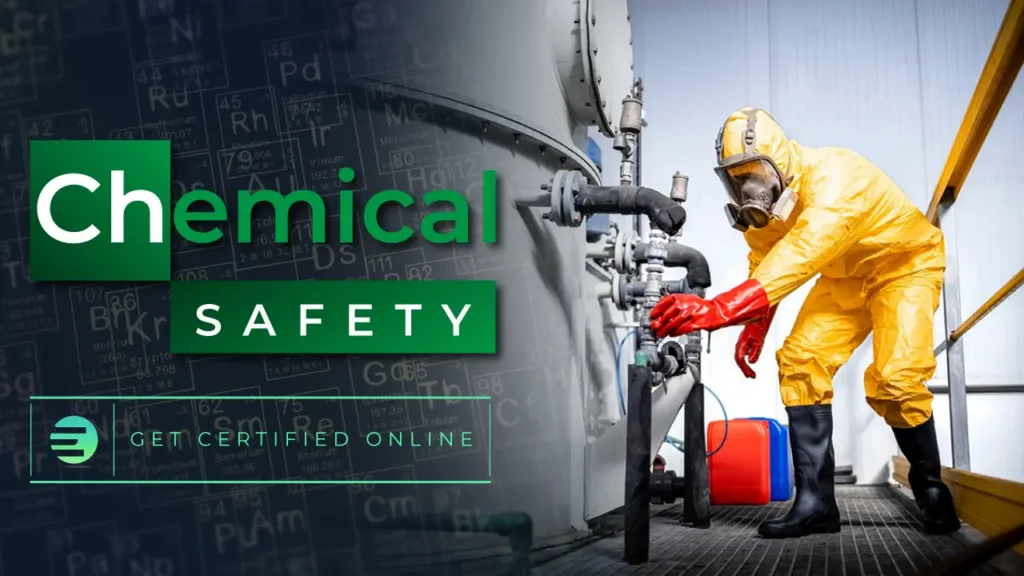
Chemical Safety is an online course built to OSHA's Hazard Communication Standard, 29 CFR 1910.1200. It covers GHS labels, all 16 sections of a safety data sheet, routes of entry, health effects, PPE, ventilation, safe transfer and storage.

  • Read a GHS label the way 29 CFR 1910.1200(f)(1) builds one, from pictogram through to precautionary statement.
  • Find answers fast in a safety data sheet, knowing which of the 16 sections holds first aid and which has PPE.
  • Match the glove, the goggles and the container to the chemical, then store it away from what it reacts with.
  • 2-3 hours, self-paced
  • Instant certificate
  • Mobile friendly
$69.00

Per seat. One-time payment, no subscription.

Total (1 seats x $69.00)
$69.00
− +

30-day satisfaction guarantee. No hidden fees.

Course Clips

Everything You Need to Know
About This Course

The course runs two modules of two parts each, with a knowledge check after every module and a final exam at the end.

  • Where Chemicals Turn Up: Maintenance, Lab, Housekeeping and Warehouse
  • Employer and Employee Duties Under 29 CFR 1910.1200
  • Four Routes of Entry: Inhalation, Skin, Ingestion and Injection
  • Acute and Chronic Health Effects
  • Toxicity, Irritation, Corrosion, Sensitization and Carcinogenicity
  • GHS Pictograms, Signal Words and Hazard Statements
  • Reading a Safety Data Sheet, All 16 Sections
  • Finding the SDS Before You Need It
  • Choosing PPE for the Chemical, Not for the Task
  • Compatible Containers and Secondary Container Labels
  • Chemicals That Must Never Be Mixed
  • Ventilation, Fume Hoods and Containment
  • Safe Transfer, Hygiene and No Food in Chemical Areas
  • Eyewash Stations and Emergency Showers
  • Storage: Segregation, Temperature, Security and Fire Protection
  • Container Inspections and What to Report

OSHA StandardOSHA 29 CFR 1910.1200
Course Duration2-3 hours
Format100% online, fully narrated with photos and interactivity
Passing Score70% on final exam
CertificatePersonalized certificate, printable immediately upon passing
LanguagesEnglish
Device CompatibilityDesktop, tablet, and smartphone
ProgressProgress saved automatically, stop and restart without losing your place
Instructor SupportAccess professional instructors for guidance and answers to your course-related questions.
AcceptedOur courses meet federal standards, but state requirements may vary. Please verify before purchase.

The course opens by naming the chemicals used in seven different departments, so it fits anyone whose job puts them near a container.

  • Workers who handle, mix or apply chemicals
  • Maintenance technicians and custodial staff
  • Laboratory and research technicians
  • Manufacturing and production operators
  • Warehouse and logistics workers
  • Healthcare staff using disinfectants and sterilants
  • Landscaping and grounds crews
  • Safety officers running a hazard communication program

Hazard communication reaches every workplace where a hazardous chemical is present, which is most of them.

  • Chemical manufacturing and processing
  • Manufacturing and industrial production
  • Healthcare and laboratories
  • Pharmaceutical and biotechnology
  • Construction and building trades
  • Agriculture and grounds maintenance
  • Oil, gas and petrochemical
  • Warehousing and distribution

Chemical Safety, HAZWOPER or Process Safety Management?

  • Chemical Safety. The page you are on. Hazard communication for people who handle or work near chemicals as part of a normal job.
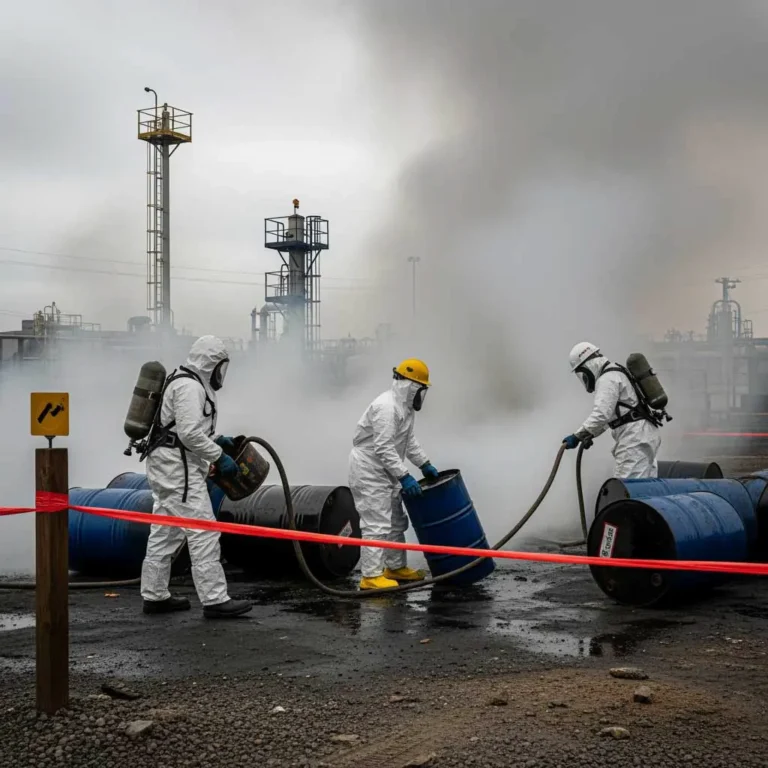
  • HAZWOPER 40 Hour. For hazardous waste site cleanup, treatment and disposal work, and emergency response to uncontrolled releases. View the HAZWOPER 40 Hour
  • Process Safety Management. For processes holding a highly hazardous chemical above the threshold quantity in 29 CFR 1910.119. View the Process Safety Management
  • Hazardous Waste Program Development Training. For the person building the waste side of the programme under RCRA. View the Hazardous Waste Program Development Training

Almost everyone needs hazard communication. The other two apply to specific work and specific quantities.


What Chemical Safety Training Does OSHA Actually Require?

Hazard communication is one of the few training duties OSHA writes down in plain words, and it is worth knowing exactly what the words say before buying anything.

  • When training is owed. Employers shall provide effective information and training on hazardous chemicals in the work area at the time of initial assignment, and whenever a new chemical hazard the employees have not previously been trained about is introduced, under 29 CFR 1910.1200(h)(1).
  • What else the employer owes. Training is one piece. The standard also requires a written hazard communication program, a list of the hazardous chemicals present, labels on containers, and safety data sheets kept readily accessible to employees during each work shift.
  • No expiry date. The standard sets no expiry on training. What triggers more of it is a new hazard in the work area, not a date on a certificate.
  • What a course cannot do. No off the shelf course can teach your chemical list, where your SDS binder lives, or your own spill procedure. Those are site specific and the standard expects them to be taught on site.

This course covers the general elements the standard names, which is the part that transfers between employers. The site specific half stays with the employer.
Verified Course Reviews

Add a review
You must be logged in to post a review Log In
3.8
Based on 4 reviews
5
50
50%
4
25
25%
3
0%
2
0%
1
25
25%
1-4 of 4 reviews
  1. good

    (0) (0)
  2. good

    (0) (0)
  3. Glitches with quiz and test questions. Repeated same questions with answers that didn’t make sense

    (0) (0)
  4. Very satisfied.

    (0) (0)

Frequently Asked Questions

Everything you need to know about the Chemical Safety.

Chemical safety training is a safety education program that teaches workers how to identify, handle, and protect themselves from hazardous chemicals in the workplace. eTraining’s course provides approximately 2–3 hours of instruction covering OSHA 29 CFR 1910.1200 (Hazard Communication Standard / GHS), including chemical hazard identification, Safety Data Sheets (SDS), GHS labeling, exposure routes and health effects, PPE selection, engineering controls, emergency response for chemical spills, and proper storage and handling procedures. Upon completion, participants receive a printable certificate of completion.

OSHA’s Hazard Communication Standard (29 CFR 1910.1200) requires employers to train all employees who may be exposed to hazardous chemicals in the workplace. Training must be provided at initial assignment and whenever new chemical hazards are introduced. Employers must maintain a written hazard communication program, a chemical inventory, Safety Data Sheets for all hazardous chemicals, and documentation of employee training. This requirement applies across all industries where hazardous chemicals are present.

The course takes approximately 2–3 hours to complete. Because it is self-paced, you can complete it over multiple sessions at your convenience. Most students finish within 1 week. You have 6 months from your enrollment date to complete all coursework. Progress is saved automatically on the same device, so you can stop and resume at any time.

The course covers: hazardous chemical identification and classification under the GHS system; how to read GHS labels (pictograms, signal words, hazard statements, precautionary statements); Safety Data Sheets (SDS) and how to read all 16 sections; chemical exposure routes (inhalation, skin absorption, ingestion, injection); health effects of chemical exposure (acute and chronic); personal protective equipment for chemical handling; engineering controls (ventilation, containment) and administrative controls; emergency response procedures for chemical spills and exposures; and proper chemical storage, handling, and disposal procedures.

Yes. eTraining’s Chemical Safety course covers OSHA 29 CFR 1910.1200 (Hazard Communication Standard) requirements and is accepted nationwide. You receive a printable certificate of completion that documents your training. Employers across all 50 U.S. states accept this training as part of their hazard communication compliance programs.

Chemical safety training is a broad term covering all aspects of working safely with chemicals, including identification, handling, storage, PPE, and emergency response. GHS/HazCom training specifically focuses on OSHA’s Hazard Communication Standard (29 CFR 1910.1200) and the Globally Harmonized System for labeling and communication. eTraining’s Chemical Safety course covers both GHS/HazCom requirements and broader chemical safety practices, providing comprehensive chemical safety education in a single course.

A Safety Data Sheet (SDS) is a standardized 16-section document that provides detailed information about a hazardous chemical, including its properties, health hazards, exposure limits, PPE requirements, first aid procedures, fire-fighting measures, and disposal instructions. Under OSHA 29 CFR 1910.1200, employers must maintain an SDS for every hazardous chemical in the workplace and ensure that employees know how to access and read them. This course teaches workers how to read and use all 16 sections of an SDS.

Yes. Upon passing the final exam with a score of 70% or higher, you can immediately print a certificate of completion. This certificate serves as proof of training for your employer.

Yes. The course is accessible on desktop computers, laptops, tablets, and smartphones. Progress saves automatically on the same device, so you can stop and resume where you left off.

There is no federally mandated expiration date for this training certificate. However, health and safety plans should be reviewed and updated annually, and whenever workplace conditions, hazards, or regulations change. Refresher training is recommended to stay current with evolving OSHA standards and best practices for safety program management.

You must score at least 70% on the final exam to pass and receive your certificate of completion. The course includes knowledge-check quizzes that do not count toward your final grade but help prepare you for the exam. If you do not pass on your first attempt, you can retake the exam.

Better Training. Better Outcomes.

Fifteen years, 200,000+ professionals certified, and a completion rate roughly double the industry average.

OSHA citation printed on every certificate

Your employer and site safety officer can verify compliance at a glance, with no phone calls and no lookups.

No setup. No LMS. Training in minutes.

Pay once, get instant access. No account setup, no downloads, no IT involvement. Works in any browser.

Built for field workers, not classrooms

Grounded in real jobsite operations. Scenarios reflect the work your crew actually does.

Trusted by safety managers & contractors

Used by EHS managers, general contractors and federal site supervisors to keep crews certified on time.

200,000+
Professionals certified
87%
Completion rate (industry avg <45%)
10M+
Hours of training delivered
15
Years in business

Your go-to source for workplace safety updates.

Join our monthly newsletter covering industry stories, news & timely updates, and get a free 110-page OSHA manual covering the latest training requirements.

eTraining and the eTraining logo copyright 2026 eTraining, Inc. All Rights Reserved.