


Featured Courses
Previously trained hazardous waste workers complete required OSHA annual refresher certification training

2026 8 Hour HAZWOPER Refresher

Annual 8-hour HAZWOPER refresher meeting OSHA 29 CFR 1910.120(e)(8) requirements.
Comprehensive lithium battery safety safety training for workers and workplace for workplace compliance

Lithium Battery Safety

Covers what happens when lithium batteries fail and how to prevent fires and explosions.

View All OSHA Courses

image

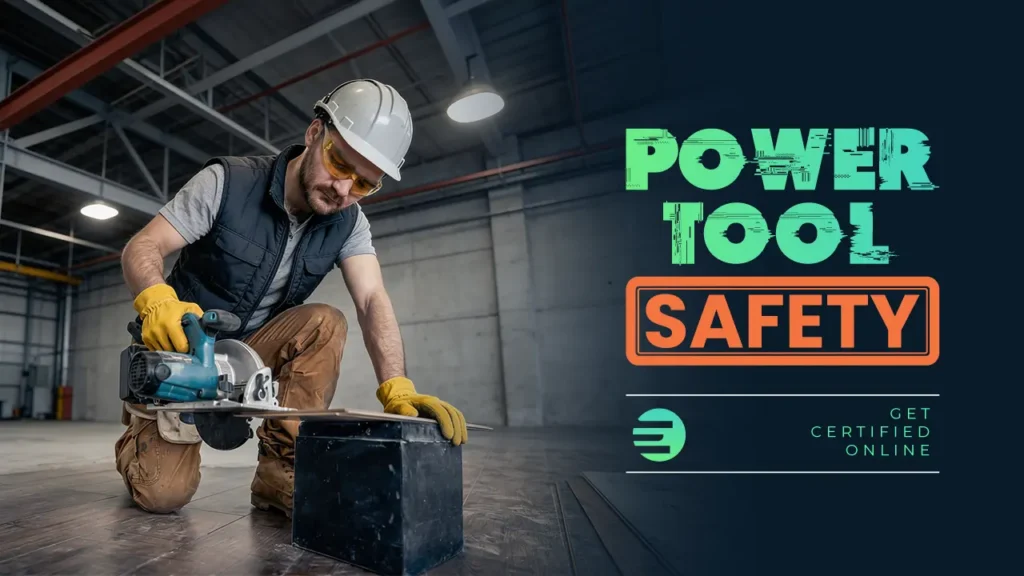
Power Tool Safety

4.6(26 reviews)
Power Tool Safety

Course Overview

Power Tool Safety is a four-part course covering the whole of OSHA 29 CFR 1926 Subpart I. It works through hand tools, power-operated hand tools, abrasive wheels, woodworking machines, jacks, air receivers and power transmission guarding.

  • Recognise the fourteen ways tools hurt people, from flying projectiles to noise, vibration and nip points.
  • Match the switch to the tool, keep guards in place, and know the numbers OSHA sets for grinder clearances.
  • Handle the tools that bite hardest: powder-actuated, pneumatic, hydraulic, fuel-powered and abrasive wheels.
  • 1-2 hours, self-paced
  • Instant certificate
  • Mobile friendly
$39.00

Per seat. One-time payment, no subscription.

+

30-day satisfaction guarantee. No hidden fees.

Course Clips

Everything You Need to Know
About This Course

Four parts, in the order the course runs them: tool types and hazards, hazard controls, the terms and general requirements of 29 CFR 1926 Subpart I, then the section-by-section rules for hand tools, powered tools, abrasive wheels, woodworking machinery, jacks, air receivers and power transmission. Each part ends in a short quiz at 70%, retaken until passed, with no time limit.

  • Tool Injury Data and Where the Exposures Come From
  • The Fourteen Tool Hazard Categories
  • Flying Projectiles, Sparks, Accidental Starting and Shock
  • Noise Exposure Limits and Vibration Injury
  • The Three Switch Types and Which Tools Need Each
  • Guarding: Point of Operation, Nip Points and Rotating Parts
  • Hand Tool Rules Under 1926.301
  • Power-Operated Hand Tools Under 1926.302
  • Powder-Actuated Tools, Training and Misfire Procedure
  • Pneumatic Tools, Hose Safety Devices and Fastener Guards
  • Hydraulic Tools and Fire-Resistant Fluid
  • Fuel-Powered Tools and Refuelling
  • Electric Tools, Grounding and Double Insulation
  • Abrasive Wheels: Ring Testing, Flanges and Guard Angles
  • Tongue Guard and Work Rest Clearances
  • Woodworking Machines and Circular Saw Guards
  • Jacks: Capacity, Blocking and Inspection Intervals
  • Air Receivers and Mechanical Power-Transmission Guarding

OSHA Standard29 CFR 1926 Subpart I
Course Duration1-2 hours
Format100% online, fully narrated with photos and interactivity
Passing Score70% on final exam
CertificatePersonalized certificate, printable immediately upon passing
LanguagesEnglish
Device CompatibilityDesktop, tablet, and smartphone
ProgressProgress saved automatically, stop and restart without losing your place
Instructor SupportAccess professional instructors for guidance and answers to your course-related questions.
AcceptedOur courses meet federal standards, but state requirements may vary. Please verify before purchase.

Power Tool Safety is for the people on a construction site who pick up a tool, whether it plugs in, runs on air, burns fuel or fires a cartridge, and for the foremen and safety leads who hand those tools out on the employer's behalf under the instruction duty at 29 CFR 1926.21(b)(2).

  • Carpenters and framers running circular saws, routers and nailers all shift.
  • Laborers who borrow a grinder, a drill or a breaker from the gang box.
  • Masons and concrete crews using powder-actuated tools and cut-off saws.
  • Ironworkers and welders grinding, cutting and drilling steel.
  • Electricians and plumbers drilling and cutting through framing with corded and cordless tools.
  • Mechanical and HVAC installers working pneumatic tools off a site compressor.
  • Demolition crews handling saws, breakers, jacks and pry bars.
  • Shop hands at a contractor's yard who run bench grinders, table saws and belt-driven equipment.
  • Foremen, superintendents and safety coordinators who assign tools and keep the training file.

29 CFR 1926 Subpart I applies wherever construction work puts a hand or power tool in a worker's hand. These are the operations that send crews to this course.

  • General building contractors framing, finishing and fitting out commercial and residential projects.
  • Residential remodeling and renovation crews working with saws, routers and sanders.
  • Concrete and masonry contractors running powder-actuated tools, grinders and cut-off saws.
  • Steel erection and ironwork, where grinding, drilling and weld prep run all day.
  • Electrical and plumbing contractors drilling and cutting on active job sites.
  • Roofing and siding crews using pneumatic nailers off a compressor.
  • Demolition and site-clearing contractors handling breakers, saws and jacks.
  • Highway and bridge work, with jacks, air receivers and fuel-powered saws on site.
  • Mechanical and HVAC installation, from hole saws to hydraulic benders.
  • Contractor shops and yards where bench grinders, table saws and belt-driven equipment are kept up.

Power Tool Safety or Machine Guarding Training?

Subpart I covers the tool in your hands. The machine guarding courses cover the fixed machinery on the floor, which OSHA regulates separately.

  • Power Tool Safety. The page you are on. Hand tools, power tools, abrasive wheels, woodworking machines, jacks and air receivers under Subpart I.
  • Machine Guarding Safety. Fixed machinery: guard types, point of operation devices and safeguarding methods. View the Machine Guarding Safety
  • Machine Guarding for Mechanical Power Presses. The press-specific course, built on 29 CFR 1910.217. View the Machine Guarding for Mechanical Power Presses

Take this one for portable and bench tools. Add a machine guarding course if your people work at fixed production machinery.


What Does OSHA Require for Hand and Power Tool Safety?

Subpart I sets the rules, and four of them account for most citations the course is built to prevent.

  • Guard what moves. Belts, gears, shafts, pulleys, sprockets, spindles, drums, flywheels and chains must be guarded where employees can contact them, and a guard a tool was designed to take must be fitted (29 CFR 1926.300(b)).
  • Match the switch to the tool. Hand-held powered tools need a positive on-off control, a momentary contact on-off control, or a constant pressure switch, depending on the tool (1926.300(d)).
  • Do not issue unsafe tools. Employers must not issue or permit the use of unsafe hand tools, including sprung wrenches, mushroomed impact tools and split wooden handles (1926.301).
  • Provide the PPE. Employees exposed to falling, flying, abrasive or splashing objects, or to harmful dusts, fumes, mists, vapors or gases, must be given the PPE that protects against it (1926.300(c)).


Verified Course Reviews

Add a review
You must be logged in to post a review Log In
4.6
Based on 26 reviews
5
77
77%
4
15
15%
3
4
4%
2
0%
1
4
4%
1-2 of 26 reviews
  1. learn alot about power tools

    (0) (0)
  2. VERY GOOD SECTION ON POWER TOOLS

    (0) (0)

Frequently Asked Questions

Everything you need to know about the Power Tool Safety.

Yes. Upon passing the final exam with a score of 70% or higher, you can immediately print a certificate of completion. This certificate serves as proof of training for your employer.

Yes. The course is accessible on desktop computers, laptops, tablets, and smartphones. Progress saves automatically on the same device, so you can stop and resume where you left off.

You must score at least 70% on the final exam to pass and receive your certificate of completion. The course includes knowledge-check quizzes that do not count toward your final grade but help prepare you for the exam. If you do not pass on your first attempt, you can retake the exam.

  Power Tool Safety is an online safety training program that provides workers with essential knowledge to identify and prevent workplace hazards. The course covers Basic Concepts and  Hand & Power Tools in accordance with OSHA standards (OSHA Hand and Power Tools (29 CFR 1910.243)). Upon completion, participants receive a personalized certificate of completion.

While this course may not be federally mandated for all workers, many employers require this training as a condition of employment. This training is recommended for all workers exposed to these hazards. State regulations, union requirements, employer safety policies, and industry standards may also mandate completion of this course.

 The course requires a minimum of 90 minutes of instruction time. Because it is self-paced, you can complete it over multiple sessions at your convenience. You have 6 months from your enrollment date to complete all coursework. Progress is saved automatically, so you can stop and resume on the same device at any time.

  Yes. eTraining's Power Tool Safety is developed in accordance with OSHA standards and best practices for workplace safety training. The course is delivered through eTraining's fully narrated, interactive platform. You receive a personalized certificate of completion upon passing, which documents your training and is accepted by employers nationwide.

The course covers: Basic Concepts, Hand & Power Tools, Tool Hazards, Mechanical Power Transmission, Definitions, Requirements, Pneumatic & Hydraulic Tools, Hazard Controls. The course is divided into modules with quizzes at the end of each section, followed by a comprehensive final exam. Interactive content and real-world examples help reinforce learning.

Yes. This OSHA-compliant course is accepted nationwide across all 50 U.S. states. However, some states and jurisdictions may have additional specific training requirements beyond this course. Workers should verify with their employer or local regulations whether additional training is required.

Better Training. Better Outcomes.

Fifteen years, 200,000+ professionals certified, and a completion rate roughly double the industry average.

OSHA citation printed on every certificate

Your employer and site safety officer can verify compliance at a glance, with no phone calls and no lookups.

No setup. No LMS. Training in minutes.

Pay once, get instant access. No account setup, no downloads, no IT involvement. Works in any browser.

Built for field workers, not classrooms

Grounded in real jobsite operations. Scenarios reflect the work your crew actually does.

Trusted by safety managers & contractors

Used by EHS managers, general contractors and federal site supervisors to keep crews certified on time.

200,000+
Professionals certified
87%
Completion rate (industry avg <45%)
10M+
Hours of training delivered
15
Years in business

Your go-to source for workplace safety updates.

Join our monthly newsletter covering industry stories, news & timely updates, and get a free 110-page OSHA manual covering the latest training requirements.

eTraining and the eTraining logo copyright 2026 eTraining, Inc. All Rights Reserved.