

Featured Courses
Previously trained hazardous waste workers complete required OSHA annual refresher certification training

2026 8 Hour HAZWOPER Refresher

Annual 8-hour HAZWOPER refresher meeting OSHA 29 CFR 1910.120(e)(8) requirements.
Comprehensive lithium battery safety safety training for workers and workplace for workplace compliance

Lithium Battery Safety

Covers what happens when lithium batteries fail and how to prevent fires and explosions.

View All OSHA Courses

image

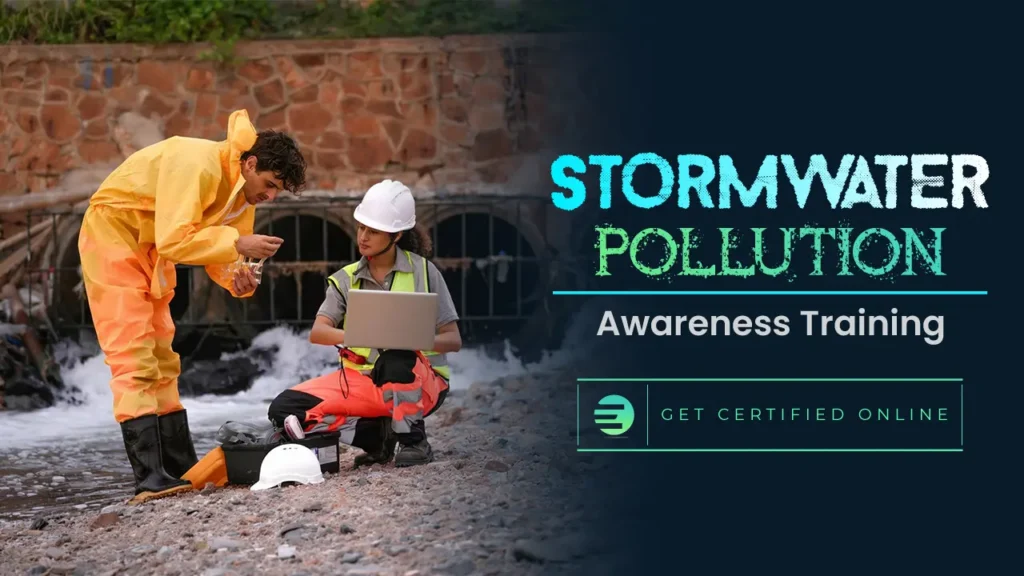
Stormwater Pollution Awareness Training

Stormwater Pollution Awareness Training

Course Overview

Stormwater Pollution Awareness Training is a four module online course on keeping pollutants out of runoff. It covers what stormwater carries and where it goes, the NPDES permit framework, employee duties, the SWPPP, control measures and inspections.

  • Start from the fact the subject rests on: a storm drain discharges straight to a stream, with no treatment.
  • Work out which permit covers your site, using the eleven industrial categories listed at 40 CFR 122.26(b)(14).
  • Report what you see with enough detail to act on, and keep the records the three years 40 CFR 122.41 sets.
  • 1-1.5 hours, self-paced
  • Instant certificate
  • Mobile friendly
$29.95

Per seat. One-time payment, no subscription.

Total (1 seats x $29.95)
$29.95
− +

30-day satisfaction guarantee. No hidden fees.

Everything You Need to Know
About This Course

The course runs four modules with a quiz after each, then a final exam and scenarios.

  • What Stormwater Is and Why It Reaches Streams Untreated
  • The Natural Water Cycle Against the Paved One
  • Sediment, Oil and Grease, Metals, Chemicals and Bacteria
  • Environmental, Health and Economic Consequences
  • The Clean Water Act and Section 402
  • NPDES: Industrial, Construction and MS4 Permits
  • The Eleven Industrial Categories and the Multi Sector Permit
  • Where State and Local Rules Go Further Than Federal
  • Penalties, Citizen Suits and Enforcement
  • Knowing the Pollution Sources in Your Own Work Area
  • Visual Indicators: Sheens, Stains, Odours and Sediment
  • Good Housekeeping, and Why Sweeping Beats Hosing
  • Reporting a Problem With Enough Detail to Act On
  • The SWPPP, Its Eight Sections and When to Amend It
  • Source Control Against Treatment BMPs
  • Routine, Annual and Post Storm Inspections
  • The Spill Response Sequence and When to Call the NRC
  • Records, Retention and the Reports a Permit Demands

OSHA StandardEPA NPDES (National Pollutant Discharge Elimination System) and OSHA General Duty Clause (Section 5(a)(1)).
Course Duration1-1.5 hours
Format100% online, fully narrated with interactive content
Passing Score70% on final exam
CertificatePersonalized certificate, printable immediately upon passing
LanguagesEnglish
Device CompatibilityDesktop, tablet, and smartphone
ProgressProgress saved automatically, stop and restart without losing your place
Instructor SupportAccess professional instructors for guidance and answers to your course-related questions.
AcceptedOur courses meet federal standards, but state requirements may vary. Please verify before purchase.

Anyone whose work happens outdoors or near a drain at a site that holds a stormwater permit, and the supervisors and coordinators who have to show the permit is being followed. No environmental background is assumed.

  • Construction crews and site workers
  • Foremen and site supervisors
  • Maintenance and facilities staff
  • Environmental compliance coordinators
  • Contractors working on permitted sites
  • Fleet, yard and loading dock staff
  • Municipal public works crews
  • Anyone named on a SWPPP pollution prevention team

Stormwater duties attach to the site rather than the trade. A permit, a disturbed acre or an industrial activity left exposed to rain is what brings a workplace into scope.

  • Construction and land development
  • Manufacturing and metal fabrication
  • Transportation and vehicle maintenance yards
  • Scrap, salvage and recycling operations
  • Landfills and waste handling
  • Bulk fuel, chemical and material storage
  • Municipal public works and MS4 operators
  • Quarries, aggregates and mineral processing

Stormwater Pollution Awareness or Another Environmental Medium?

Take this one where runoff is the exposure. Take the others where the discharge leaves by a stack or on a manifest.


Why Stormwater Pollution Reaches a Stream Untreated

The course opens on the one fact everything else follows from, and it is the fact most people get wrong.

  • Two systems. A site has two drainage systems and they do different things. The sanitary sewer takes what goes down a sink or a toilet and sends it to a treatment plant. The storm drain takes rain off the pavement and sends it to the nearest stream.
  • No treatment. Nothing happens in between. Stormwater is not screened, settled or disinfected before it discharges, which is why the only place to deal with a pollutant is before it reaches the grate.
  • More water, faster. Paving changes the volume as well as the path. The course's worked figure is about 27,000 gallons from one acre of parking lot in a one inch rain, against roughly 5,000 from a forested acre, arriving faster and with more energy.
  • Whatever is on the ground. And it carries whatever the surface was holding: sediment from disturbed soil, oil and grease from vehicles, metals from brake dust, chemicals, trash, bacteria, even heat off hot asphalt.

That is the whole argument for housekeeping. A spill swept up is a spill that never becomes a discharge.

Verified Course Reviews

Add a review
You must be logged in to post a review Log In
0.0
Based on 0 reviews
5
0%
4
0%
3
0%
2
0%
1
0%
0 of 0 reviews

Sorry, no reviews match your current selections

Frequently Asked Questions

Everything you need to know about the Stormwater Pollution Awareness Training.

Yes. Upon passing the final exam with a score of 70% or higher, you can immediately print a certificate of completion. This certificate serves as proof of training for your employer.

Yes. The course is accessible on desktop computers, laptops, tablets, and smartphones. Progress saves automatically on the same device, so you can stop and resume where you left off.

Poor stormwater management can result in environmental damage to waterways and ecosystems, regulatory violations, and significant financial penalties. Construction and industrial sites are among the most common sources of stormwater pollutants such as sediment, chemicals, and debris. This course helps workers understand their role in preventing these outcomes.

Yes. Module 3 includes spill prevention and containment as a core topic, covering strategies for preventing spills at construction and industrial sites and responding appropriately if a spill occurs.

The course is designed for construction workers, supervisors, maintenance personnel, and environmental compliance staff who work in environments where stormwater runoff poses a risk. It is well suited for anyone on a job site or at a facility where managing stormwater discharge and regulatory compliance are part of daily operations.

   The course takes approximately 1 to 1.5 hours to complete. It is fully self-paced, so learners can finish it in a single session or across multiple sittings. Progress saves on the same device.

The course covers stormwater runoff fundamentals, sources of stormwater pollution, erosion and sediment control, best management practices (BMPs), spill prevention and containment, construction site controls, industrial facility runoff risks, inspection and monitoring basics, employee responsibilities, and environmental impact prevention.

  The course is organized into four modules: Module 1 covers Introduction to Stormwater Pollution, including what stormwater runoff is, why stormwater management matters, and a regulatory overview; Module 2 covers Pollution Sources and Risks, including common site pollutants, sediment and erosion impacts, and industrial discharge concerns; Module 3 covers Prevention and Control Measures, including BMPs and site controls, spill prevention strategies, and inspection and maintenance; Module 4 covers Responsibilities and Compliance, including worker responsibilities, supervisor oversight, and environmental protection practices. A final exam follows all four modules.

Best management practices (BMPs) are techniques and strategies used to prevent stormwater pollution at construction and industrial sites. Common examples include silt fences, sediment basins, erosion blankets, inlet protection, and proper material storage. The course covers how to select and apply BMPs as part of an overall stormwater pollution prevention plan.

Poor stormwater management can result in environmental damage to waterways and ecosystems, regulatory violations, and significant financial penalties. Construction and industrial sites are among the most common sources of stormwater pollutants such as sediment, chemicals, and debris. This course helps workers understand their role in preventing these outcomes.

Yes. Module 3 includes spill prevention and containment as a core topic, covering strategies for preventing spills at construction and industrial sites and responding appropriately if a spill occurs.

Better Training. Better Outcomes.

Fifteen years, 200,000+ professionals certified, and a completion rate roughly double the industry average.

OSHA citation printed on every certificate

Your employer and site safety officer can verify compliance at a glance, with no phone calls and no lookups.

No setup. No LMS. Training in minutes.

Pay once, get instant access. No account setup, no downloads, no IT involvement. Works in any browser.

Built for field workers, not classrooms

Grounded in real jobsite operations. Scenarios reflect the work your crew actually does.

Trusted by safety managers & contractors

Used by EHS managers, general contractors and federal site supervisors to keep crews certified on time.

200,000+
Professionals certified
87%
Completion rate (industry avg <45%)
10M+
Hours of training delivered
15
Years in business

Your go-to source for workplace safety updates.

Join our monthly newsletter covering industry stories, news & timely updates, and get a free 110-page OSHA manual covering the latest training requirements.

eTraining and the eTraining logo copyright 2026 eTraining, Inc. All Rights Reserved.