

🔥 Fire Prevention Week Sale · 20% Off Fire Safety Courses · Ends Oct 10 · Code Learn More →
Featured Courses
Previously trained hazardous waste workers complete required OSHA annual refresher certification training

2026 8 Hour HAZWOPER Refresher

Annual 8-hour HAZWOPER refresher meeting OSHA 29 CFR 1910.120(e)(8) requirements.
Comprehensive lithium battery safety safety training for workers and workplace for workplace compliance

Lithium Battery Safety

Covers what happens when lithium batteries fail and how to prevent fires and explosions.

View All OSHA Courses

image

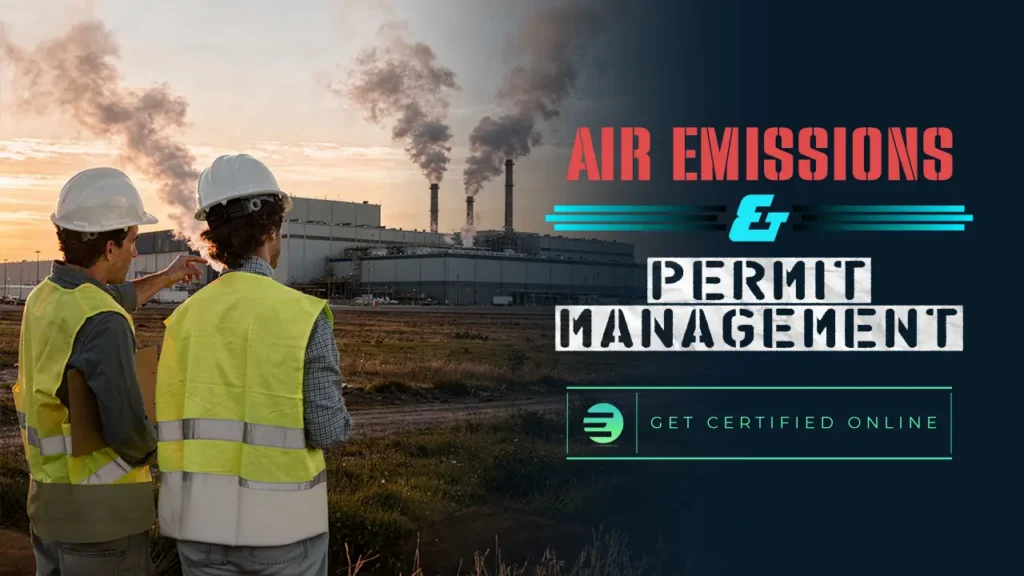
Air Emissions and Permit Management

5(1 reviews)
Air Emissions and Permit Management

Course Overview

Air Emissions and Permit Management is a 50 minute online course built to the Clean Air Act permit programs in 40 CFR Part 70 and 40 CFR 52.21. It covers emission sources, air permits, monitoring, recordkeeping, inspections and daily practice.

  • Tell stationary, mobile and fugitive emission sources apart, and name the pollutants each one puts in the air.
  • Work out which of the three air permits applies, using the major source thresholds written into 40 CFR 70.2.
  • Run the monitoring and records an air permit calls for, and know what an inspector asks to see on the day.
  • 45-60 minutes, self-paced
  • Instant certificate
  • Mobile friendly
$65.00

Per seat. One-time payment, no subscription.

− +

30-day satisfaction guarantee. No hidden fees.

Course Clips

Everything You Need to Know
About This Course

The course runs three modules across seven parts, with a quiz after each module and a final exam at the end.

  • Stationary, Mobile and Fugitive Emission Sources
  • The Clean Air Act, NAAQS and Hazardous Air Pollutants
  • EPA, State Agencies and Who Issues Your Permit
  • Construction, Title V and Synthetic Minor Permits
  • Major Source Thresholds and What Crosses Them
  • When a Change or a Replacement Triggers a Permit
  • Stack Testing, Opacity Monitoring and CEMS
  • Records to Keep and How Long to Keep Them
  • Agency Inspections and Common Permit Violations
  • Reporting Deviations and Keeping a Permit Current
  • Good Housekeeping That Stops Emissions at Source
  • Hazard Communication and Respiratory Protection

OSHA StandardClean Air Act (40 CFR Part 70)
Course Duration45-60 minutes
Format100% online, fully narrated with photos and interactivity
Passing Score70% on final exam
CertificatePersonalized certificate, printable immediately upon passing
LanguagesEnglish
Device CompatibilityDesktop, tablet, and smartphone
ProgressProgress saved automatically, stop and restart without losing your place
Instructor SupportAccess professional instructors for guidance and answers to your course-related questions.
AcceptedOur courses meet federal standards, but state requirements may vary. Please verify before purchase.

The course is written for the construction and industrial workers who operate, maintain and watch the equipment an air permit covers.

  • Environmental compliance officers and managers
  • Facility managers and plant operators
  • Environmental health and safety (EHS) professionals
  • Engineers and technical staff responsible for air quality compliance
  • Operations managers at facilities with air permits
  • Workers at facilities that generate regulated air emissions
  • Government and regulatory agency personnel
  • New employees at facilities subject to Clean Air Act requirements

Any site holding an air permit, or big enough to need one, has people who touch permit compliance every shift.

  • Manufacturing and heavy industry
  • Construction and demolition
  • Oil, gas and petrochemical refining
  • Chemical processing
  • Power generation and utilities
  • Asphalt and concrete batch plants
  • Waste management and incineration
  • Food and beverage processing

Air Emissions Training or Indoor Air Quality Training?

  • Air Emissions and Permit Management. The page you are on. Emissions leaving the site, the permits that authorise them, and the monitoring and records that prove compliance.
  • Indoor Air Quality. Air inside the workplace: ventilation, contaminants, comfort complaints and how to investigate them. View the Indoor Air Quality
  • Annual Environmental Training. The broader yearly environmental refresher across several media, rather than a deep pass on air permits. View the Annual Environmental Training
  • Stormwater Pollution Awareness Training. The water counterpart for construction sites, covering runoff and discharge instead of emissions. View the Stormwater Pollution Awareness Training


Who Keeps an Air Permit in Compliance Day to Day?

A permit is signed in an office and kept in compliance on the floor. The course is built around that gap, and around the worker who closes it.

  • The permit is a legal document. A Title V permit binds the facility to specific operating conditions and emission limits, and it is issued for a fixed term of five years under 40 CFR 70.6(a)(2).
  • Records are the proof. Compliance is demonstrated on paper, which is why 40 CFR 70.6(a)(3)(ii)(B) requires monitoring data and support information to be kept for at least five years.
  • Most violations start small. The course walks through the violations that actually get written up: exceeded limits, missed monitoring, thin records, control equipment left off, and dust crossing the fence line.
  • Falsifying is a separate crime. Knowingly falsifying a required record is a criminal offence under section 113(c) of the Clean Air Act, and the course draws a hard line between an honest error and a covered up one.
Verified Course Reviews

Add a review
You must be logged in to post a review Log In
5.0
Based on 1 review
5
100
100%
4
0%
3
0%
2
0%
1
0%
1-1 of 1 review
  1. I have taken many training courses similar to this one, and by far, this was one of the best presented. The videos were clear, informative, and easy to follow. After watching each module, I had a good understanding of the material and felt well prepared for the quizzes at the end. Overall, I thought the training was very well done and effective.

    (0) (0)

Frequently Asked Questions

Everything you need to know about the Air Emissions and Permit Management.

Yes. Upon passing the final exam with a score of 70% or higher, you can immediately print a certificate of completion. This certificate serves as proof of training for your employer.

Yes. The course is accessible on desktop computers, laptops, tablets, and smartphones. Progress saves automatically on the same device, so you can stop and resume where you left off.

This course is designed for environmental compliance officers, facility managers, EHS professionals, plant operators, engineers, and anyone who works at a facility that generates regulated air emissions or holds air permits under the Clean Air Act.

The Air Emissions and Permit Management course is an online environmental compliance training program that teaches facility personnel how air permits work, what emission limits mean for operations, and how day-to-day activities can impact compliance with the Clean Air Act. The course covers permit structures, emission thresholds, monitoring and reporting duties, common violation causes, and best practices for maintaining continuous compliance.

The course is self-paced, so completion time varies. You have 6 months from enrollment to finish. Progress saves automatically on the same device.

The course covers an overview of air emissions and the Clean Air Act, understanding air permits and permit conditions, major versus minor sources of air pollution, emission limits, monitoring and reporting requirements, common causes of air permit violations, how operational changes affect permit compliance, best practices for recordkeeping, and steps to maintain continuous compliance.

The Clean Air Act and EPA regulations require facilities with air permits to train personnel on permit conditions, monitoring requirements, and compliance procedures. Specific training requirements vary by permit type and state regulatory program. This course provides foundational knowledge to support compliance with these obligations.

Under the Clean Air Act, a major source is a facility that emits or has the potential to emit pollutants above certain thresholds set by EPA (for example, 100 tons per year of any criteria pollutant, or 10 tons per year of a single hazardous air pollutant). A minor source falls below these thresholds. Major sources face more stringent permitting, monitoring, and reporting requirements.

Air permit violations can result in enforcement actions from EPA or state environmental agencies, including notices of violation, consent orders, civil penalties (which can be substantial), and in serious cases, criminal prosecution. Common violations include exceeding emission limits, failing to monitor or report as required, and making operational changes without updating the permit.

Better Training. Better Outcomes.

Fifteen years, 200,000+ professionals certified, and a completion rate roughly double the industry average.

OSHA citation printed on every certificate

Your employer and site safety officer can verify compliance at a glance, with no phone calls and no lookups.

No setup. No LMS. Training in minutes.

Pay once, get instant access. No account setup, no downloads, no IT involvement. Works in any browser.

Built for field workers, not classrooms

Grounded in real jobsite operations. Scenarios reflect the work your crew actually does.

Trusted by safety managers & contractors

Used by EHS managers, general contractors and federal site supervisors to keep crews certified on time.

200,000+
Professionals certified
87%
Completion rate (industry avg <45%)
10M+
Hours of training delivered
15
Years in business

Your go-to source for workplace safety updates.

Join our monthly newsletter covering industry stories, news & timely updates, and get a free 110-page OSHA manual covering the latest training requirements.

eTraining and the eTraining logo copyright 2026 eTraining, Inc. All Rights Reserved.