


If you work on a construction site, take the Occupational Safety and Health Administration (OSHA) 10-Hour course. If you supervise others or have safety duties, take OSHA 30. Federal OSHA doesn’t require either card. Its Outreach Training Program, the safety classes behind both cards, is voluntary and “does not meet the training requirements for any OSHA standards.” Some states, cities, public contracts and employers do require a card, and they decide which one counts.
This guide is for whoever has to make the call. That’s the site manager, the safety lead, human resources (HR), or the worker buying their own card.
OSHA 10 vs. OSHA 30 at a Glance
Both courses cover OSHA’s construction standards, 29 CFR 1926. Both end with a U.S. Department of Labor (DOL) card. The difference between OSHA 10 and OSHA 30 is depth, and who the course is meant for.
| OSHA 10 Construction | OSHA 30 Construction | |
|---|---|---|
| Who it’s for | Workers on a construction site | Supervisors and workers with safety duties |
| Training time | At least 10 hours | At least 30 hours |
| Our course | 10.25 hours, 17 modules | 30+ hours, 37 modules |
| Standard covered | 29 CFR 1926 | 29 CFR 1926 |
| Card | DOL 10-hour card | DOL 30-hour card |
| Federal expiration date | None (some cities and states set limits) | None (some cities and states set limits) |
| Time to finish our online course | 6 months from enrollment | 6 months from enrollment |
| Our price (Oct 2026) | $59 | $159 |
| Spanish version | Yes | Yes |
Who Needs OSHA 10 and Who Needs OSHA 30?
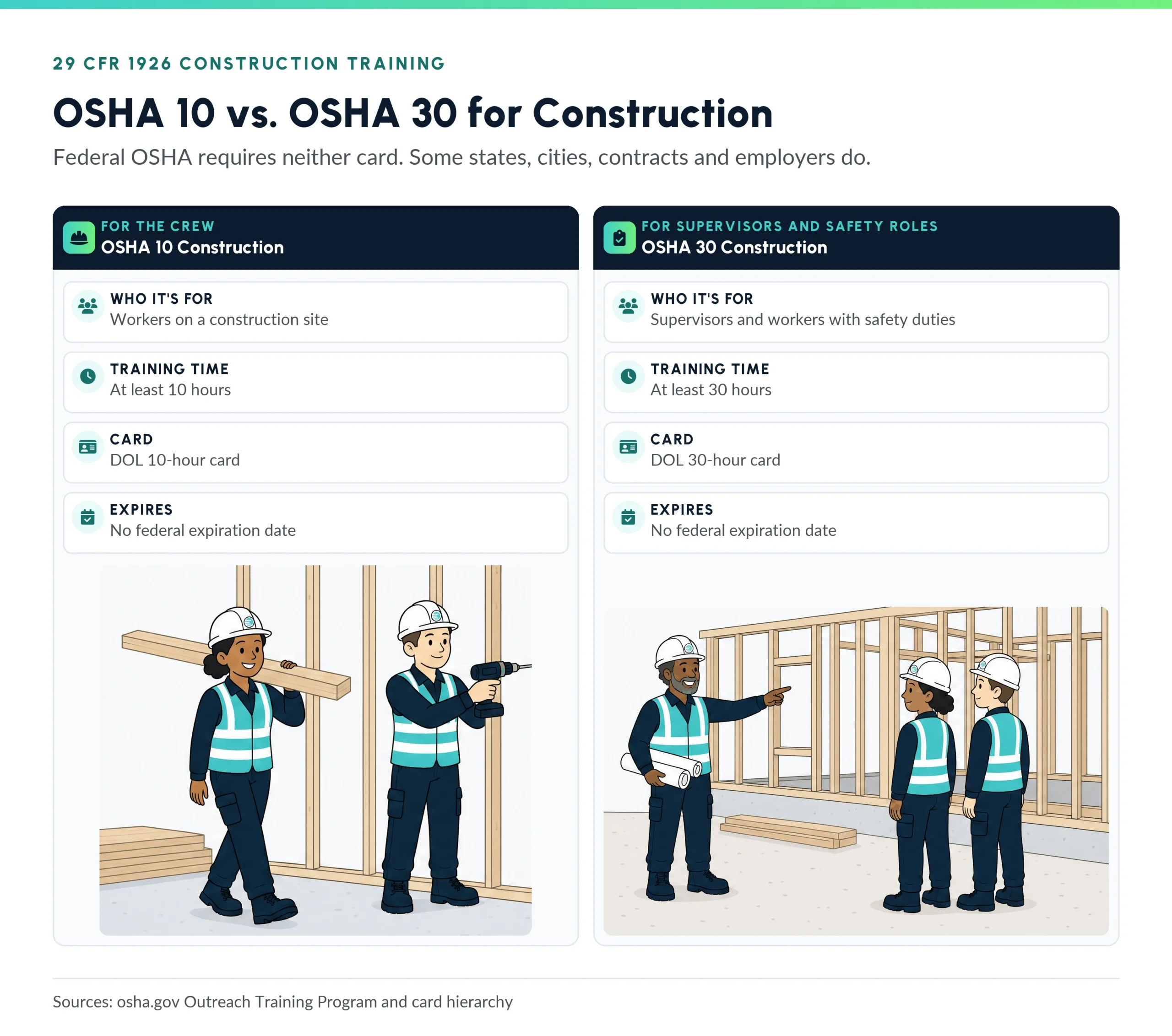
OSHA says the 10-hour class gives workers awareness of common job hazards. It calls the 30-hour class “more appropriate for supervisors or workers with some safety responsibility.” That gives you a simple rule by role:
- You work on the crew (laborer, carpenter, apprentice, equipment operator): OSHA 10 is usually enough.
- You direct other people’s work (foreman, superintendent, site supervisor): take OSHA 30.
- Safety is part of your job (safety lead, site safety coordinator): take OSHA 30.
A state, city, contract or employer rule can override this, so check the job’s requirements first. You don’t need OSHA 10 before OSHA 30. OSHA lists no prerequisite, so a new foreman can go straight to the 30-hour course.
These cards are for construction work. For jobs like manufacturing or warehousing, the matching card is OSHA 10 General Industry, which covers 29 CFR 1910.
Is OSHA 10 or OSHA 30 Required by Law?
Not by federal OSHA. Still, a card can be a condition of the job. These state and city laws require one for some or all construction work (checked October 2026):
| Where | Who needs it | Card and deadline |
|---|---|---|
| New York State (Labor Law 220-h) | Every laborer, worker and mechanic on site for state or municipal public works contracts of $250,000 or more | OSHA 10, before doing any work on the project |
| New York City (Local Law 196) | Workers on sites that need a site safety plan, a construction superintendent, or a site safety coordinator or manager. Most licensed home improvement work is exempt | Site Safety Training (SST) card: 40 hours for workers, 62 for supervisors. OSHA 10 counts as 10 hours and OSHA 30 as 30 hours if taken in the last 5 years |
| Nevada (NRS 618.983 and 618.987) | All construction workers | OSHA 10 for workers and OSHA 30 for supervisors, within 15 days of hire |
| Connecticut (CGS 31-53b) | Public works: new construction of $1 million or more, or remodeling of $100,000 or more. Delivery drivers who only load and unload are excluded | OSHA 10, shown with the first certified payroll |
| Massachusetts (MGL c.30 s.39S) | Everyone on site for public works contracts over $10,000 | OSHA 10, by the day the worker starts |
| Missouri (RSMo 292.675) | On-site workers on any public works contract. Material haulers and some utility work are excluded | OSHA 10, within 60 days of starting work |
| New Hampshire (RSA 277:5-a) | On-site workers on public projects of $100,000 or more. Police on traffic duty, trained flaggers and inspectors are exempt | OSHA 10, before starting work |
| Rhode Island (RIGL 37-23-1) | On-site workers on state or municipal projects of $100,000 or more | OSHA 10, carried at all times on the job |
| West Virginia (WV Code 21-3-22) | Workers on public improvement contracts over $50,000. Workers on site less than 21 days and delivery drivers are excluded | OSHA 10, within 21 days of being assigned to the site |
| Philadelphia | All workers on permitted construction and demolition sites, except delivery people, design professionals and special inspectors | OSHA 10 for workers. OSHA 30 for at least one supervisor per company with a contractor, excavation or demolition license (plumbing, electrical and fire suppression contractors are excluded) |
Read the full rule for your state or city before you bid, since they’re all worded differently. Plan for the mail, too. Our DOL card usually arrives 6 to 8 weeks after the course, so where a law says “before starting work,” train new hires before day one.
A general contractor can require cards from every trade on site, even where no law does. If that’s you, here’s how to check your subcontractors’ training.
How Long Does OSHA 30 Take?
OSHA 30 takes at least 30 hours of training time. OSHA limits Outreach training to 7½ hours a day, so the fastest anyone can finish is 4 days. Online, you have 6 months from enrollment to finish our course. Most of our students finish in 2 to 4 weeks.
OSHA 10 takes at least 10 hours, so it’s at least 2 days. Most of our students finish it in 1 to 2 weeks.
When you pass the final exam, you can print a certificate of completion right away. Your DOL card comes by mail, usually within 6 to 8 weeks. OSHA’s rules give trainers up to 90 days to issue it.
Does OSHA 30 Expire?
Federal OSHA doesn’t set an expiration date for the 10-hour or 30-hour construction card. Some cities, states and employers do set limits:
- New York City: SST cards are good for 5 years. OSHA training only counts toward one if you took it in the last 5 years.
- Connecticut public works: the OSHA 10 card can’t be dated more than 5 years before the project starts. Plumbers and electricians with an older card need a 4-hour refresher.
- Philadelphia: a licensed contractor’s OSHA 30 must be completed within 5 years before the license application or renewal. At renewal, 30 hours of continuing education can count instead.
- Your employer or union: some set their own refresher schedule, so ask.
If you lose your card, you’ll need to contact the provider you trained with. OSHA allows a replacement only if you took the class within the last 5 years.
How Much Do OSHA 10 and OSHA 30 Cost?
Our OSHA 10 Construction course is $59 a seat and OSHA 30 Construction is $159 a seat (October 2026). Both come in Spanish too, with the same DOL card. Here are OSHA 10 Construction in Spanish and OSHA 30 Construction in Spanish.
Picture a contractor hiring 8 carpenters and 2 supervisors for a job in Las Vegas. Nevada law gives each of them 15 days from hire to show a valid card. The carpenters need OSHA 10 and the supervisors need OSHA 30.
- 8 carpenters x $59 = $472
- 2 supervisors x $159 = $318
- Total: $790 at single-seat prices
The mailed card takes longer than 15 days, so they’d enroll the crew before the start date. Teams of 5 or more can ask for group pricing through a business account. You assign seats by email and see who’s finished.
Is OSHA 40 the Same as OSHA 30?
No. OSHA 40 is a hazardous waste and emergency response course, not a bigger version of OSHA 30. Its full name is the 40-Hour Hazardous Waste Operations and Emergency Response (HAZWOPER) course.
On a hazardous waste site, general site workers such as equipment operators and laborers need at least 40 hours of off-site instruction. They also need 3 days of supervised field experience (29 CFR 1926.65(e)(3)(i)). Workers who are on site only now and then for a limited task can need 24 hours instead (1926.65(e)(3)(ii)). Everyone covered needs 8 hours of refresher training every year (1926.65(e)(8)).
If your crew works where hazardous waste is cleaned up or stored, our HAZWOPER guide explains who needs which level. For other construction work, stick with OSHA 10 or OSHA 30.
Pick the Card That Fits the Role
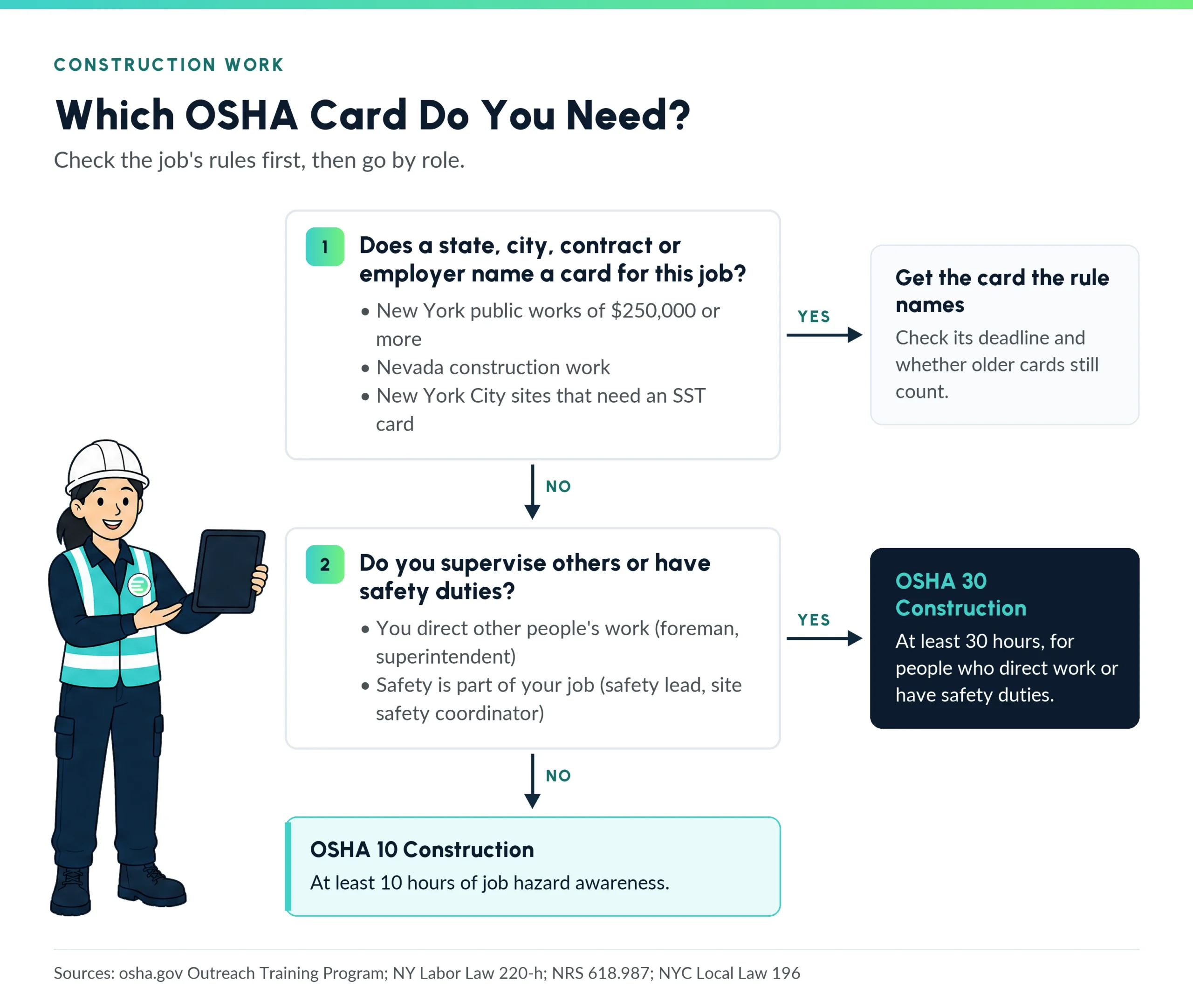
Check the job’s rules first: the state, the city, the contract and your employer. If none names a card, go by role. Workers on the crew take OSHA 10 Construction for $59. Supervisors and anyone with safety duties take OSHA 30 Construction for $159.
Frequently Asked Questions
Do I need OSHA 10 before OSHA 30?
No. OSHA doesn’t list the 10-hour course as a prerequisite, so you can take OSHA 30 first.
Do I need OSHA 30 to be a foreman?
No. Federal OSHA doesn’t require it, though some laws, contracts and employers do. Nevada requires OSHA 30 for supervisors. Philadelphia requires it for at least one supervisor at each licensed contractor, excavation or demolition company.
Can I take OSHA 10 or OSHA 30 online?
Yes. OSHA keeps a list of authorized online providers and says it can’t validate training from vendors that aren’t on it. Our courses run through ClickSafety, which is on that list. Here’s how our online OSHA 10 is authorized.
What’s the difference between OSHA 10 General Industry and OSHA 10 Construction?
General Industry covers 29 CFR 1910 for work like manufacturing and warehousing. Construction covers 29 CFR 1926. Take the one that matches the work you’ll do.
How long does it take to get my OSHA card?
Usually 6 to 8 weeks by mail for our courses. You can print a certificate as soon as you pass. OSHA’s rules give trainers up to 90 days to issue the card. More on the OSHA 10 card and the OSHA 30 card.
Sources: OSHA