


🔥 Fire Prevention Week Sale · 20% Off Fire Safety Courses · Ends Oct 10 · Code Learn More →
Featured Courses
Previously trained hazardous waste workers complete required OSHA annual refresher certification training

2026 8 Hour HAZWOPER Refresher

Annual 8-hour HAZWOPER refresher meeting OSHA 29 CFR 1910.120(e)(8) requirements.
Comprehensive lithium battery safety safety training for workers and workplace for workplace compliance

Lithium Battery Safety

Covers what happens when lithium batteries fail and how to prevent fires and explosions.

View All OSHA Courses

image

Overhead Crane Safety

3.8(4 reviews)
Overhead Crane Safety

Course Overview

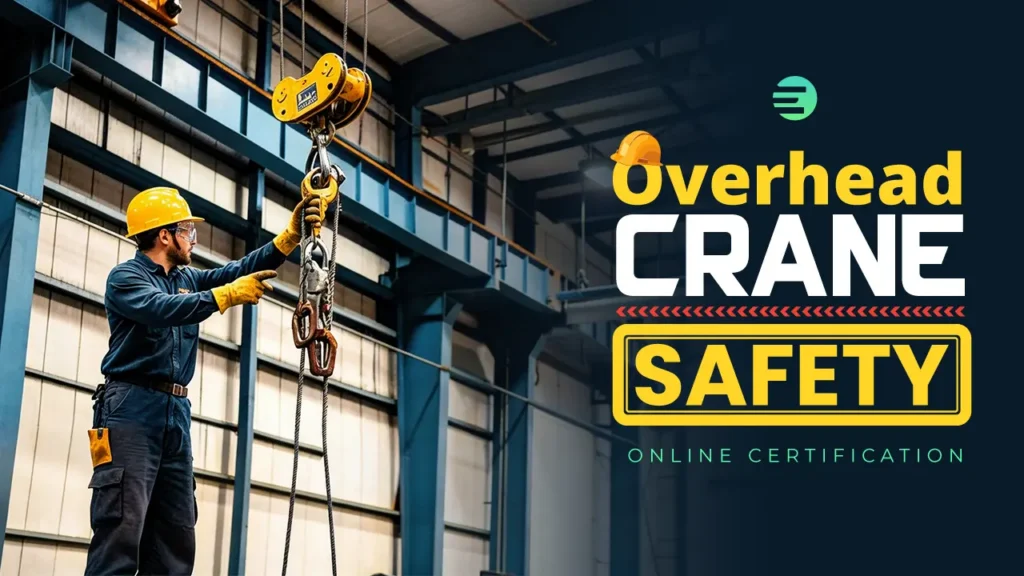
Overhead crane training built to OSHA 29 CFR 1910.179 for the people who run bridge, gantry and jib cranes and the crews working under them. Three modules cover the machine, the rules, the inspections and the response when something fails.

  • Covers the bridge, trolley, hoist and brakes, plus pendant, radio remote and cab controls and their limits.
  • Explains the frequent and periodic inspection bands in 29 CFR 1910.179(j), and what each one actually checks.
  • Works through load swing, side pulls and five kinds of crane malfunction, with the response to each one.
  • 2-3 hours, self-paced
  • Instant certificate
  • Mobile friendly
$40.00

Per seat. One-time payment, no subscription.

− +

30-day satisfaction guarantee. No hidden fees.

Course Clips

Everything You Need to Know
About This Course

Overhead Crane Safety runs in three modules, each ending with a quiz. Module 1 covers the crane itself, Module 2 the rules, capacity and inspections, and Module 3 safe operating practice, emergencies and three scenario exercises.

  • What overhead cranes do, and where bridge, gantry, jib and monorail cranes are used.
  • Crane components: the bridge, the trolley, the hoist and the braking systems.
  • Control systems: pendant, radio remote and cab controls, and the limits of each.
  • The definitions 29 CFR 1910.179 uses, from rated load and side pull to designated and appointed.
  • OSHA 29 CFR 1910.179 and how ANSI/ASME B30.2 sits alongside it.
  • Employer duties for training, inspection, maintenance and hazard communication.
  • Operator duties for pre-use checks, load limits and reporting defects.
  • Determining load weight from specifications, load cells or density and volume.
  • Rated capacity, marked load ratings and what overloading does to a crane.
  • Load testing and why a test load is capped rather than targeted.
  • Frequent and periodic inspections, and what each one looks at.
  • Signs of wear in wire ropes, hooks, bearings, electrical systems and structure.
  • Preventive maintenance schedules, records and why documentation matters.
  • Rigging basics and how sling angle changes the load on each leg.
  • Preventing load swing and side pulls with smooth operation, taglines and positioning.
  • Loading and unloading protocols, signalling, and clearing the area.
  • Emergency response to overload, electrical, mechanical, control and structural failures.
  • Emergency stops and braking systems, and the operating limits that prevent accidents.

OSHA Standard29 CFR 1910.179
Course Duration2-3 hours
Format100% online, fully narrated with photos and interactivity
Passing Score70% on final exam
CertificatePersonalized certificate, printable immediately upon passing
LanguagesEnglish
Device CompatibilityDesktop, tablet, and smartphone
ProgressProgress saved automatically, stop and restart without losing your place
Instructor SupportAccess professional instructors for guidance and answers to your course-related questions.
AcceptedOur courses meet federal standards, but state requirements may vary. Please verify before purchase.

Overhead Crane Safety is for the people who run these cranes, the people who maintain them and the people working underneath.

  • Overhead, bridge and gantry crane operators.
  • Crane maintenance and repair technicians.
  • Manufacturing and production floor workers.
  • Steel mill and metalworking crews.
  • Warehouse and logistics staff working near cranes.
  • Supervisors overseeing crane operations.
  • Safety officers in industrial settings.
  • Riggers and hook-up crews attaching loads.
  • Maintenance planners who schedule crane inspections.
  • Anyone the employer designates to operate a crane.

These are the operations where a bridge crane runs above the floor all shift, and where a dropped or swinging load reaches people working below.

  • Manufacturing and production facilities
  • Steel mills and metalworking
  • Automotive plants
  • Paper mills and printing
  • Warehousing and distribution
  • Food processing
  • Chemical manufacturing
  • Shipyards and port terminals
  • Power generation plants
  • General heavy industry

Experience the first 5 minutes of the course right here. No account or payment required.

Overhead Crane Safety or the Crane Operator Course?

Overhead Crane Safety is built around the bridge crane that runs on a fixed runway above a plant floor. The other crane courses cover mobile crane work and the person who oversees a lift.

  • Overhead Crane Safety. The page you are on. Two to three hours on overhead and gantry cranes under 29 CFR 1910.179: components and controls, capacity and load ratings, frequent and periodic inspections, safe operating practice and emergencies. Buy it for plant crews working with a bridge crane.
  • Crane Operator Training Course. The operator course for mobile crane work, which sits under a different set of rules from the crane bolted above a shop floor. View the Crane Operator Training Course
  • Crane Safety for the Competent Person. Written for the person overseeing crane work and signing off on inspections, rather than the person at the controls. View the Crane Safety for the Competent Person

If the crane travels on a runway above your floor, Overhead Crane Safety is the right buy. Add the competent person course for whoever oversees the lifts.


What 1910.179 Requires of an Overhead Crane

29 CFR 1910.179 sets specific duties around who operates a crane, how it is marked, how often it is inspected and how it is tested. Overhead Crane Safety covers each, so you can check the course against the standard before buying.

  • Only designated personnel operate. Paragraph (b)(8) limits operation to designated personnel, meaning those the employer selects as qualified for specific duties. The course covers what an operator needs to know.
  • The rated load is marked. Paragraph (b)(5) requires the rated load plainly marked on each side of the crane, legible from the floor. The course covers why that marking is the first thing an operator checks.
  • Inspections run on two cycles. Paragraph (j) sets frequent inspections at daily to monthly intervals and periodic inspections at 1 to 12 months. The course covers what each one looks at.
  • Tests come before service. Paragraph (k) covers operational and rated load tests for new and altered cranes, with reports kept on file. The course covers what those tests prove.
Verified Course Reviews

Add a review
You must be logged in to post a review Log In
3.8
Based on 4 reviews
5
25
25%
4
25
25%
3
50
50%
2
0%
1
0%
1-2 of 4 reviews
  1. okay

    (0) (0)
  2. ok

    (0) (0)

Frequently Asked Questions

Everything you need to know about the Overhead Crane Safety.

Yes. Upon passing the final exam with a score of 70% or higher, you can immediately print a certificate of completion. This certificate serves as proof of training for your employer.

Yes. The course is accessible on desktop computers, laptops, tablets, and smartphones. Progress saves automatically on the same device, so you can stop and resume where you left off.

You must score at least 70% on the final exam to pass and receive your certificate of completion. The course includes knowledge-check quizzes that do not count toward your final grade but help prepare you for the exam. If you do not pass on your first attempt, you can retake the exam.

 Overhead Crane Safety is an OSHA-compliant online safety training program that provides workers with essential knowledge to identify and prevent workplace hazards. The course covers OSHA Standards for Overhead Cranes and  Definitions of Crane Related Terms in accordance with OSHA standards (OSHA Overhead Cranes (29 CFR 1910.179)). Upon completion, participants receive a personalized certificate of completion.

While this course may not be federally mandated for all workers, many employers require this training as a condition of employment. OSHA recommends this training for all workers exposed to these hazards. State regulations, union requirements, employer safety policies, and industry standards may also mandate completion of this course.

The course requires a minimum of 150 minutes of instruction time. Because it is self-paced, you can complete it over multiple sessions at your convenience. You have 6 months from your enrollment date to complete all coursework. Progress is saved automatically, so you can stop and resume on the same device at any time.

Yes. eTraining's Overhead Crane Safety is developed in accordance with OSHA standards and best practices for workplace safety training. The course is delivered through eTraining's fully narrated, interactive platform. You receive a personalized certificate of completion upon passing, which documents your training and is accepted by employers nationwide.

The course covers: OSHA Standards for Overhead Cranes, Definitions of Crane Related Terms, Crane Components, Crane Capacity and Load Requirements, OSHA Safe Work Practices, Training Requirements, Operator and Employer Responsibilities, Safety Hazards and Responses to Hazards. The course is divided into modules with quizzes at the end of each section, followed by a comprehensive final exam. Interactive content and real-world examples help reinforce learning.

   Yes. This OSHA-compliant course is accepted nationwide across all 50 U.S. states. However, some states and jurisdictions may have additional specific training requirements beyond this course. Workers should verify with their employer or local regulations whether additional training is required.

Better Training. Better Outcomes.

Fifteen years, 200,000+ professionals certified, and a completion rate roughly double the industry average.

OSHA citation printed on every certificate

Your employer and site safety officer can verify compliance at a glance, with no phone calls and no lookups.

No setup. No LMS. Training in minutes.

Pay once, get instant access. No account setup, no downloads, no IT involvement. Works in any browser.

Built for field workers, not classrooms

Grounded in real jobsite operations. Scenarios reflect the work your crew actually does.

Trusted by safety managers & contractors

Used by EHS managers, general contractors and federal site supervisors to keep crews certified on time.

200,000+
Professionals certified
87%
Completion rate (industry avg <45%)
10M+
Hours of training delivered
15
Years in business

Your go-to source for workplace safety updates.

Join our monthly newsletter covering industry stories, news & timely updates, and get a free 110-page OSHA manual covering the latest training requirements.

eTraining and the eTraining logo copyright 2026 eTraining, Inc. All Rights Reserved.