

Construction Appreciation Week · 10% Off Sitewide · Ends Sept 18 · Code
Featured Courses
Previously trained hazardous waste workers complete required OSHA annual refresher certification training

2026 8 Hour HAZWOPER Refresher

Annual 8-hour HAZWOPER refresher meeting OSHA 29 CFR 1910.120(e)(8) requirements.
Comprehensive lithium battery safety safety training for workers and workplace for workplace compliance

Lithium Battery Safety

Covers what happens when lithium batteries fail and how to prevent fires and explosions.

View All OSHA Courses

image

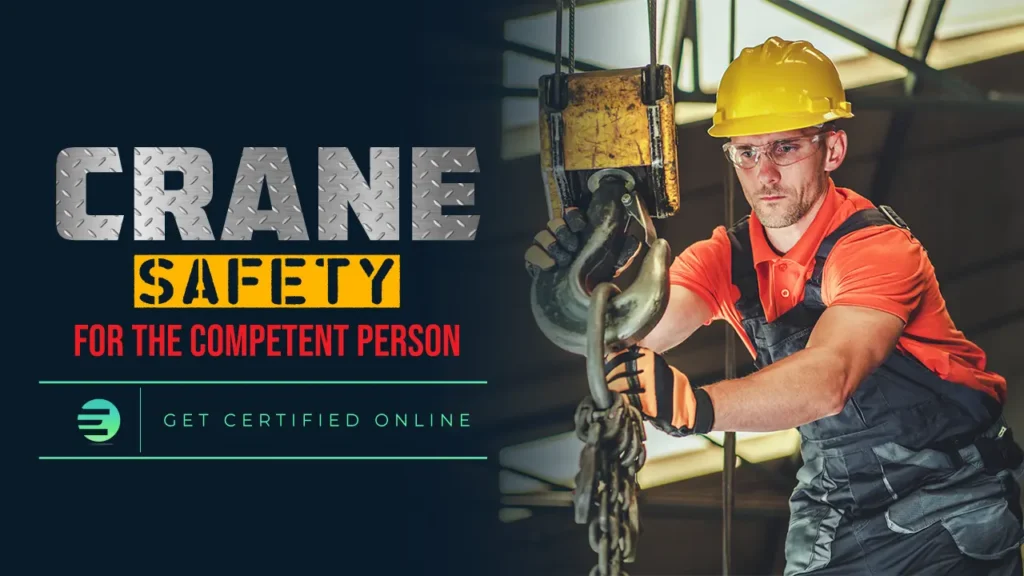
Crane Safety for the Competent Person

4.6(22 reviews)
Crane Safety for the Competent Person

Course Overview

The Crane Safety for the Competent Person course is an online training program designed for workers who need in-depth understanding of crane job sites and the safety requirements and responsibilities of different worker roles including the signal person, rigger, operator, and competent person. Ten units cover hazards, rigging, signals and rescue under OSHA 29 CFR 1926.1400, the standard for Cranes and Derricks in construction.

  • Explains who does each inspection under 29 CFR 1926.1412, and what the competent person checks each shift.
  • Trains you to spot hazards behind most crane deaths: power lines, collapse, falling loads and pinch points.
  • Includes 19 downloads you keep afterwards: load charts, operator handbooks, rigger and signal person guides.

eTraining fully endorses the national certification program offered by the National Commission for the Certification of Crane Operators (NCCCO) and will prepare candidates for the CCO certification examinations.

CCO

  • 9 to 10 hours, self-paced
  • Instant certificate
  • Mobile friendly

Price Match Plus: eTraining will beat any competitor's price + $10

$129.00 $189.00

Per seat. One-time payment, no subscription.

+

30-day satisfaction guarantee. No hidden fees.

Course Clips

Everything You Need to Know
About This Course

Ten narrated units, each ending in a knowledge check, with a final exam at the end of the course. Here is what the units teach.

  • Scope of the cranes and derricks standard.
  • Crane duty classifications.
  • Causes of crane fatalities and injuries.
  • Employer provisions and responsibilities.
  • The four routes to operator qualification.
  • Crane components, setup and planning.
  • Assembly and disassembly oversight.
  • Shift, monthly and annual inspections.
  • Wire rope, post-assembly and severe service inspections.
  • Requirements for specific crane types.
  • Rigging material selection, use and inspection.
  • Rigger qualification and recordkeeping.
  • Standard hand signals and voice communication.
  • Signal person qualification and recognition testing.
  • Working near overhead power lines.
  • Emergency response to electrocution, falls and crushing.
  • Hoist line and fall protection rescue procedures.
  • Swing radius control and exclusion zones.

OSHA Standard29 CFR 1926.1400
Course Duration9 to 10 hours
Format100% online, narrated with photos, video, and interactivity
Passing Score70% on final exam
CertificatePersonalized certificate, printable immediately upon passing
LanguagesEnglish
Device CompatibilityDesktop, tablet, and smartphone
ProgressProgress saved automatically, stop and restart without losing your place
Instructor SupportAccess professional instructors for guidance and answers to your course-related questions.
AcceptedOur courses meet federal standards, but state requirements may vary. Please verify before purchase.
NCCCO PreparationThis course prepares candidates for the NCCCO CCO certification examinations

This course is for the person a contractor puts in charge of crane safety on site, and for the supervisors and managers who have to back that person up.

  • Construction supervisors and foremen on job sites with crane operations
  • Designated competent persons for crane and derrick work
  • Safety officers overseeing crane operations
  • Project managers responsible for lift planning and crane safety
  • Workers with safety responsibilities on crane job sites
  • Signal persons, riggers, and operators seeking advanced knowledge
  • Workers preparing for NCCCO certification examinations
  • Employers needing to designate qualified competent persons for crane work

Employers across a wide range of industries use this course to meet federal, state, and site-specific safety training requirements for their workforce.

  • Commercial and industrial construction
  • Heavy civil construction and infrastructure projects
  • Structural steel erection
  • Bridge and highway construction
  • Demolition contractors
  • Refineries and petrochemical facilities
  • Power plant construction and maintenance
  • Shipyard and maritime construction
  • Manufacturing facilities with overhead cranes
  • Tower crane operations for high-rise construction

Experience the first 5 minutes of the course right here. No account or payment required.

Competent Person or Qualified Person: Which Do You Need?

These two words appear all through Subpart CC and they are not the same job. 29 CFR 1926.1412 hands them different inspections, which is where the difference bites.

  • Crane Safety for the Competent Person. The competent person runs the shift inspection under 1926.1412(d) and can stop the work. This course covers that duty and everything it touches: hazards, planning, rigging, signals, inspections and rescue. View the Crane Safety for the Competent Person
  • Crane Operator Training Course. Operator qualification is a separate track with its own paragraph, 29 CFR 1926.1427, and four routes through it. This course covers running the crane and the qualification process. View the Crane Operator Training Course
  • Overhead Crane Safety. For plants running overhead and gantry cranes, which sit under general industry rules rather than the construction subpart. Different standard, different inspection schedule. View the Overhead Crane Safety

Under 29 CFR 1926.1412(f) the annual inspection belongs to a qualified person, which is a demonstrated-ability standard rather than a course.


Does Crane Competent Person Training Expire?

Nothing in 29 CFR 1926 Subpart CC puts a date on crane competent person training. Refresher training under 1926.1430(g)(2) is triggered by what happens on site, not by the calendar.

  • The trigger is conduct, not a date. 1926.1430(g)(2) requires refresher training when the employee's conduct indicates retraining is necessary. A near miss, a dropped load or a missed inspection is the trigger the standard has in mind.
  • An evaluation can trigger it too. The same paragraph triggers on an evaluation of the employee's knowledge. If you assess someone and they cannot explain the shift inspection, that is your answer.
  • Your contracts may say something different. General contractors, owners and insurers routinely ask for a refresher every twelve months. That is a contract term rather than a federal rule, and it is worth checking before you buy for a crew.
  • The certificate is dated, which is what gets checked. Your Certificate of Completion carries the date you passed, so a site gate or an audit can see how current the training is without a conversation.

Diary the retraining against your own contracts, and treat any near miss as a trigger regardless of the date.

Verified Course Reviews

Add a review
You must be logged in to post a review Log In
4.6
Based on 22 reviews
5
73
73%
4
18
18%
3
5
5%
2
4
4%
1
0%
1-2 of 22 reviews
  1. great info

    (0) (0)
  2. A lot of slides

    (0) (0)

Frequently Asked Questions

Everything you need to know about the Crane Safety for the Competent Person.

Yes. Upon passing the final exam with a score of 70% or higher, you can immediately print a certificate of completion. This certificate serves as proof of training for your employer.

Yes. The course is accessible on desktop computers, laptops, tablets, and smartphones. Progress saves automatically on the same device, so you can stop and resume where you left off.

  Crane Safety for the Competent Person training is an OSHA-compliant safety program covering 29 CFR 1926.1400. It provides approximately 9 to 10 hours of instruction on crane operations, safety requirements, hazard recognition, rigging, inspection, signals, emergency response, and the responsibilities of signal persons, riggers, operators, and competent persons. The course prepares candidates for NCCCO CCO certification examinations and goes beyond basic awareness to provide detailed knowledge necessary to create safe working environments. Upon completion, participants receive a certificate of completion.

  OSHA 29 CFR 1926.1400 requires that a competent person be present on every job site where cranes are in operation. Workers who need this training include designated competent persons for crane operations, construction supervisors and foremen overseeing crane work, safety officers responsible for crane safety programs, project managers involved in lift planning, and workers preparing for NCCCO certification. The competent person must have sufficient experience and knowledge to recognize crane hazards, correct unsafe conditions, and has the authority to shut down operations until hazards are corrected.

 The course requires approximately 9 to 10 hours of instruction time. Because it is self-paced, most students complete it within two to three weeks. You can complete as much or as little at one time as you like. Progress is saved automatically, so you can stop and resume on the same device at any time.

  Yes. eTraining fully endorses the national certification program offered by the National Commission for the Certification of Crane Operators (NCCCO) and this course will prepare candidates for the CCO certification examinations. While the course provides comprehensive knowledge of crane safety and operations, candidates must still complete the NCCCO certification process separately, which includes written and practical examinations administered by NCCCO.

  The course covers hazard types and recognition including power lines, electrocution, crane collapses, ground conditions, struck-by hazards, caught-in-between, and falls, responsibilities including employer provisions, operator qualification and certification, and competent/qualified person requirements, crane operations including crane components, rigging devices, slings, hitches, hooks, safety devices, operational aids, fall protection, and signals, site operations including planning, load charts, assembly and disassembly, operating near power lines, multiple crane operations, and hoisting personnel, inspections including shift, monthly, annual, and wire rope inspections, specific crane types including tower cranes, derricks, floating cranes, overhead and gantry cranes, and dedicated pile drivers, rigging including the lifting process, qualifications, wire rope, chain slings, synthetic slings, block and tackle, load calculations, and case studies, signals including hand signals for mobile cranes, crawler cranes, telescopic booms, tower cranes, and voice communication, emergency response including electrocution, falls, rescue procedures, caught-in-between, and struck-by incidents, and training including competent person qualifications, planning, inspections, incident command, and documentation. The course is divided into 10 parts with 11 units covering these topics comprehensively.

  Yes. eTraining’s Crane Safety for the Competent Person course is built from OSHA standard 29 CFR 1926.1400 and covers all required competent person knowledge areas and responsibilities. You receive a certificate of completion upon passing that documents your training. The course is accepted by employers and meets OSHA’s requirements for competent person training on crane job sites. It also prepares candidates for NCCCO certification examinations.

  Yes. The course covers mobile cranes, crawler cranes, telescopic boom cranes, tower cranes, overhead and gantry cranes, derricks, floating cranes and derricks on barges, dedicated pile drivers, and sideboom cranes. Each crane type has specific safety requirements, operational considerations, and regulatory standards covered in the training. The course provides comprehensive knowledge applicable to various crane operations in construction and general industry.

You must score at least 70% on the final exam to pass and receive your certificate of completion. The course includes knowledge-check quizzes that do not count toward your final grade but help prepare you for the exam. If you do not pass on your first attempt, you can retake the exam.

Better Training. Better Outcomes.

Fifteen years, 200,000+ professionals certified, and a completion rate roughly double the industry average.

OSHA citation printed on every certificate

Your employer and site safety officer can verify compliance at a glance, with no phone calls and no lookups.

No setup. No LMS. Training in minutes.

Pay once, get instant access. No account setup, no downloads, no IT involvement. Works in any browser.

Built for field workers, not classrooms

Grounded in real jobsite operations. Scenarios reflect the work your crew actually does.

Trusted by safety managers & contractors

Used by EHS managers, general contractors and federal site supervisors to keep crews certified on time.

200,000+
Professionals certified
87%
Completion rate (industry avg <45%)
10M+
Hours of training delivered
15
Years in business

Your go-to source for workplace safety updates.

Join our monthly newsletter covering industry stories, news & timely updates, and get a free 110-page OSHA manual covering the latest training requirements.

eTraining and the eTraining logo copyright 2026 eTraining, Inc. All Rights Reserved.