


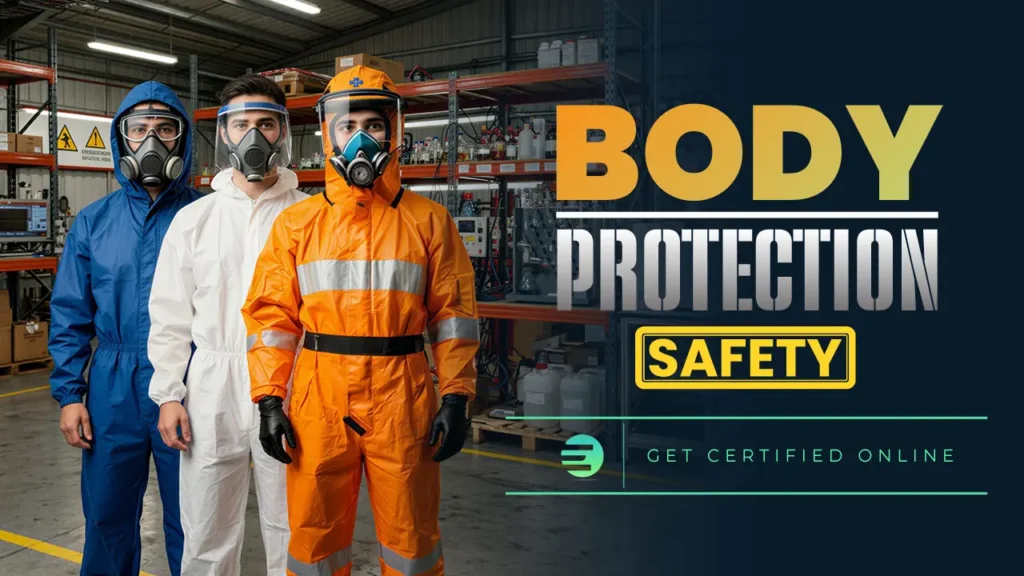
Body Protection or General PPE Training?
eTraining sells both, and they are not the same size of course. One walks through every category of protective equipment. This one takes a single category and goes all the way down it.
- Body Protection Safety. This is the page you are on. Seventy-five minutes on protective clothing alone: what the materials are, the four EPA levels, the nine-step selection process, donning and doffing an encapsulating suit, decontamination, inspection and storage. Take it when clothing is the control your people depend on.
- Personal Protective Equipment Safety. The breadth course. Head, eye and face, foot, hearing, hand, body and respiratory protection across 29 CFR 1910 Subpart I, in one to two hours. It includes a body protection section, at the depth a general course allows. Take it when your crew needs the whole picture once. View the Personal Protective Equipment Safety
- Decontamination Procedures. Decontamination has its own course in the HAZWOPER catalogue. This course covers decon as it applies to protective clothing, including the decon line and reuse decisions. Take the dedicated course where decon is a job on your site rather than a step at the end of one. View the Decontamination Procedures
If your people wear coveralls and a hard hat, the general PPE course covers them. If they are getting into a splash suit or an encapsulating suit, this is the one that goes deep enough to matter.
What Does OSHA Require PPE Training to Cover?
29 CFR 1910.132(f)(1) names five things every employee who uses PPE must be trained to know. They are worth reading before you buy any PPE course, because they are the checklist an inspector works from.
- When PPE is necessary, and what PPE is necessary. The first two of the five. For protective clothing that means knowing which hazards call for it at all, and then which of the four EPA levels the conditions actually demand. This course spends a whole part on that decision.
- How to don, doff, adjust and wear it. The third. Doffing an encapsulating suit is where contamination gets transferred to the wearer, and 1910.132(f)(2) says employees have to demonstrate they can do it before they work in it. The course walks the full sequence with an assistant.
- The limitations of the equipment. The fourth, and the one most training skips. No material resists every chemical, and none is an effective barrier against prolonged exposure. Breakthrough time is the number that tells you when a suit stops protecting.
- Care, maintenance, useful life and disposal. The fifth. Inspection before use, storage that keeps contaminated clothing away from clean, and an honest decision about whether a suit can be reused or has to be thrown away.
Under 1910.132(f)(3) retraining is triggered by change rather than by a date: the workplace changes, the equipment changes, or someone's knowledge slips. There is no expiry to diary. There is a condition to watch for.



Great course
easy