


Featured Courses
Previously trained hazardous waste workers complete required OSHA annual refresher certification training

2026 8 Hour HAZWOPER Refresher

Annual 8-hour HAZWOPER refresher meeting OSHA 29 CFR 1910.120(e)(8) requirements.
Comprehensive lithium battery safety safety training for workers and workplace for workplace compliance

Lithium Battery Safety

Covers what happens when lithium batteries fail and how to prevent fires and explosions.

View All OSHA Courses

image

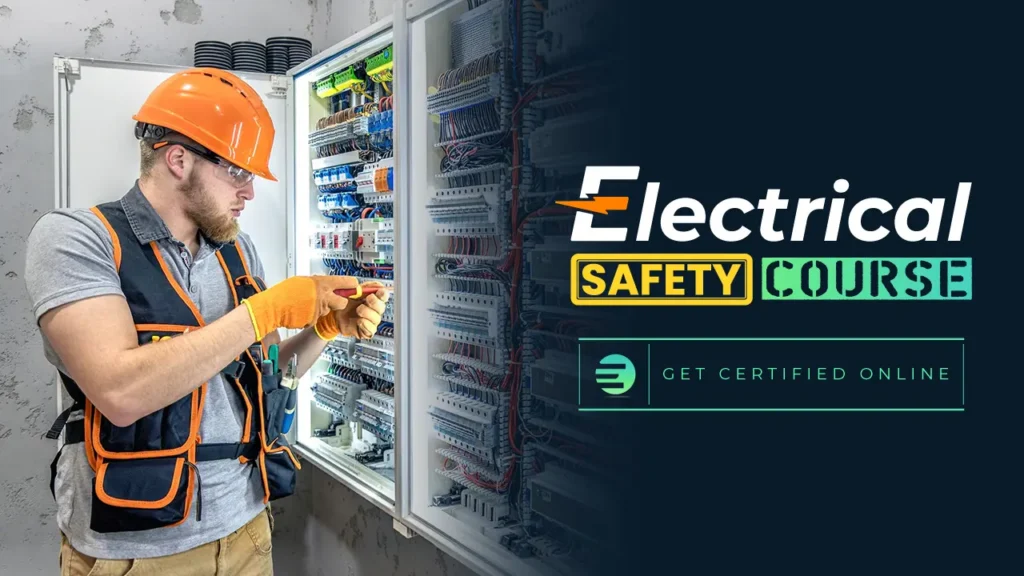
Electrical Safety Course

4.4(5 reviews)
Electrical Safety Course

Course Overview

Electrical Safety is an online course based on OSHA's construction electrical standard, 29 CFR 1926 Subpart K, that teaches workers to recognize shock, burn and fall hazards and control them with grounding, GFCIs and safe work practices.

  • Learn how current, voltage and resistance affect the human body, and why low voltage does not mean low hazard.
  • Spot damaged cords, missing ground prongs, overloaded circuits, wet conditions and overhead power line risks.
  • Use GFCIs, assured grounding programs, lockout/tagout of circuits and the right cords on a construction site.

Supervisors and designated competent persons can go further with our Electrical Safety for the Competent Person course.

  • 2 hours, self-paced
  • Instant certificate
  • Mobile friendly
$35.00

Per seat. One-time payment, no subscription.

+

30-day satisfaction guarantee. No hidden fees.

Course Clips

Everything You Need to Know
About This Course

The course runs 4 parts and about 160 narrated slides. Quizzes follow Parts 2 and 4, and a final exam follows the last part.

  • Basic Electrical Concepts: Current, Voltage, Resistance and Ohm's Law
  • Effects of Electric Current on the Human Body
  • Electrical Injuries: Electrocution, Shock, Burns and Falls
  • Common Hazards: Exposed Parts, Power Lines, Damaged Cords, Poor Grounding, Overloads and Wet Conditions
  • Personal Protective Equipment and Tool Safety
  • Lockout/Tagout of Circuits and Safe Work Practices
  • Grounding, GFCIs and the Assured Equipment Grounding Conductor Program
  • Overcurrent Devices, Flexible Cords and Extension Cords
  • Electrical Terms and Definitions
  • Installation Requirements, Working Space and Guarding Live Parts
  • Wiring Design and Protection, including Outside Conductor Clearances
  • Temporary Wiring, Boxes, Switches and Panelboards
  • Equipment for General Use: Lighting, Receptacles, Motors, Transformers and Capacitors
  • Specific-Purpose Equipment: Cranes, Hoists, Elevators, Welders and X-Ray
  • Hazardous (Classified) Locations: Classes, Groups and Divisions
  • Systems Over 600 Volts and Tunnel Installations

OSHA Standard29 CFR 1926 Subpart K
Course Duration2 hours
Format100% online, fully narrated with photos and interactivity
Passing Score70% on final exam
CertificatePersonalized certificate, printable immediately upon passing
LanguagesEnglish
Device CompatibilityDesktop, tablet, and smartphone
ProgressProgress saved automatically, stop and restart without losing your place
Instructor SupportAccess professional instructors for guidance and answers to your course-related questions.
AcceptedOur courses meet federal standards, but state requirements may vary. Please verify before purchase.

This course is for workers who use electrical tools, cords and equipment on the job, and the people who oversee that work.

  • Construction workers and laborers
  • Workers who use portable power tools and extension cords
  • Maintenance and facilities staff
  • Apprentices and helpers on electrical crews
  • Equipment operators working near overhead power lines
  • Site supervisors and forepersons
  • Safety managers and safety coordinators
  • Workers who set up temporary wiring and lighting
  • Employees in hazardous (classified) locations

The course follows OSHA's construction electrical rules, and its hazard lessons apply wherever workers use power tools, cords and electrical equipment.

  • Commercial and residential construction
  • Electrical contracting
  • Renovation and remodeling
  • Facilities and building maintenance
  • Crane, hoist and elevator work
  • Welding and fabrication shops
  • Petroleum refineries and fuel dispensing
  • Grain elevators and feed mills
  • Textile mills and woodworking plants
  • Tunnel and underground construction

Which Electrical Safety Course Do You Need?

eTraining offers three electrical safety courses, and the right one depends on how close the work gets to live parts.

  • Electrical Safety Course. The page you are on. For workers who use power tools, cords and electrical equipment and need to recognize and control shock hazards under OSHA's construction electrical rules.
  • Electrical Safety for the Competent Person. For the person the employer designates to oversee electrical safety and inspect electrical conditions on site. View the Electrical Safety for the Competent Person
  • NFPA 70E Electrical Safety. For qualified workers who work on or near energized equipment and need training on arc flash and electrical safe work practices. View the NFPA 70E Electrical Safety – 2024

Match the course to the work: awareness for tool users, competent person training for site oversight, and NFPA 70E for energized work.


What Does OSHA's Construction Electrical Standard Require on Site?

OSHA's construction electrical standard, 29 CFR 1926 Subpart K, sets the rules for power and lighting on a jobsite, and the course walks through the ones crews meet every day.

  • GFCIs or an assured grounding program. Employers must use GFCIs on 120-volt, 15- and 20-amp receptacles, or run an assured equipment grounding conductor program (29 CFR 1926.404(b)(1)).
  • The right extension cords. Extension cords for portable tools must be three-wire and designed for hard or extra-hard usage (29 CFR 1926.405(a)(2)(ii)(J)).
  • Guarded live parts. Live parts of equipment operating at 50 volts or more must be guarded against accidental contact (29 CFR 1926.403(i)(2)).
  • Tagged circuits. De-energized equipment and circuits must be made inoperative and tagged at every point they can be energized (29 CFR 1926.417(b)).

The course is hazard awareness training. It does not cover arc flash or NFPA 70E energized work practices.

Verified Course Reviews

Add a review
You must be logged in to post a review Log In
4.4
Based on 5 reviews
5
60
60%
4
20
20%
3
20
20%
2
0%
1
0%
1-2 of 5 reviews
  1. ok

    (0) (0)
  2. Good one

    (0) (0)

Frequently Asked Questions

Everything you need to know about the Electrical Safety Course.

Electrical safety training is a safety education program that teaches workers how to recognize and avoid electrical hazards in the workplace. eTraining’s course provides approximately 4 hours of instruction covering OSHA 29 CFR 1910.300 standards, including electrical concepts, hazard recognition, safe work practices, wiring design and protection, and specific-purpose equipment requirements. Upon completion, participants receive a printable certificate of completion. 

OSHA requires employers to train all employees who face a risk of electric shock or other electrical hazards (OSHA 29 CFR 1910.332). This includes workers who work directly with electricity, such as electricians and maintenance workers, as well as workers who may be exposed to electrical hazards indirectly, such as construction laborers and machine operators. Employers are responsible for determining which employees need this training based on their job duties and hazard exposure.

The course takes approximately 4 hours to complete. Because it is self-paced, you can complete it over multiple sessions at your convenience. Most students finish within 1 to 2 weeks. You have 6 months from your enrollment date to complete all coursework. Progress is saved automatically on the same device, so you can stop and resume at any time.

The course covers: basic electrical concepts including current, voltage, and resistance; electrical hazard types including shock, electrocution, burns, and arc flash; hazard control methods including personal protective equipment (PPE), lockout/tagout, and ground-fault circuit interrupters (GFCIs); safe work practices and tool safety; wiring design and protection standards; grounding requirements; and specific-purpose equipment and special systems such as cranes, elevators, and hazardous locations. The course is divided into 4 parts with quizzes at the end of each section.

Yes. eTraining’s Electrical Safety course covers OSHA 29 CFR 1910.300 general industry electrical standards and is accepted nationwide. You receive a printable certificate of completion that documents your training. Employers across all 50 U.S. states accept this training as part of their electrical safety compliance programs.

Electrical safety training based on OSHA 29 CFR 1910.300 covers general electrical safety standards including wiring, grounding, and equipment requirements. NFPA 70E (Standard for Electrical Safety in the Workplace) focuses specifically on arc flash hazard analysis, electrical PPE requirements, and safe work practices for energized electrical work. eTraining’s course covers OSHA electrical safety standards. Workers who perform energized electrical work may also need NFPA 70E-specific training.

No. eTraining’s Electrical Safety course is 100% online with no in-person component required. However, employers may have additional site-specific or hands-on training requirements beyond this course. Check with your employer for any additional training obligations.

Yes. Upon passing the final exam with a score of 70% or higher, you can immediately print a certificate of completion. This certificate serves as proof of training for your employer.

Yes. The course is accessible on desktop computers, laptops, tablets, and smartphones. Progress saves automatically on the same device, so you can stop and resume where you left off.

There is no federally mandated expiration date for this training certificate. However, health and safety plans should be reviewed and updated annually, and whenever workplace conditions, hazards, or regulations change. Refresher training is recommended to stay current with evolving OSHA standards and best practices for safety program management.

You must score at least 70% on the final exam to pass and receive your certificate of completion. The course includes knowledge-check quizzes that do not count toward your final grade but help prepare you for the exam. If you do not pass on your first attempt, you can retake the exam.

Better Training. Better Outcomes.

Fifteen years, 200,000+ professionals certified, and a completion rate roughly double the industry average.

OSHA citation printed on every certificate

Your employer and site safety officer can verify compliance at a glance, with no phone calls and no lookups.

No setup. No LMS. Training in minutes.

Pay once, get instant access. No account setup, no downloads, no IT involvement. Works in any browser.

Built for field workers, not classrooms

Grounded in real jobsite operations. Scenarios reflect the work your crew actually does.

Trusted by safety managers & contractors

Used by EHS managers, general contractors and federal site supervisors to keep crews certified on time.

200,000+
Professionals certified
87%
Completion rate (industry avg <45%)
10M+
Hours of training delivered
15
Years in business

Your go-to source for workplace safety updates.

Join our monthly newsletter covering industry stories, news & timely updates, and get a free 110-page OSHA manual covering the latest training requirements.

eTraining and the eTraining logo copyright 2026 eTraining, Inc. All Rights Reserved.