

Featured Courses
Previously trained hazardous waste workers complete required OSHA annual refresher certification training

2026 8 Hour HAZWOPER Refresher

Annual 8-hour HAZWOPER refresher meeting OSHA 29 CFR 1910.120(e)(8) requirements.
Comprehensive lithium battery safety safety training for workers and workplace for workplace compliance

Lithium Battery Safety

Covers what happens when lithium batteries fail and how to prevent fires and explosions.

View All OSHA Courses

image

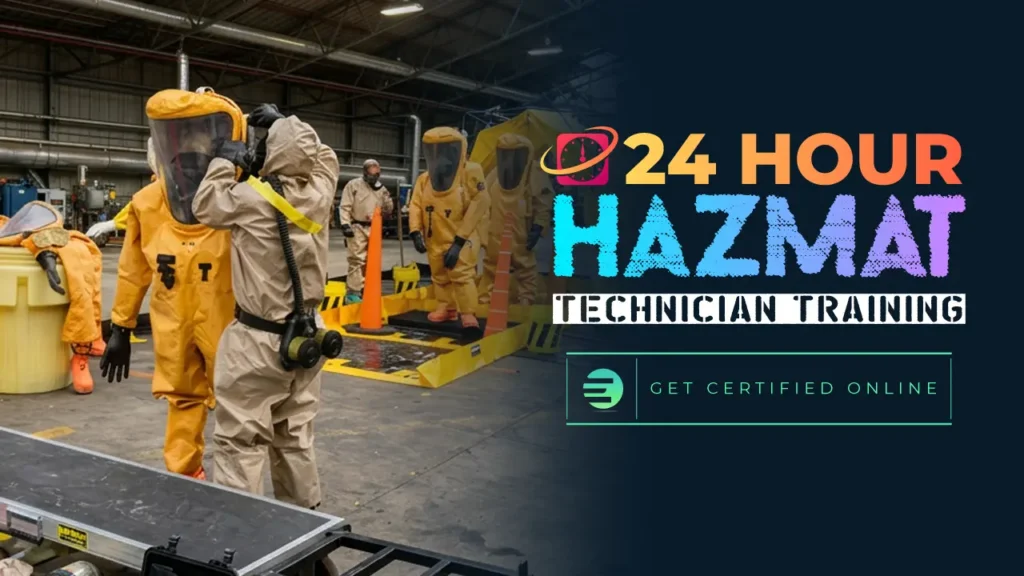
24-Hour Hazmat Technician Training

5(5 reviews)
24-Hour Hazmat Technician Training

Course Overview

Hazmat technician certification training teaches whoever stops a release. This 24-hour online course covers detection, incident command, personal protective equipment and decontamination under 29 CFR 1910.120(q)(6)(iii), the technician standard.

  • Explains the hazmat technician level at 29 CFR 1910.120(q)(6)(iii), where OSHA requires at least 24 hours.
  • Trains crews to identify unknown chemicals on scene with colorimetric tubes and photoionization detectors.
  • Walks through the five types of decontamination, the three control zones and the eight hazmat command roles.
  • 24 hours, self-paced
  • Instant certificate
  • Mobile friendly
$179.00

Per seat. One-time payment, no subscription.

+

30-day satisfaction guarantee. No hidden fees.

Course Clips

Everything You Need to Know
About This Course

Eleven modules, with knowledge checks as you go and five case studies that put the material on a scene. The first module sets out how the Occupational Safety and Health Administration (OSHA), the Environmental Protection Agency (EPA) and the Department of Transportation (DOT) each reach hazardous materials work, and which one governs an emergency response.

  • Regulatory overview: OSHA, EPA and DOT.
  • Implementing the facility emergency response plan.
  • Field survey instruments and air monitoring.
  • Incident command system and the hazmat branch.
  • Personal protective equipment and respiratory protection.
  • Medical surveillance for hazmat team members.
  • Hazard and risk assessment.
  • Control, containment and confinement.
  • Decontamination procedures.
  • Hazmat chemistry and toxicology.
  • Site emergencies and pre-planning.

OSHA StandardOSHA 29 CFR 1910.120(q)(6)(iii)
Course Duration24 hours
Format100% online, self-paced
Passing Score70% on final exam
CertificatePrintable certificate of completion available upon passing
LanguagesEnglish
Device CompatibilityDesktop, tablet, and smartphone
ProgressProgress saved automatically, stop and restart without losing your place
AcceptedOur courses meet federal standards, but state requirements may vary. Please verify before purchase.

The standard sorts responders by what they do at an incident, not by job title. This course is built for the people who make entry and go to the point of release.

  • Hazmat team members who make entry to plug, patch or stop a release.
  • Industrial emergency response team members who approach the point of release rather than hold a perimeter.
  • Spill response crews at chemical plants, tank farms and loading racks.
  • Refinery and petrochemical responders who work releases on their own site.
  • Municipal and county hazmat teams covered by EPA's worker protection rule.
  • Fire service personnel assigned to a hazmat branch.
  • Environmental and remediation staff whose duties at an incident put them at the point of release.
  • Safety managers who buy and document technician-level training for a response team.
  • Responders moving up from a defensive role to making entry.
  • Anyone whose employer will certify them at the hazardous materials technician level.

These are the operations that keep a release response team on staff, or that expect their own people to handle a spill before mutual aid arrives.

  • Chemical manufacturing plants with an in-house release response team.
  • Refineries and petrochemical sites running tank farms and loading racks.
  • Oil and gas operations, from well pads to gathering systems.
  • Fire departments that staff a hazmat branch.
  • County and municipal emergency management agencies.
  • Environmental remediation contractors who respond as well as clean up.
  • Bulk terminals and distribution warehouses handling drums and totes.
  • Water and wastewater treatment plants storing bulk chlorine or caustic.
  • Utilities and power generation sites keeping acids, caustics and fuels on site.
  • Manufacturers holding reactive or flammable solvents in production.

Experience the first 5 minutes of the course right here. No account or payment required.

Which Hazmat Course: OSHA Technician, HAZWOPER or DOT?

  • 24-Hour Hazmat Technician Training. You are on it. This one is for the responders who make entry and approach the point of release to plug, patch or stop it, under OSHA's emergency response rules.
  • 24 Hour Hazwoper Online Course. 24-hour HAZWOPER training is the one to buy when the work is on a hazardous waste cleanup site rather than an active release. It answers paragraph (e) of 29 CFR 1910.120, while this page answers paragraph (q), and the matching hour count is why these two get confused more than any other pair. View the 24 Hour Hazwoper Online Course
  • OSHA 40-Hour HAZWOPER Training Online. 40-hour HAZWOPER training is the longer site-worker course, for general site workers on hazardous waste operations. This is usually what a remediation crew needs. View the OSHA 40-Hour HAZWOPER Training Online
  • DOT HazMat General Awareness - Employee Training. DOT hazmat employee training covers the people who ship, package or handle hazardous materials in transport, under 49 CFR. Different agency, different clock: that one repeats at least every three years. View the DOT HazMat General Awareness - Employee Training


What the 24-Hour Hazmat Certificate Proves to an Auditor

An auditor looking at your hazmat team asks for a file. This is what the course puts in it, and what still has to sit beside it.

  • Twenty-four hours of technician-level instruction, dated. The Certificate of Completion names the course and the hours, and it is available to print as soon as the final exam is passed.
  • Coverage across the competency areas the standard lists. 29 CFR 1910.120(q)(6)(iii) lists the areas a hazardous materials technician must be competent in, and the modules run across them: emergency response plan, field survey instruments, incident command, protective equipment, hazard and risk assessment, control and containment, decontamination, chemistry and toxicology.
  • The line the employer signs. The standard gives the employer the job of certifying competency. The course record is the training evidence that sits underneath that signature.
  • The refresher clock, started. Technician-level training carries an annual refresher or a yearly competency demonstration under 29 CFR 1910.120(q)(8), so the completion date is the date the next one is measured from.

Keep the certificate, the employer's competency record and the hands-on sign-off in one folder, and the file is complete.
Verified Course Reviews

Add a review
You must be logged in to post a review Log In
5.0
Based on 5 reviews
5
100
100%
4
0%
3
0%
2
0%
1
0%
1-2 of 5 reviews

  1. The course clearly stated what I would be able to do after completing it. :
    By the end of the course, I could do what it said I would be able to do. :
    The course was easy to navigate and worked reliably on my device. :

    bb

    (0) (0)
  2. good

    (0) (0)

Frequently Asked Questions

Everything you need to know about the 24-Hour Hazmat Technician Training.

Yes. Upon passing the final exam with a score of 70% or higher, you can immediately print a certificate of completion. This certificate serves as proof of training for your employer.

Yes. The course is accessible on desktop computers, laptops, tablets, and smartphones. Progress saves automatically on the same device, so you can stop and resume where you left off.

  Part 7 is one of the most comprehensive sections of the course. It covers ongoing scene assessment, container types (bulk, fixed site, radioactive material packaging), underground pipelines, assessing container damage, container stressors, breach and release mechanisms, product dispersion patterns, product behavior after release, environmental considerations during releases, the four primary pathways of a product release, and hazard and risk assessment for property and environmental protection.

  The course includes several real-world case studies integrated throughout the 11 parts. These include a HAZMAT case study on an acid tanker rollover (Part 7), a confinement/containment plan building exercise (Part 8.5), a decontamination line setup exercise (Part 9), and a site emergency case study (Part 11). These case studies apply the concepts taught in each section to practical scenarios.

  The course is organized into 11 parts. Part 1 covers regulatory overview (OSHA, EPA, DOT, SARA). Part 2 covers implementing the facility emergency response plan. Part 3 covers field survey instruments. Part 4 covers the incident command system. Part 5 covers personal protective equipment. Part 6 covers medical surveillance. Part 7 covers hazard and risk assessment. Part 8 covers control, containment, and confinement. Part 8.5 covers building a confinement/containment plan. Part 9 covers decontamination procedures. Part 10 covers HAZMAT chemistry and toxicology. Part 11 covers site emergencies.

   Employers should provide follow-up, on-site specific equipment training with the actual equipment that will be used as part of the emergency response role. The online course provides the knowledge-based training foundation; employers are responsible for providing site-specific equipment familiarization and practical application.

  The course covers hazmat threat identification and classification, PPE selection/respiratory protection/suit operations, field monitoring instruments and detection techniques, control/containment/confinement strategies, leak mitigation and product-control procedures, tactical decision-making and risk assessment methods, and decontamination operations and post-incident procedures. The 11-part outline includes regulatory overview, emergency response planning, field survey instruments, incident command system, PPE, medical surveillance, hazard and risk assessment, control/containment/confinement, decontamination procedures, HAZMAT chemistry and toxicology, and site emergencies.

  This course is designed for hazardous materials technicians and emergency responders who need to take control of hazardous materials incidents. This includes members of HAZMAT teams, spill response teams, emergency response teams, industrial emergency response team members, environmental technicians, and health and safety professionals.

  The 24-Hour HAZMAT Technician Training is an online course that provides a focused, practical foundation for responding to hazardous materials emergencies at the technician level. It covers 11 parts from regulatory overview through site emergencies, including hazmat threat identification, PPE selection, field monitoring instruments, incident command, hazard and risk assessment, control/containment/confinement, decontamination, HAZMAT chemistry, and site emergency procedures.

   Part 1 of the course covers the regulatory overview for HAZMAT technicians, including OSHA (Occupational Safety and Health Administration), EPA (Environmental Protection Agency), DOT/PHMSA (Department of Transportation via the Pipeline and Hazardous Materials Safety Administration), and the Superfund Amendments and Reauthorization Act (SARA). It also covers 40 CFR Part 311 (Worker Protection), Federal Hazmat Law 49 USC 5101, and provides a comparative summary of regulatory requirements.

Better Training. Better Outcomes.

Fifteen years, 200,000+ professionals certified, and a completion rate roughly double the industry average.

OSHA citation printed on every certificate

Your employer and site safety officer can verify compliance at a glance, with no phone calls and no lookups.

No setup. No LMS. Training in minutes.

Pay once, get instant access. No account setup, no downloads, no IT involvement. Works in any browser.

Built for field workers, not classrooms

Grounded in real jobsite operations. Scenarios reflect the work your crew actually does.

Trusted by safety managers & contractors

Used by EHS managers, general contractors and federal site supervisors to keep crews certified on time.

200,000+
Professionals certified
87%
Completion rate (industry avg <45%)
10M+
Hours of training delivered
15
Years in business

Your go-to source for workplace safety updates.

Join our monthly newsletter covering industry stories, news & timely updates, and get a free 110-page OSHA manual covering the latest training requirements.

eTraining and the eTraining logo copyright 2026 eTraining, Inc. All Rights Reserved.