

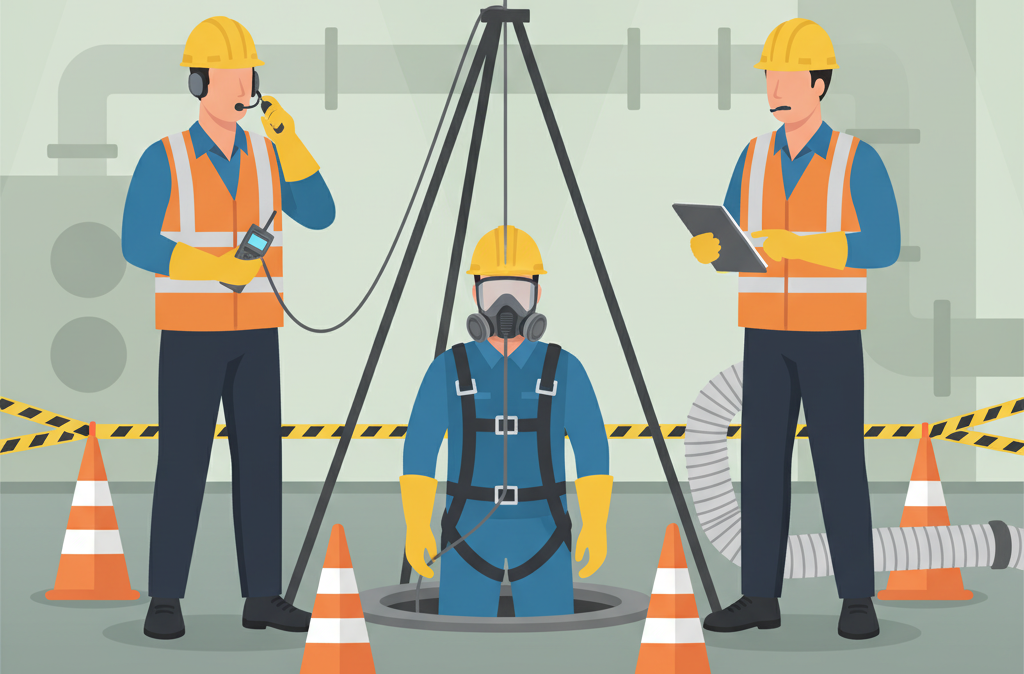
Confined space entrant responsibilities: Highest risk role
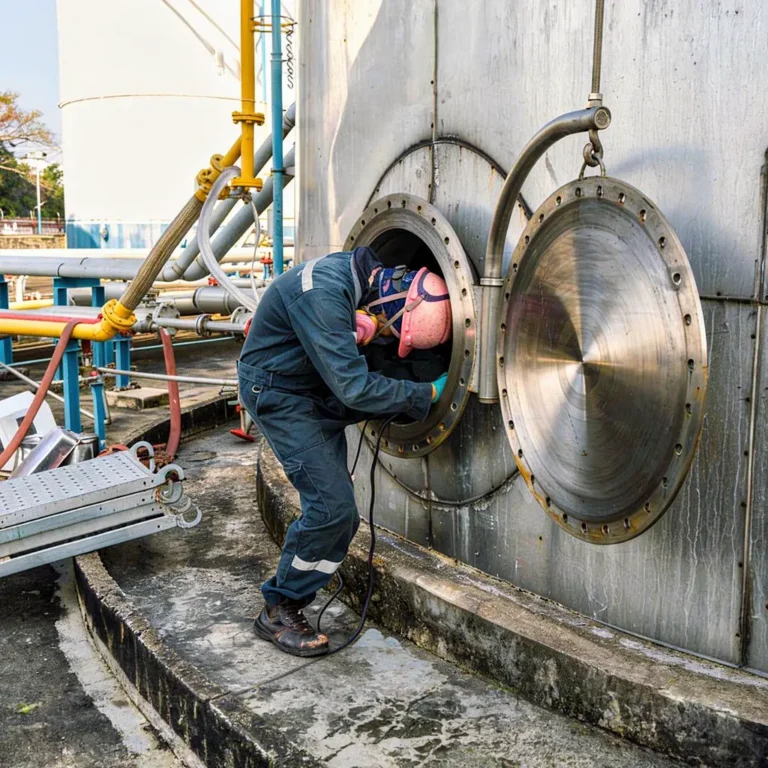
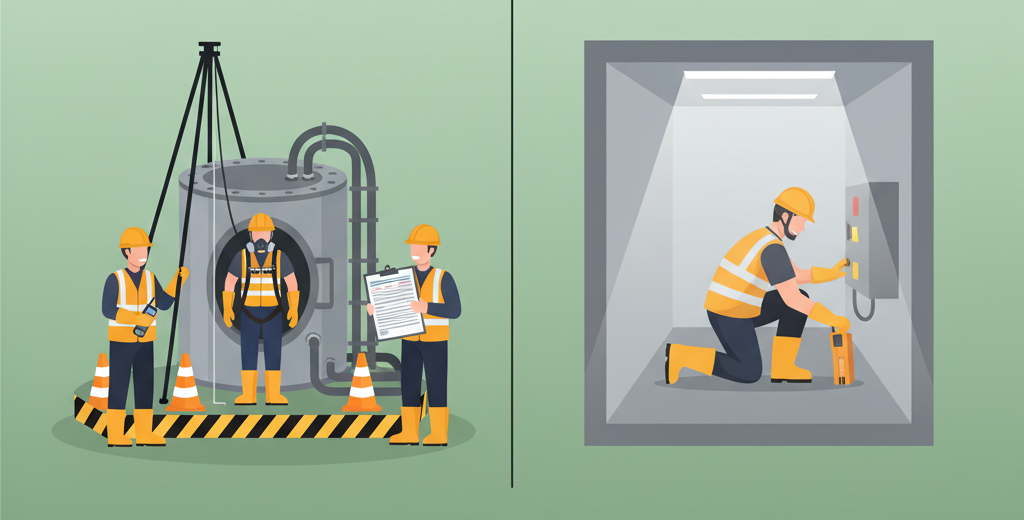
The entrant is the worker who physically enters the confined space — and carries the greatest personal risk. Before entering, the entrant must have direct written authorization from their employer. Per the OSHA confined space standard, the entrant must:
- Know the hazards associated with confined space entry, and in particular, the specific hazards of the PRCS being entered.
- Know how to use all required equipment, including PPE, communication devices, and retrieval systems.
- Know and follow the established procedures for communicating with the attendant.
- Know how to alert the attendant of any hazardous or prohibited conditions that develop inside.
- Know how to safely exit the space independently (self-rescue) if an evacuation is needed.
Confined space attendant responsibilities: Most duties by OSHA
The attendant remains outside the PRCS at all times and serves as the lifeline between the entrant and the outside world. At least one attendant must be assigned to every PRCS team. Despite a common misconception that the attendant simply “stands by,” OSHA requires the attendant to be highly proactive. Their duties include:
- Know the hazards — including using air monitoring equipment to track atmospheric conditions inside the space and communicate any changes.
- Understand the behavioral effects of hazard exposure (e.g., signs of oxygen deficiency or toxic gas effects).
- Maintain an accurate count and identification of all authorized entrants inside the space.
- Remain stationed outside the PRCS for the entire duration of entry operations until properly relieved.
- Maintain continuous communication with all entrants throughout the work period.
- Monitor for conditions inside or outside the space that may require an evacuation, and order evacuation when necessary.
- Summon rescue services and other emergency assistance if needed.
- Warn away and keep unauthorized individuals from approaching or entering the permit space.
- Never perform duties that would interfere with their primary responsibility of monitoring and protecting the entrants.
Common misconception: Many workers believe the attendant only needs to act if something goes wrong. In fact, OSHA requires the attendant to be continuously active — monitoring air quality, tracking personnel, and communicating — throughout the entire entry operation.
Confined space supervisor duties:
The entry supervisor is the third required member of a PRCS team. In most cases, this person is the employer or directly represents the employer. The entry supervisor holds ultimate authority over whether an entry happens, continues, or is terminated. It is recommended that this person also be cross-trained to serve as an entrant or attendant if needed. Per OSHA, the entry supervisor must:
- Know the hazards associated with the specific PRCS, including the mode of exposure, signs/symptoms, and consequences.
- Verify that all required safe entry conditions exist before authorizing entry — including completion of all required testing, equipment checks, and isolation procedures.
- Terminate entry operations and cancel the entry permit whenever required conditions are not met or conditions change.
- Verify that rescue services are available and capable of responding effectively before authorizing entry.
- Remove unauthorized persons from the area of the permit space.
- Ensure that acceptable entry conditions are maintained throughout the entire operation.
Responsibility matrix at a glance
| Duty | Entrant | Attendant | Supervisor |
|---|---|---|---|
| Know the hazards of the specific PRCS | YES | YES | YES |
| Use and operate required equipment | YES | YES | — |
| Authorize and terminate entry | — | — | YES |
| Monitor atmospheric conditions | — | YES | — |
| Summon rescue if needed | — | YES | YES |
| Self-rescue capability required | YES | — | — |
| Verify rescue service availability | — | — | YES |
| Track and ID authorized entrants | — | YES | — |
| Remove unauthorized persons | — | YES | YES |
Training requirements:
Because permit-required confined spaces present serious and often rapidly changing hazards, every team member must be properly trained before participating in any PRCS operation. At minimum, this means awareness-level confined space training and certification. For permit-required spaces — which carry a higher probability of hazard — OSHA recommends competent person-level training, especially for supervisor training.
Get OSHA-compliant confined space certification
e-Training Inc. offers online confined space training that meets OSHA standards — complete at your own pace, on any device.
Frequently asked questions
Can one person serve as both the entrant and attendant?
- No. OSHA requires the attendant to remain outside the confined space at all times. Having one person fill both roles simultaneously would leave the space unmonitored from the outside, which is a direct violation of the standard.
- Yes. OSHA 29 CFR 1910.146 requires an authorized entrant, an attendant, and an entry supervisor for every permit-required confined space entry. These are minimum requirements — employers may assign additional personnel based on the complexity and risk level of the operation.
- The supervisor must be present to authorize the entry and verify initial conditions, but OSHA does not require them to remain on-site for the entire operation. However, they must be reachable and able to terminate the entry permit if conditions change.
- A permit-required confined space (PRCS) contains, or has the potential to contain, a serious hazard — such as a hazardous atmosphere, engulfment risk, or any other recognized serious safety or health risk. Non-permit spaces do not contain these hazards and require less formal entry procedures.