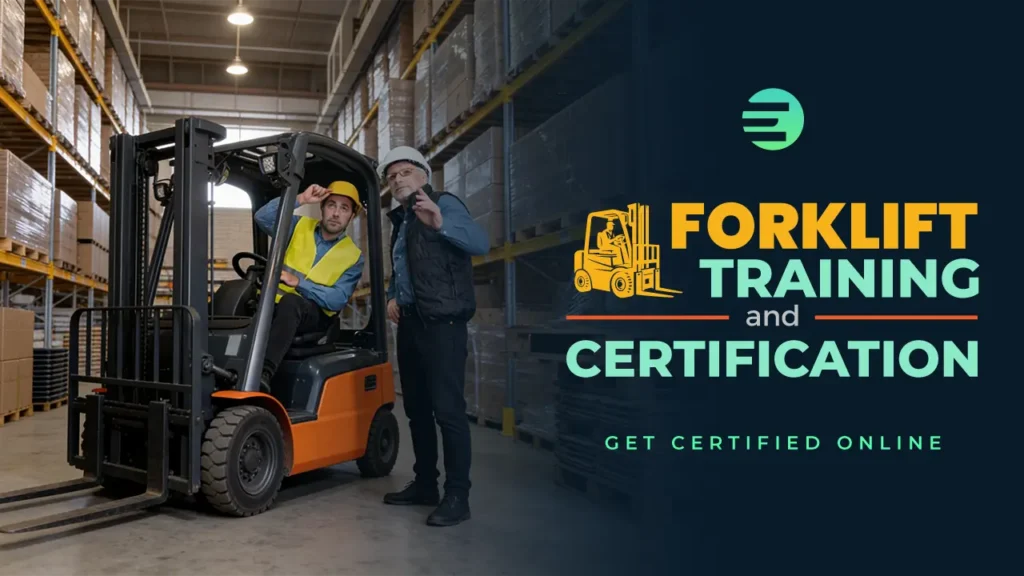
the Forklift training is developed from OSHA 29 CFR 1910.178, the standard that sets safety requirements for the design, maintenance, and operation of powered industrial trucks. The three hours course covers the seven forklift classes, load stability, daily inspections and pedestrian safety.
Covers all seven forklift classes, load stability, daily inspections, refueling and safe battery charging.
Pass the final exam and print your Certificate of Completion the same day, with the OSHA standard listed.
Your employer then adds the hands-on drive test and the workplace evaluation that complete certification.
Important: This course provides the formal instruction (classroom) portion of OSHA forklift certification. OSHA also requires employers to provide hands-on practical training and a workplace performance evaluation before an operator is fully certified. Forklift certification must be re-evaluated every 3 years or sooner if required by OSHA conditions.
Five modules and 318 slides, working from what a forklift is through to the floor it drives around on. Every module ends with a knowledge check, and the course closes with a final exam.
How OSHA defines a powered industrial truck.
The seven forklift classes, Class I through Class VII.
Truck designations and where each one is allowed to work.
Hazardous classified locations.
Forklift components and the identification plate.
Load capacity and reading the rating plate.
Stability and the stability triangle.
Load handling, stacking and unstacking.
Controls, instrumentation, steering and maneuvering.
Visibility, spotters and hand signals.
Forks, attachments and their limits.
Daily inspection and removal from service.
Battery changing, charging and electrolyte handling.
Refueling and LPG cylinder handling.
Operating limitations.
Pedestrian traffic and right of way.
Ramps, grades and sloped surfaces.
Loading docks and trailer work.
Narrow aisles, racking and safe stacking.
Carbon monoxide in enclosed areas.
Surface conditions and floor loading limits.
Unattended trucks, parking and traveling with a load.
Operator training and evaluation requirements.
Refresher training triggers.
The employer's certification record.
OSHA Standard
29 CFR 1910.178
Course Duration
3 hours
Format
100% online, fully narrated with photos and interactivity
Passing Score
70% on final exam
Certificate
Personalized certificate, printable immediately upon passing
Languages
English and Spanish
Device Compatibility
Desktop, tablet, and smartphone
Progress
Progress saved automatically, stop and restart without losing your place
Accepted
Our courses meet federal standards, but state requirements may vary. Please verify before purchase.
Anyone who operates a powered industrial truck at work needs this training before they are assigned to drive one.
Forklift operators taking their first operator training
Warehouse and distribution staff moving pallets on a counterbalance truck
Order picker and reach truck operators working narrow aisle racking
Electric pallet jack and walkie operators, which the standard covers the same way
Shipping, receiving and dock crews loading and unloading trailers
Manufacturing and production workers moving materials between lines
Construction crews running rough terrain or straight mast forklifts on site
Operators due their three-year evaluation who need the classroom part again
Operators moving to a class or type of truck they have not driven before
Safety and training managers who have to certify a crew and keep the records
Forklifts turn up wherever material moves in bulk, and 29 CFR 1910.178 applies the same way in every one of these operations.
Warehousing and distribution centers running counterbalance and reach trucks
Manufacturing plants moving raw stock and finished goods between lines
Construction sites working rough terrain forklifts over uneven ground
Shipping ports and dock operations loading and unloading trailers
Retail and wholesale stockrooms working tight aisles and high racking
Food and beverage storage moving palletized stock
Cold storage and refrigeration, where floors are slick and batteries drain faster
Lumber yards and building material suppliers handling long loads outdoors
Automotive and heavy equipment facilities
Grain, feed and agricultural storage, where combustible dust decides which truck may enter
Paper, printing and packaging plants running roll clamps and other attachments
Forklift Operator or Competent Person: Which Course?
eTraining sells three forklift courses. The difference is who is sitting down to take it.
Forklift Certification: Safety Training. This is the course on this page, and it is the one most crews need. It is written for the person who drives the truck: operators taking their first training, and operators coming back around the three-year cycle. Three hours online, $39 per person. View the Forklift Certification: Safety Training
Forklift Certification: Safety Training, Spanish. The same five modules and the same 29 CFR 1910.178 standard, delivered in Spanish. Buy it for operators who would rather train in Spanish, and they receive the same personalized certificate. It is a separate enrollment from the English course. View the Forklift Certification: Safety Training, Spanish
Competent Person Forklift Safety Course. Written for the supervisor or designated competent person who oversees forklift work, rather than for the operator driving the truck. Buy it for whoever walks the floor and signs off on the operator evaluation. Drivers still need the operator course. View the Competent Person Forklift Safety Course
Buying for a crew? Start with the operator course for everyone who drives, in whichever language they will learn best, then add the competent person course for whoever supervises them.
When Forklift Operators Need Retraining Sooner
Most safety managers plan forklift training on a three-year cycle, and 29 CFR 1910.178(l)(4)(ii) lists five things that pull an operator back in before the three years are up.
A near-miss counts, not just an accident. 29 CFR 1910.178(l)(4)(ii) names both. An operator involved in a near-miss needs refresher training, and so does one observed operating unsafely.
A new class of truck restarts the conversation. Moving an operator from a counterbalance truck to a reach truck or an order picker is a different type of truck under the paragraph. The seven classes are taught here, so the classroom half is already covered.
A change on the floor can trigger it too. A change in workplace conditions that could affect safe operation is on the list. New racking, a new aisle layout or a new loading dock can all qualify.
The three-year evaluation runs underneath all of that. 29 CFR 1910.178(l)(4)(iii) sets the outside limit: the employer evaluates each operator at least once every three years, whatever else has happened.
Plan for three years, budget for sooner. The classroom part is $39 a seat whenever you need it, and it is the same course either time.
Complete your Forklift Training and Certification at your own pace, on any device, with an instant certificate when you're done.
Most Popular
English
Unlocked progress. Complete modules in any order.
$39.00
Español
Desbloqueado. Completa los módulos en cualquier orden.
$39.00
30-Day Guarantee Instant Access Instant Certificate No Hidden Fees
Frequently Asked Questions
Everything you need to know about the Forklift Training and Certification.
Forklift certification training is OSHA-required training for all workers who operate powered industrial trucks. Under OSHA standard 29 CFR 1910.178, employers must ensure operators receive formal instruction, practical hands-on training, and a performance evaluation before operating a forklift. eTraining’s course provides the formal instruction component.
eTraining’s online forklift certification course takes approximately 3 hours to complete. The course is self-paced, so you can pause and resume at any time on the same device. After completing the online portion, your employer must provide hands-on practical training and a performance evaluation before you are fully certified.
In the U.S., there is no government-issued forklift license. OSHA requires forklift operators to be certified by their employer through training and evaluation. The term “forklift license” is informal; the correct requirement is employer-issued forklift certification.
Yes, OSHA requires training for operators of powered industrial trucks, which includes electric pallet jacks. According to OSHA standards (specifically, 29 CFR 1910.178(l)), employers must ensure that each operator is competent to operate a powered industrial truck safely, as demonstrated by the successful completion of training and evaluation. The training must cover both general principles of safe operation and the specific type of equipment the operator will use, in this case, electric pallet jacks. The training program must include a combination of formal instruction (e.g., lecture, discussion, interactive computer learning, video tape, written material), practical training (demonstrations performed by the trainer and practical exercises by the trainee), and evaluation of the operator's performance in the workplace. Topics must cover vehicle operation, load handling, vehicle maintenance, and understanding the workplace environment where the electric pallet jack will be used. After initial training, operators must be evaluated at least once every three years, and refresher training is required in certain situations, such as the operator being involved in an accident or a near-miss incident, demonstrating unsafe operation, or when there are changes in the workplace or type of vehicle that affect operational safety. This ensures that electric pallet jack operators are always equipped with the necessary knowledge and skills to operate these vehicles safely and efficiently.
Forklift certification under OSHA regulations is valid for 3 years from the date of the most recent evaluation. After 3 years, operators must undergo refresher training and a new performance evaluation. Recertification may also be required sooner if the operator is involved in an accident, observed operating unsafely, the workplace conditions change, or they are assigned a different type of forklift.
Yes. OSHA requires three components for complete forklift certification: (1) formal instruction (this online course), (2) practical hands-on training with demonstrations and exercises, and (3) an evaluation of the operator’s performance in the workplace. Steps 2 and 3 must be conducted by the employer or a qualified trainer at the work site.
There are several types of forklifts, each designed for specific tasks and environments. While the exact number can vary depending on how one categorizes them, here are nine common types: 1. Counterbalance Forklifts: The most common type, with forks at the front and a counterweight at the back to balance loads.
2. Reach Trucks: Designed for warehouse operations, these have two outer legs that distribute the load weight, with a reaching mechanism to extend into racking.
3. Pallet Jacks (Pallet Trucks): Manual or powered, these are used for moving pallets over short distances.
4. Order Pickers: Tailored for warehouse use, allowing the operator to be lifted with the forks to pick items from shelves.
5. Sideloaders: Ideal for handling long or awkward loads, these forklifts carry the load at the side.
6. Telehandlers (Telescopic Handler): With a boom and extendable arm, these are used for higher lifting and reaching capabilities, often in construction and agriculture.
7. Rough Terrain Forklifts: Designed for uneven surfaces with pneumatic tires, suitable for outdoor construction sites.
8. Electric Forklifts: Battery-powered and used indoors for their lack of emissions and reduced noise.
9. Stackers: Used in small warehouses or retail spaces for stacking and moving pallets. Each type is tailored to specific requirements, such as load capacity, maneuverability, and the ability to operate in different environments, from tight warehouse spaces to outdoor construction sites.
The most popular type of forklift is the counterbalance forklift. It is widely used across various industries due to its versatility and straightforward design. Counterbalance forklifts have forks at the front and a counterweight in the back, allowing them to lift and transport heavy loads directly in front of them. This design enables the operator to drive up to the load without the need for extended arms or other mechanisms, making it suitable for a wide range of lifting tasks.
Yes. eTraining’s Forklift Training and Certification course is developed directly from OSHA standard 29 CFR 1910.178 and covers all required formal instruction topics. The course meets OSHA, ANSI, and CSA standards for forklift operator training. Your certificate lists the specific OSHA standard covered.
OSHA requires a “competent person” be present on every job site where forklifts operate. A competent person is someone capable of identifying hazards, authorized to take corrective measures, and trained in forklift safety standards. eTraining offers a separate Forklift Safety for the Competent Person course for supervisors and designated competent persons.
According to industry data, the average forklift operator earns $15–$20 per hour, with annual salaries ranging from approximately $31,000 to $42,000 depending on location, industry, experience, and type of forklift operated. Certified operators with specialized skills (e.g., reach truck, order picker) often command higher wages.
Yes. eTraining offers the complete Forklift Training and Certification course in Spanish. The Spanish version covers the same content, is based on the same OSHA 29 CFR 1910.178 standard, and provides the same personalized certificate upon completion.
Yes. Upon passing the final exam with a score of 70% or higher, you can immediately print a certificate of completion. This certificate serves as proof of training for your employer.
Yes. The course is accessible on desktop computers, laptops, tablets, and smartphones. Progress saves automatically on the same device, so you can stop and resume where you left off.
Better Training. Better Outcomes.
Fifteen years, 200,000+ professionals certified, and a completion rate roughly double the industry average.
OSHA citation printed on every certificate
Your employer and site safety officer can verify compliance at a glance, with no phone calls and no lookups.
No setup. No LMS. Training in minutes.
Pay once, get instant access. No account setup, no downloads, no IT involvement. Works in any browser.
Built for field workers, not classrooms
Grounded in real jobsite operations. Scenarios reflect the work your crew actually does.
Trusted by safety managers & contractors
Used by EHS managers, general contractors and federal site supervisors to keep crews certified on time.
Join our monthly newsletter covering industry stories, news & timely updates, and get a free 110-page OSHA manual covering the latest training requirements.
eTraining and the eTraining logo copyright 2026 eTraining, Inc. All Rights Reserved.






great class easy and affordable
It was informative and correct. I’m proud of myself for the accomplishment that I knew I was capable of achieving
No
Test was not easy
This class is very good for training