


Featured Courses
Previously trained hazardous waste workers complete required OSHA annual refresher certification training

2026 8 Hour HAZWOPER Refresher

Annual 8-hour HAZWOPER refresher meeting OSHA 29 CFR 1910.120(e)(8) requirements.
Comprehensive lithium battery safety safety training for workers and workplace for workplace compliance

Lithium Battery Safety

Covers what happens when lithium batteries fail and how to prevent fires and explosions.

View All OSHA Courses

image
OSHA Annual Requirement

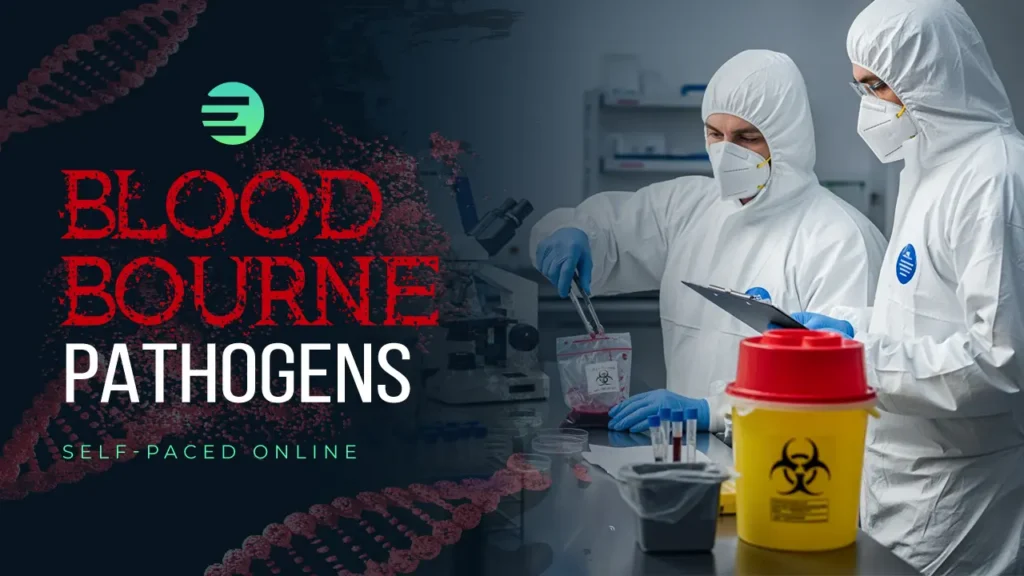
Bloodborne Pathogens (Updated)

4.8(45 reviews)
Bloodborne Pathogens (Updated)

Course Overview

Bloodborne pathogens training prepares nurses, medics and cleaners to handle blood and sharps under OSHA 29 CFR 1910.1030, the general industry standard. Ninety minutes online: exposure control plan, universal precautions, PPE, hepatitis B vaccine.

  • Covers the hepatitis B vaccine employers must offer at no cost, and the signed form a worker uses to decline.
  • Trains staff to treat blood and body fluids as if infectious, and to pick, wear, remove and dispose of PPE.
  • Walks through the exposure control plan, biohazard labels, and the training records and sharps injury log.
  • 90 minutes, self-paced
  • Instant certificate
  • Mobile friendly
$16.95

Per seat. One-time payment, no subscription.

− +

30-day satisfaction guarantee. No hidden fees.

Course Clips

Everything You Need to Know
About This Course

Nine parts, one per paragraph of 29 CFR 1910.1030 and in the standard's own order: scope and definitions, the exposure control plan, methods of compliance, HIV and HBV research laboratories, the hepatitis B vaccine and post-exposure follow-up, labels, training and recordkeeping. Twenty-five short knowledge checks sit inside the parts and give you the answer either way, and a separate auto-graded final exam closes the course.

  • Scope of the standard and how bloodborne pathogens spread.
  • Definitions used in the standard.
  • Exposure control plan.
  • Methods of compliance.
  • HIV and HBV research laboratories and production facilities.
  • Hepatitis B vaccination and post-exposure evaluation and follow-up.
  • Biohazard labels and signs.
  • Training requirements.
  • Recordkeeping.

OSHA Standard29 CFR 1910.1030
Course Duration90 minutes
Format100% online, fully narrated with photos and interactivity
Passing Score70% on final exam
CertificatePersonalized certificate, printable immediately upon passing
LanguagesEnglish
Device CompatibilityDesktop, tablet, and smartphone
ProgressProgress saved automatically, stop and restart without losing your place
AcceptedOur courses meet federal standards, but state requirements may vary. Please verify before purchase.

This bloodborne pathogens (BBP) training course is for any employee whose job brings reasonably anticipated contact with blood or other potentially infectious materials, which is how 29 CFR 1910.1030(b) defines occupational exposure, and for the manager who writes the exposure control plan behind them.

  • Physicians, nurses and emergency room staff who draw blood, give injections and handle sharps every shift.
  • Paramedics and emergency medical technicians, and firefighters who respond to injuries.
  • Dentists, hygienists and dental assistants working in the mouth, where saliva counts as infectious.
  • Laboratory and blood bank technologists and technicians handling specimens.
  • Orderlies, housekeeping staff and laundry workers in healthcare facilities who clean spills and handle contaminated linen.
  • Home healthcare workers giving injections and wound care in patients' homes.
  • Medical examiners, morticians and medical waste treatment employees.
  • Law enforcement officers who search, restrain and transport people.
  • First-aid responders an employer designates to render aid, as a primary or collateral duty.
  • Safety managers and program owners who prepare the exposure control plan, the sharps injury log and the training program the course walks through.

29 CFR 1910.1030 reaches by exposure rather than by industry: any employer whose employees have reasonably anticipated contact with blood or other potentially infectious materials. These are the operations that send staff to this course.

  • Hospitals and medical clinics, from the emergency room to the phlebotomy chair.
  • Dental offices and oral surgery practices.
  • Emergency medical services and fire departments running ambulance and rescue calls.
  • Clinical laboratories and blood banks.
  • HIV and HBV research laboratories and production facilities, which carry extra rules the course covers.
  • Nursing homes and assisted living, where nurses and aides give injections and wound care.
  • Home healthcare agencies.
  • Funeral homes, mortuaries and medical examiner offices.
  • Medical waste treatment and transport operations.
  • Law enforcement agencies.
  • Healthcare housekeeping and laundry operations that clean spills and process contaminated linen.
  • Industrial sites with a designated first-aid team, whose responders the standard covers.

Experience the first 5 minutes of the course right here. No account or payment required.

How Often Is Bloodborne Pathogens Training Required?

Bloodborne pathogens training is required at the time an employee is first assigned to tasks with occupational exposure, and at least once a year after that, under OSHA 29 CFR 1910.1030(g)(2). Each annual session has to land within one year of the previous one.

  • The first session comes before the exposure. Paragraph (g)(2)(ii)(A) places initial training at the time of assignment to tasks where exposure may take place. A new nurse, aide or housekeeper should have finished it before the first shift with a sharps container in reach, which is why a 90-minute online course fits onboarding week.
  • The clock resets every year. Paragraph (g)(2)(iv) requires the annual session within one year of the previous training. The date on the Certificate of Completion is the date to count from, so file it where the retraining reminder is set.
  • A change in duties adds a session. Paragraph (g)(2)(v) calls for additional training when new or modified tasks or procedures affect an employee's exposure. Moving a housekeeper onto regulated waste pickup or a nurse onto a new sharps device is the kind of change it means.
  • The certificate names the standard. The Certificate of Completion prints the OSHA citation, so anyone reading the file, an inspector, a client or next year's safety manager, sees which standard the session was built to and the date the next one is due from.

Keep the retraining date on the same calendar as the exposure control plan review, which also runs annually under a separate paragraph of the standard, (c)(1)(iv). This course delivers the session in about 90 minutes and a Certificate of Completion your staff print the same day.
Verified Course Reviews

Add a review
You must be logged in to post a review Log In
4.8
Based on 45 reviews
5
82
82%
4
16
16%
3
2
2%
2
0%
1
0%
1-2 of 45 reviews
  1. Excellent Training Session

    (0) (0)
  2. The test has a technical glitch. On 4 to 7 of the questions, it varies, the correct answers can not be highlighted and clicked. You can highlight all answers but the correct ones. I reset/resume/retook the test 5 times before I could get through it with enough clickable correct answers to pass. And at that I was only to achieve an 80%.

    (0) (0)

Frequently Asked Questions

Everything you need to know about the Bloodborne Pathogens (Updated).

Bloodborne pathogens are infectious microorganisms in human blood that can cause disease in humans. The three primary bloodborne pathogens are: Human Immunodeficiency Virus (HIV), which causes AIDS; Hepatitis B Virus (HBV), which causes liver inflammation and can lead to chronic liver disease; and Hepatitis C Virus (HCV), the most common chronic blood-borne infection in the United States. These pathogens can be transmitted through direct contact with infected blood or other potentially infectious materials.

OSHA requires bloodborne pathogen training for all employees who have “reasonably anticipated” occupational exposure to blood or other potentially infectious materials (OPIM). This includes healthcare workers, emergency responders, custodial staff, law enforcement, correctional facility workers, tattoo and piercing artists, laboratory workers, dental professionals, first aid providers, and anyone else whose job duties may bring them into contact with blood or OPIM.

eTraining’s Bloodborne Pathogens course takes approximately 90 minutes (1.5 hours) to complete, followed by a final exam. The course is self-paced, so you can pause and resume at any time. Most students complete the entire course and exam in a single session. Your progress is saved on the device you’re using, allowing you to pick up where you left off on that device.

OSHA requires annual (every 12 months) retraining for all employees with occupational exposure to bloodborne pathogens. This is not optional, employers must ensure their affected workers complete bloodborne pathogen training every year to maintain compliance with 29 CFR 1910.1030.

OSHA’s Bloodborne Pathogens standard (29 CFR 1910.1030) requires employers to protect workers from health hazards caused by exposure to blood and other potentially infectious materials. The standard mandates: an exposure control plan, annual employee training, Hepatitis B vaccination offered at no cost, use of engineering controls and PPE, proper labeling and disposal of biohazardous materials, and post-exposure evaluation and follow-up procedures.

OSHA requires employers to offer the Hepatitis B vaccination series at no cost to all employees with occupational exposure to bloodborne pathogens. The vaccination must be offered within 10 working days of initial assignment. Employees may decline the vaccine but must sign a declination form. This is a workplace requirement separate from the training.

Yes. eTraining’s Bloodborne Pathogens Training meets OSHA’s training requirements under 29 CFR 1910.1030 and is accepted for healthcare workers, emergency responders, dental professionals, and other at-risk workers. However, employers may also need to provide site-specific training covering their own Exposure Control Plan and workplace-specific procedures.

Yes. Tattoo artists, body piercers, and other body art professionals have occupational exposure to bloodborne pathogens and should complete bloodborne pathogen training. eTraining’s course covers the OSHA standard applicable to all workers with blood exposure risk. Some states (such as California) have additional state-specific bloodborne pathogen requirements for body art professionals.

This course is developed to meet OSHA’s Bloodborne Pathogens standard (29 CFR 1910.1030) and covers CDC-recommended practices for infection control, including standard precautions, hand hygiene, PPE use, and safe sharps disposal. The content aligns with both OSHA regulatory requirements and CDC best practices for preventing bloodborne pathogen transmission.

Contact eTraining at info@etraintoday.com to inquire about Spanish-language availability for the Bloodborne Pathogens course. Many of eTraining’s other courses, including OSHA 10-Hour, OSHA 30-Hour, Forklift, and HAZWOPER, are available in Spanish.

Yes. Upon passing the final exam with a score of 70% or higher, you can immediately print a certificate of completion. This certificate serves as proof of training for your employer.

Yes. The course is accessible on desktop computers, laptops, tablets, and smartphones. Progress saves automatically on the same device, so you can stop and resume where you left off.

Better Training. Better Outcomes.

Fifteen years, 200,000+ professionals certified, and a completion rate roughly double the industry average.

OSHA citation printed on every certificate

Your employer and site safety officer can verify compliance at a glance, with no phone calls and no lookups.

No setup. No LMS. Training in minutes.

Pay once, get instant access. No account setup, no downloads, no IT involvement. Works in any browser.

Built for field workers, not classrooms

Grounded in real jobsite operations. Scenarios reflect the work your crew actually does.

Trusted by safety managers & contractors

Used by EHS managers, general contractors and federal site supervisors to keep crews certified on time.

200,000+
Professionals certified
87%
Completion rate (industry avg <45%)
10M+
Hours of training delivered
15
Years in business

Your go-to source for workplace safety updates.

Join our monthly newsletter covering industry stories, news & timely updates, and get a free 110-page OSHA manual covering the latest training requirements.

eTraining and the eTraining logo copyright 2026 eTraining, Inc. All Rights Reserved.