

Labor Day Week Sale · 20% Off Sitewide · Ends Sept 9 · Code
Featured Courses
Previously trained hazardous waste workers complete required OSHA annual refresher certification training

2026 8 Hour HAZWOPER Refresher

Annual 8-hour HAZWOPER refresher meeting OSHA 29 CFR 1910.120(e)(8) requirements.
Comprehensive lithium battery safety safety training for workers and workplace for workplace compliance

Lithium Battery Safety

Covers what happens when lithium batteries fail and how to prevent fires and explosions.

View All OSHA Courses

image

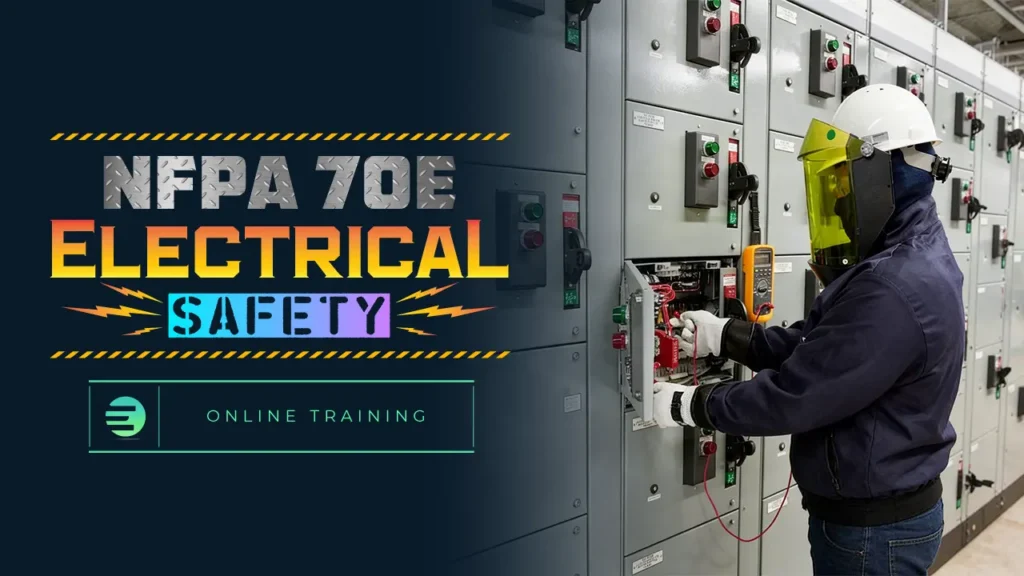
NFPA 70E Electrical Safety - 2024

4.5 (38 reviews)
NFPA 70E Electrical Safety - 2024

Course Overview

NFPA 70E Electrical Safety Training is an online electrical safety training program for the people who work on or near energized gear, and it teaches the standard they work to. Three hours online, covering risk assessment, arc flash boundaries, PPE tables, work permits, lockout and test procedures, and reflects the 2024 update.

  • Devotes a whole part to arc flash: what it is, where the boundaries fall, and what the label has to carry.
  • Splits qualified persons from unqualified ones, the line 29 CFR 1910.332 draws before any of this applies.
  • Comes from an electrical engineer who sits on NFPA code panels and started out as an apprentice electrician.
  • 3 hours, self-paced
  • Instant certificate
  • Mobile friendly

Price Match Plus: eTraining will beat any competitor's price + $10

$59.99

Per seat. One-time payment, no subscription.

+

30-day satisfaction guarantee. No hidden fees.

Course Clips

Everything You Need to Know
About This Course

Seven parts, about three hours, and they run in the order the work does: understand the program, assess the risk, authorize the job, then handle the hazard and prove the circuit is dead.

  • Principles of an electrical safety program.
  • Risk assessment, and who counts as a qualified person.
  • Electrical safety controls.
  • Job briefing and the energized electrical work permit.
  • Anatomy of an arc flash.
  • Arc flash boundaries and labeling requirements.
  • Personal protective equipment and the PPE tables.
  • Safe work practices.
  • Lockout and tagout requirements for electrical work.
  • Testing procedures and test equipment.
  • Protective grounding equipment.
  • Energized conductors and equipment precautions.
  • Prevention methods and hazard analysis.
  • AC and DC systems.

OSHA StandardNFPA 70E (2024)
Course Duration3 hours
Format100% online, fully narrated with photos and interactivity
Passing Score70% on final exam
CertificatePersonalized certificate, printable immediately upon passing
LanguagesEnglish
Device CompatibilityDesktop, tablet, and smartphone
ProgressProgress saved automatically, stop and restart without losing your place
Instructor SupportAccess professional instructors for guidance and answers to your course-related questions.
AcceptedOur courses meet federal standards, but state requirements may vary. Please verify before purchase.

This course is for workers who perform electrical work on or near energized equipment, as well as those responsible for managing electrical safety in the workplace.

  • Electricians and electrical maintenance workers.
  • Anyone treated as a qualified person on energized equipment.
  • Facility maintenance technicians and building engineers.
  • Industrial and plant workers exposed to electrical hazards.
  • HVAC technicians working inside live panels and units.
  • Utility workers and power generation staff.
  • Construction workers who meet energized systems on site.
  • Safety managers and officers writing an electrical safety program.

Anywhere a panel gets opened while the building is running. These are the operations where an electrical safety program is written around NFPA 70E rather than around general awareness.

  • Electrical contracting and electrical services.
  • Manufacturing and industrial plant operations.
  • Facility management and building maintenance.
  • Utility and power generation companies.
  • Data centers and telecommunications facilities.
  • Oil, gas and petrochemical operations.
  • Commercial and residential construction.
  • Government and municipal electrical infrastructure.

NFPA 70E or the General Electrical Safety Course?

These two get compared more than any other pair in the catalogue, and the honest difference is not depth for its own sake. It is what the worker is exposed to.

  • NFPA 70E Electrical Safety. NFPA 70E is the consensus standard for working on or near energized equipment, and it assumes the worker will be close to live parts. Arc flash boundaries, PPE tables, energized work permits, and the risk assessment behind all of it.  View the NFPA 70E Electrical Safety (this page)
  • Electrical Safety Course. The general Electrical Safety Course is awareness for workers who are around electrical systems rather than in them. It is the right level for most of a site's headcount and it does not pretend to be the 70E course. View the Electrical Safety Course
  • Electrical Safety for the Competent Person. Electrical Safety for the Competent Person is the program-level course, for whoever is accountable for how the other two get used. View the Electrical Safety for the Competent Person

If someone on your crew is going inside a live panel, they need the 70E course. If they walk past it, they need the general one. Most sites buy both, for different lists of people.

What a Qualified Electrical Person Has to Do

29 CFR 1910.332(b)(3) sets a floor for anyone treated as a qualified person, and it is shorter and more specific than most people expect: three things, named in the text.

  • Tell exposed live parts from everything else. 29 CFR 1910.332(b)(3) requires a qualified person to be trained to distinguish exposed live parts from other parts of electric equipment. It sounds obvious until somebody opens a panel they have not seen before.
  • Know the voltage in front of them. The same paragraph requires them to determine the nominal voltage of exposed live parts, which is what every downstream decision about boundaries and protective equipment depends on.
  • Know how close they are allowed to get. And to know the clearance distances specified in 29 CFR 1910.333(c), and the voltages to which they will be exposed. Three requirements, one paragraph.
  • And the depth is set by the risk, not by the job title. 29 CFR 1910.332(c) then says the degree of training is determined by the risk to the employee, which is why a worker who occasionally opens a live panel is not trained to the same depth as one who does it daily.

This course is built for the people that paragraph is describing. If your crew is not in it, the general Electrical Safety Course is the better buy.
Verified Course Reviews

Add a review
You must be logged in to post a review Log In
4.4
Based on 38 reviews
5
74
74%
4
10
10%
3
8
8%
2
3
3%
1
5
5%
1-2 of 38 reviews
  1. A lot of information

    (0) (0)
  2. Sometimes I feel that testing it was tricky, but after doble check my errors I realized the correct answers… In summary I liked the training

    (0) (0)

Frequently Asked Questions

Everything you need to know about the NFPA 70E Electrical Safety - 2024.

Yes. Upon passing the final exam with a score of 70% or higher, you can immediately print a certificate of completion. This certificate serves as proof of training for your employer.

Yes. The course is accessible on desktop computers, laptops, tablets, and smartphones. Progress saves automatically on the same device, so you can stop and resume where you left off.

You must score at least 70% on the final exam to pass and receive your certificate of completion. The course includes knowledge-check quizzes that do not count toward your final grade but help prepare you for the exam. If you do not pass on your first attempt, you can retake the exam.

NFPA 70E training is a safety training program based on the National Fire Protection Association’s Standard for Electrical Safety in the Workplace (NFPA 70E). The standard provides guidelines for protecting workers from electrical hazards, including arc flash and electric shock. eTraining’s course covers the 2024 update and is approximately 3 hours in length.

The course is broken into 7 parts covering: Principles of Electrical Safety Program, Risk Assessment and the Qualified Person, Electrical Safety Controls and Job Briefing and Risk Assessments and Electrical Work Permit, Anatomy of an Arc Flash and Labeling Requirements, PPE Equipment and Tables, Safe Work Practices and Lockout/Tagout Requirements, and Testing Procedures and Test Equipment.

  The course is written and developed by David Carpenter, PhD in Electrical Engineering. Dr. Carpenter serves as Principal (voting member) to NFPA 79 Industrial Machines, and NFPA 790 & 791. He started his career as an apprentice electrician and has served on codes and standards committees including NFPA, OSHA, NEIS, and IEEE for the past 28 years.

The course is approximately 3 hours in length. Because it is fully self-paced, you can complete it over multiple sessions at your convenience. Your progress saves automatically on the same device, so you can pause and resume at any time.

NFPA 70 (the National Electrical Code or NEC) covers the installation of electrical wiring and equipment. NFPA 70E covers electrical safety practices in the workplace, focusing on protecting workers from electrical hazards such as arc flash and electric shock. eTraining’s course covers NFPA 70E – the workplace safety standard.

Arc flash is a dangerous release of energy caused by an electrical fault or short circuit that can produce extreme heat, intense light, pressure waves, and sound blasts. Arc flash is one of the most serious electrical hazards in the workplace. The course dedicates Part 4 to arc flash requirements, hazard analysis, boundaries, and PPE protection levels.

Yes. This course is 100% online and fully self-paced. There is no in-person component required. The course uses a combination of audio, full-motion video, text, and graphics.

Better Training. Better Outcomes.

Fifteen years, 200,000+ professionals certified, and a completion rate roughly double the industry average.

OSHA citation printed on every certificate

Your employer and site safety officer can verify compliance at a glance, with no phone calls and no lookups.

No setup. No LMS. Training in minutes.

Pay once, get instant access. No account setup, no downloads, no IT involvement. Works in any browser.

Built for field workers, not classrooms

Grounded in real jobsite operations. Scenarios reflect the work your crew actually does.

Trusted by safety managers & contractors

Used by EHS managers, general contractors and federal site supervisors to keep crews certified on time.

200,000+
Professionals certified
87%
Completion rate (industry avg <45%)
10M+
Hours of training delivered
15
Years in business

Your go-to source for workplace safety updates.

Join our monthly newsletter covering industry stories, news & timely updates, and get a free 110-page OSHA manual covering the latest training requirements.

eTraining and the eTraining logo copyright 2026 eTraining, Inc. All Rights Reserved.