

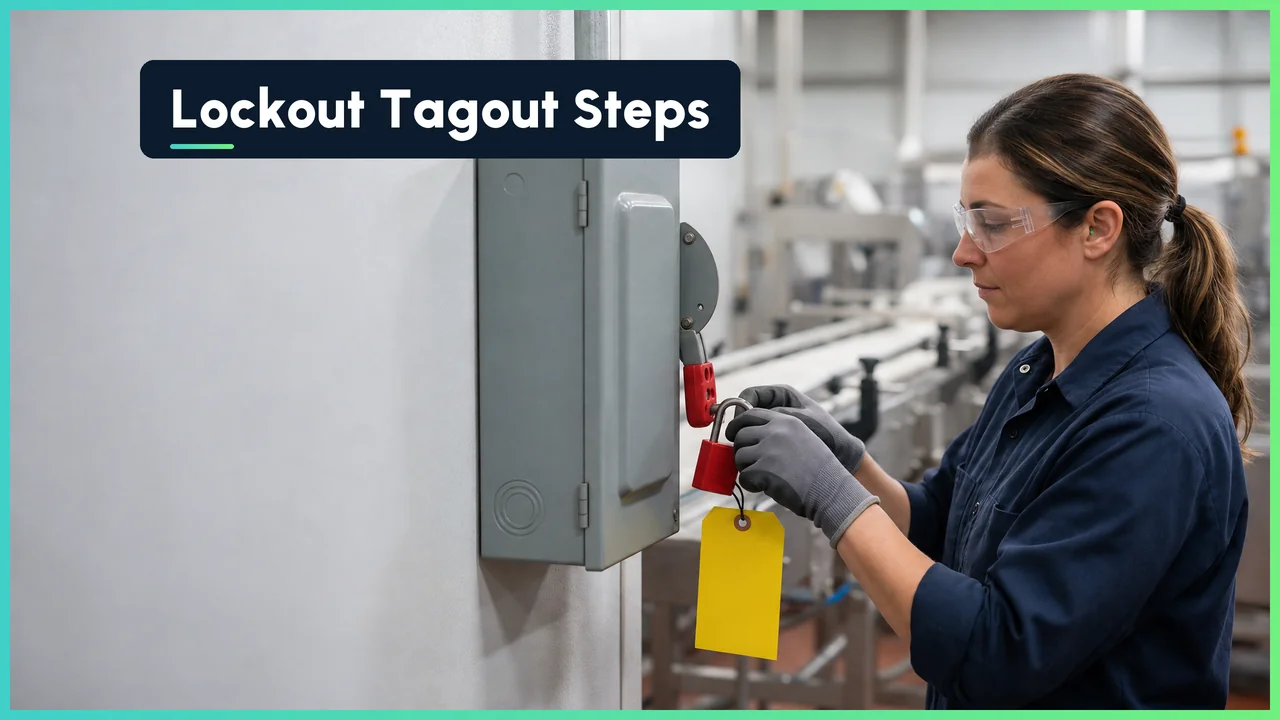
There are 6 lockout tagout steps, and the Occupational Safety and Health Administration (OSHA) lists them in order in 29 CFR 1910.147(d). Prepare, shut down, isolate, apply your lock or tag, release stored energy, and verify. Restarting has its own 3 checks under 1910.147(e), and skipping those is where a lot of injuries happen.
This guide is for whoever has to make lockout work on your floor. That’s the tech holding the lock and the operator waiting on the repair. It’s also the plant manager who signs the procedure and the human resources lead who tracks your training.
One reason to get this right now: lockout/tagout is the third most cited OSHA standard on the agency’s preliminary Top 10 list for fiscal year 2026. That list covers October 1, 2025 to August 31, 2026. It was fourth the year before.
What Are the 6 Lockout Tagout Steps?
The 6 steps are preparation, shutdown, isolation, lockout or tagout, stored energy release, and verification. 1910.147(d) puts them in that order, and the order matters. You can’t verify something you haven’t isolated, and a lock on a breaker does nothing about a raised hydraulic arm.
You’ll see 7, 8 or even 10 LOTO steps in other guides. Those split out notification or the restart as separate steps. The standard itself lists 6, and here’s each one the way it describes it.
| Step | What you do | Where it lives |
|---|---|---|
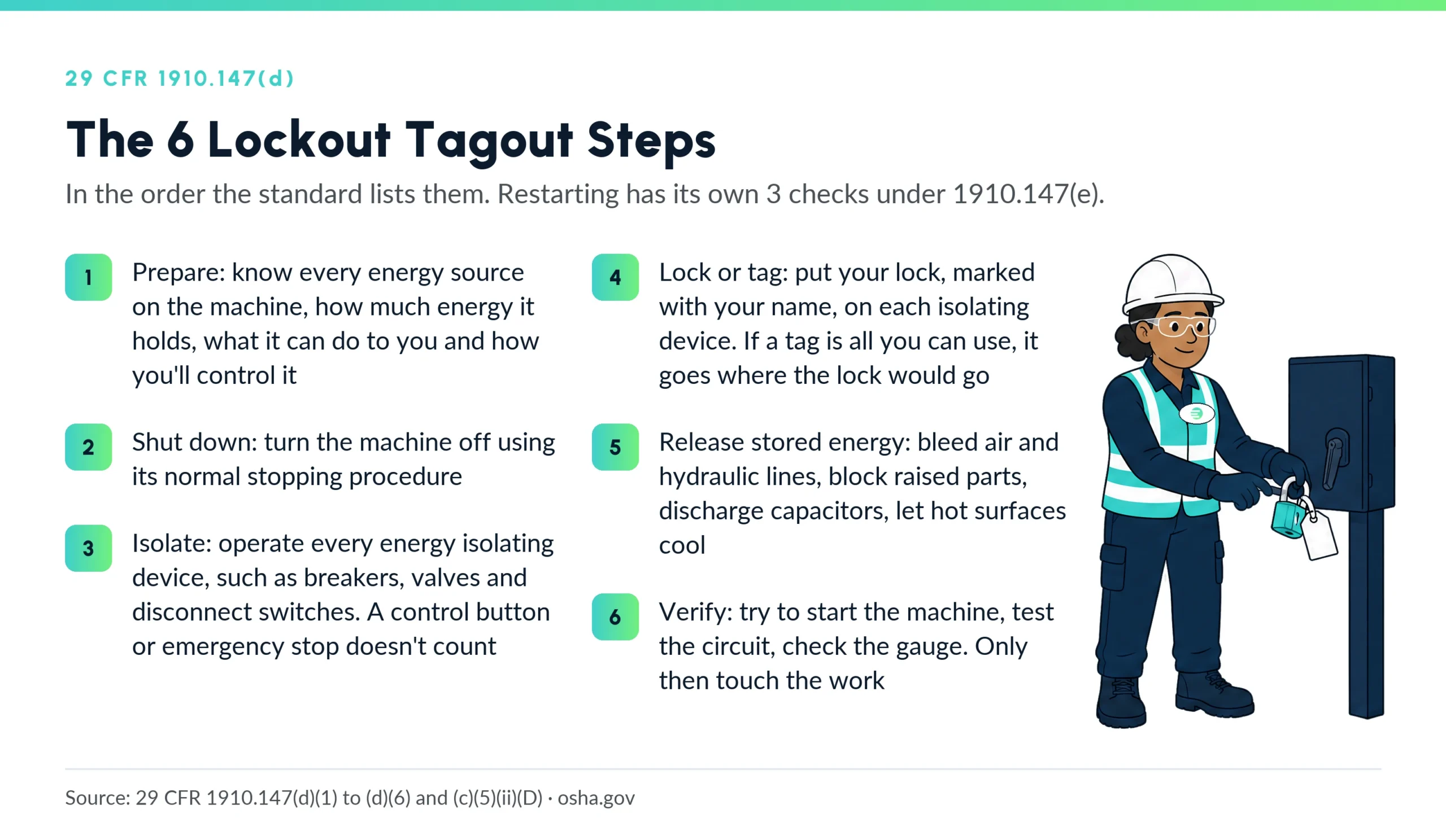
| 1. Prepare | Know every energy source on the machine, how much energy it holds, what it can do to you, and how you’ll control it | 1910.147(d)(1) |
| 2. Shut down | Turn the machine off using its normal stopping procedure, so the shutdown itself doesn’t create a new hazard | 1910.147(d)(2) |
| 3. Isolate | Find and operate every energy isolating device: breakers, valves, disconnect switches. A control button or emergency stop doesn’t count | 1910.147(d)(3) |
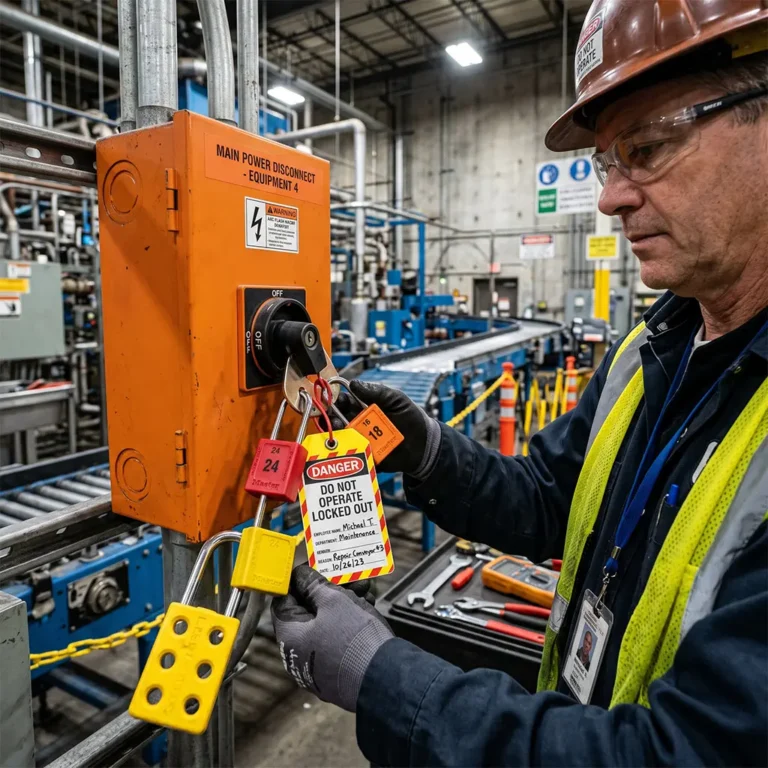
| 4. Lock or tag | Put your lock, marked with your name, on each isolating device so it stays in the off or safe position. If a tag is all you can use, it goes where the lock would go and says the device must not be moved | 1910.147(d)(4), (c)(5)(ii)(D) |
| 5. Release stored energy | Bleed air and hydraulic lines, block raised parts, discharge capacitors, let hot surfaces cool. If energy can build back up, keep checking until it can’t hurt anyone | 1910.147(d)(5) |
| 6. Verify | Try to start the machine, test the circuit, check the gauge. Only then do you touch the work | 1910.147(d)(6) |
Hazardous energy means more than electricity. OSHA’s list covers electrical, mechanical, hydraulic, pneumatic, chemical, thermal and other sources. A machine often carries more than one, and step 1 is where you count them.
A quick example
Picture a packaging line at a food plant. A conveyor jams at the case sealer, and the maintenance tech comes over to clear it.
Prepare: the conveyor runs on a 480-volt motor. The sealer has a pneumatic cylinder that holds the pressure plate up. That’s 2 energy sources. Shut down: she stops the line at the operator panel. Isolate: she opens the disconnect switch on the motor control panel and closes the air supply valve to the sealer. Lock: one personal lock on the disconnect, one on the valve, both tagged with her name. Release stored energy: she bleeds the air line at the exhaust port and watches the plate drop to rest. Verify: she presses start at the panel. Nothing moves. Now she clears the jam.
That whole sequence takes 2 or 3 minutes. Your jam takes longer.
Who Can Lock Out Equipment?
Only the authorized employees doing the servicing can apply or remove a lockout device (1910.147(c)(8)). The standard sorts people into 3 groups, in (b) and (c)(7)(i), and each gets different training:
- Authorized employees lock or tag out equipment to service it. They need training on the energy sources they’ll meet and how much energy is present. They also learn how to isolate and control it (1910.147(c)(7)(i)(A)).
- Affected employees run the equipment that’s being serviced, or work in the area while it happens. They need to know what the procedure is for and how it’s used (1910.147(c)(7)(i)(B)).
- Other employees who work where lockout happens need to know the procedure exists. They must never try to restart anything that’s locked or tagged (1910.147(c)(7)(i)(C)).
An operator who clears her own jams is an authorized employee for that task. The rest of the shift, she’s an affected employee. Train her for the job she’s doing.
Retraining is triggered by events, not the calendar. 1910.147(c)(7)(iii) requires it when a worker’s job changes or the procedure changes. It’s also required when new equipment brings a new hazard, or when the yearly inspection turns up a problem. You certify each training with the worker’s name and the date (1910.147(c)(7)(iv)).
How Do You Remove a Lock and Restart?
The person who put the lock on takes it off, after 3 checks. 1910.147(e) lists them:
- Check the equipment. Tools and parts are out of the machine, guards are back on, and components are intact (1910.147(e)(1)).
- Check for people. Everyone is clear of the equipment or safely positioned (1910.147(e)(2)(i)).
- Remove the device. Each lock comes off by the hand that applied it (1910.147(e)(3)). Then, before anyone hits start, tell the affected employees the locks are off (1910.147(e)(2)(ii)).
What if that tech went home with her lock still on the disconnect? You can remove it, but only under a written procedure that does 3 things (1910.147(e)(3)). It confirms she’s off site. It makes all reasonable efforts to reach her. And it makes sure she knows the lock is gone before she goes back to work. Cutting a lock without that procedure is a violation, and it’s how people get hurt.
The standard covers 2 more situations. On a group job, one authorized employee carries primary responsibility (1910.147(f)(3)). Every worker hangs a personal lock on the group lockbox or hasp, a clip that holds several locks. At shift change, the outgoing crew hands protection to the incoming crew in an orderly way (1910.147(f)(4)). The machine is never unprotected in between.
What Has to Be in a Written Lockout Tagout Procedure?
A written lockout tagout procedure has to spell out 4 things (1910.147(c)(4)(ii)):
- what it’s for and which equipment it covers
- the steps to shut down, isolate, block and secure the machine
- the steps to place, remove and transfer locks and tags, and who’s responsible for each
- how to test that the controls worked
Every machine needs one unless it meets all 8 conditions in 1910.147(c)(4)(i). One of those is a single energy source that one lock can isolate. If your machine misses any of the 8, it needs a written procedure. A good one fits on a laminated card at the machine, with photos of each isolation point.
If a device can’t take a lock, you can tag it instead. You then have to add protection that equals a lock (1910.147(c)(3)). Pulling a fuse, blocking the switch or removing the valve handle all count.
Lockout is an administrative control, so it only works when your people follow it. Fixed guards and interlocks do the job without anyone remembering a step. Our Machine Guarding course covers the hardware side.
The Yearly Inspection
OSHA requires you to inspect each energy control procedure at least once a year (1910.147(c)(6)(i)). The inspector has to be an authorized employee who doesn’t use that particular procedure (1910.147(c)(6)(i)(A)). Where lockout is used, the inspector reviews each authorized worker’s part in the procedure with them (1910.147(c)(6)(i)(C)). If anything’s off, you fix the procedure and retrain.
Then you certify it: the machine, the date, the employees included, and who did the inspection (1910.147(c)(6)(ii)). A compliance officer will ask for these records, so keep them where you can find them.
Where 1910.147 Doesn’t Apply
1910.147 is a general industry standard. It doesn’t cover construction, agriculture or maritime work. It also doesn’t cover electrical hazards from work on energized circuits, which fall under 1910 Subpart S.
Normal production work isn’t covered either. It becomes covered when someone has to remove a guard or put part of their body in the danger zone. Minor tool changes and adjustments are exempt when they’re routine, repetitive and part of production (1910.147(a)(2)(ii), note). Other measures still have to protect the worker. Clearing a jam that means reaching past a guard, like the example above, is covered.
There’s one everyday exception. Cord-and-plug equipment is exempt when unplugging it removes the hazard (1910.147(a)(2)(iii)(A)). The person doing the work has to keep the plug under their exclusive control. Unplug the bench grinder, keep the plug in your pocket, and you’ve met the rule. State plans can be stricter than federal OSHA, so check your state’s rule if you’re not under federal jurisdiction.
Training Your Crew on the Lockout Tagout Steps
Our Lockout Tagout course covers the kinds of hazardous energy, energy control procedures and device requirements. It also covers shutdown and startup, removing devices, and group lockout. It helps meet the training requirement in 1910.147(c)(7). The course page lists operators and supervisors alongside maintenance techs. It runs about 1 hour, self-paced, in English or Spanish, and costs $20 per seat (November 2026). Pass the exam at 70% and the certificate and wallet card print right away.
Say that food plant has 6 maintenance techs who need authorized-employee training before the yearly inspection. That’s 6 seats at $20, or $120. A business account lets you buy the seats together and watch each tech’s progress on one dashboard. You export the report when the compliance officer asks. The hands-on part, walking each tech through the written procedure at the machine, is still yours to do. The course gets them to the machine knowing why each step is there.
Frequently Asked Questions
What is lockout tagout (LOTO)?
A procedure that shuts down and de-energizes equipment before servicing. It keeps the machine from starting up or releasing energy while someone is working on it. Lockout means a physical lock on the energy isolating device; tagout means a warning tag.
What are the 6 steps of lockout tagout?
Prepare, shut down, isolate, lock or tag, release stored energy, and verify, in that order (29 CFR 1910.147(d)). Verification means trying to start the equipment after it’s locked to prove it’s dead.
Who can remove a lockout device?
The employee who applied it. If that person isn’t available, the employer may remove it under a documented procedure (1910.147(e)(3)). The procedure has to confirm the worker is off site and try to contact them. It also has to tell them before they return to work.
How often does OSHA require a lockout tagout inspection?
At least once a year for each energy control procedure (1910.147(c)(6)). An authorized employee who doesn’t use that procedure does the inspection. You certify it with the equipment, date, employees and inspector.
Does lockout tagout training expire?
No. There’s no federal expiration date. Retraining is required when a worker’s job changes, the procedure changes, or a new hazard shows up (1910.147(c)(7)(iii)). It’s also required when the yearly inspection finds problems. We recommend refreshing it yearly anyway, alongside the inspection.
Sources: OSHA