


Featured Courses
Previously trained hazardous waste workers complete required OSHA annual refresher certification training

2026 8 Hour HAZWOPER Refresher

Annual 8-hour HAZWOPER refresher meeting OSHA 29 CFR 1910.120(e)(8) requirements.
Comprehensive lithium battery safety safety training for workers and workplace for workplace compliance

Lithium Battery Safety

Covers what happens when lithium batteries fail and how to prevent fires and explosions.

View All OSHA Courses

image
OSHA Annual Requirement

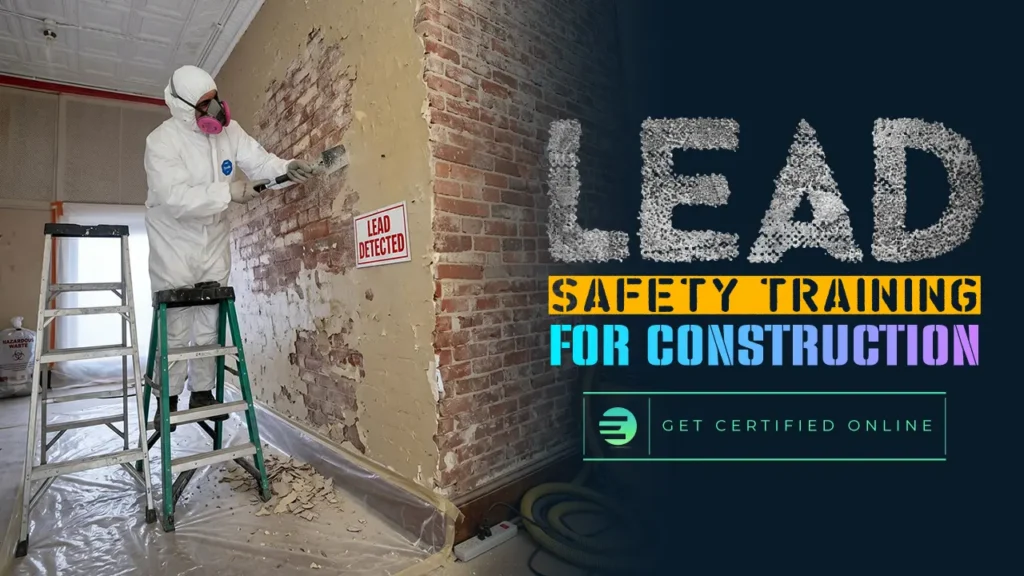
Lead Safety Training for Construction

4.9(19 reviews)
Lead Safety Training for Construction

Course Overview

Lead safety training for painters, welders and demolition crews: it trains them on OSHA 29 CFR 1926.62, the lead in construction standard. The 2-hour online course covers exposure limits, health effects, monitoring, medical surveillance and records.

  • Covers the 30 µg/m³ action level and 50 µg/m³ permissible exposure limit the construction lead standard sets.
  • Trains the crew to spot lead overexposure early, from metallic taste and headaches to tremors and joint pain.
  • Explains what employers owe the crew: air monitoring, blood tests, medical removal pay and records access.
  • 2 hours, self-paced
  • Instant certificate
  • Mobile friendly
$29.00

Per seat. One-time payment, no subscription.

+

30-day satisfaction guarantee. No hidden fees.

Course Clips

Everything You Need to Know
About This Course

Three modules across four parts, in order: what lead is and where it hides on a job, how exposure harms the body, and what the standard makes the employer do about it. Three short knowledge checks sit along the way, none counting toward your grade, and the final exam closes the course.

  • Where lead is used in construction.
  • Routes of exposure.
  • Chronic and acute overexposure.
  • Symptoms of lead overexposure.
  • Reproductive risks.
  • Chelating agents.
  • Trades most exposed to lead.
  • The OSHA lead standard for construction.
  • Protective clothing and hygiene facilities.
  • Employee observation of air monitoring.
  • Worker protection program elements.
  • Written compliance program.
  • Initial exposure assessment.
  • Periodic monitoring.
  • Notice of sampling results.
  • Biological monitoring and blood lead levels.
  • Medical examinations.
  • Medical removal protection.
  • Recordkeeping.

OSHA Standard29 CFR 1926.62
Course Duration2 hours
Format100% online, fully narrated with photos and interactivity
Passing Score70% on final exam
CertificatePersonalized certificate, printable immediately upon passing
LanguagesEnglish
Device CompatibilityDesktop, tablet, and smartphone
ProgressProgress saved automatically, stop and restart without losing your place
AcceptedOur courses meet federal standards, but state requirements may vary. Please verify before purchase.

This lead safety training course is for construction workers whose job can put them at or above the lead action level on any day, which is the trigger for training at 29 CFR 1926.62(l)(1)(ii), and for the people who run those crews and the program behind them.

  • Painters and abrasive blasters stripping or spraying coatings on bridges, tanks and older steel structures.
  • Welders, cutters and torch crews working lead-coated steel, the highest exposure tier the standard names.
  • Demolition crews taking down pre-1978 buildings and salvaging structures where lead is present.
  • Renovation and remodeling crews disturbing painted surfaces in older buildings.
  • Plumbers and pipefitters cutting into lead pipe and older plumbing products.
  • Ironworkers and electricians handling lead-containing conduits, fittings and structural coatings.
  • HVAC technicians and carpenters on repair jobs in older structures where lead paint is present.
  • Crews on lead removal or encapsulation jobs, who are covered by the OSHA standard alongside any EPA certification the work itself requires.
  • Supervisors and safety managers who run the exposure assessments, monitoring, medical surveillance and records the course walks through.
  • Any construction worker who may be exposed to lead at or above the action level on any day.

29 CFR 1926.62 reaches seven kinds of construction work where lead or lead-containing material is present, from demolition through installation to cleanup and disposal. These are the operations that send crews into it.

  • Bridge and highway rehabilitation, including blasting and repainting lead-coated steel.
  • Demolition and salvage of pre-1978 buildings and structures.
  • Residential and commercial renovation and remodeling in older buildings.
  • Structural steel painting and abrasive blasting contractors.
  • Lead paint removal and encapsulation contractors, alongside the EPA certification that abatement work carries.
  • Plumbing and pipefitting in buildings with lead pipe.
  • Electrical work on older conduit and fittings.
  • Industrial plant maintenance and renovation on lead-coated equipment and tank linings.
  • Government and municipal building restoration.
  • Emergency lead cleanup and environmental remediation on construction sites.
  • Transport, storage and disposal of lead-containing material on a construction site.

Experience the first 5 minutes of the course right here. No account or payment required.

OSHA Lead Training or EPA RRP Refresher: Which Do You Need?

A crew member exposed to lead at or above the action level on any day takes this OSHA lead training. A certified renovator whose EPA certification is coming up for renewal takes the refresher. OSHA's lead in construction standard puts the training duty on the employer of any crew exposed at or above the action level; EPA's Renovation, Repair and Painting (RRP) rule certifies the renovator who disturbs paint in pre-1978 homes and childcare facilities, and that certification has to be renewed.

  • Lead Safety Training for Construction. The page you are on. About 2 hours of OSHA awareness training for painters, welders, plumbers and demolition crews exposed to lead on construction sites: the action level and exposure limit, air monitoring, medical surveillance, medical removal and records under 29 CFR 1926.62.
  • EPA Lead Safety Refresher. Four hours for renovators who already hold EPA renovator certification under 40 CFR 745, the Renovation, Repair and Painting rule, and are due to renew it. The rule reaches paid work that disturbs paint in pre-1978 homes, childcare facilities and preschools. View the EPA Lead Safety Refresher

Neither one stands in for the other, so a renovation contractor with both duties buys both, and tracks them on two calendars: the crew's retraining date and the renovator's EPA renewal date.


What Are the OSHA Requirements for Lead Training?

OSHA requires the employer to train every construction employee who is exposed to lead at or above the action level on any day, before the job starts and again at least annually, under 29 CFR 1926.62(l).

  • The trigger is exposure, not job title. Paragraph (l)(1)(ii) reaches anyone at or above the 30 µg/m³ action level on any single day, or working with lead compounds that irritate skin or eyes. A painter on one bridge job qualifies the same as a full-time removal hand.
  • Training comes before the assignment. Paragraph (l)(1)(iii) puts the initial training ahead of the job. A 2-hour online course a crew can finish the week before mobilizing fits the way construction actually schedules work.
  • It repeats every year the exposure lasts. Paragraph (l)(1)(iv) requires the training again at least once every 12 months for each employee still at or above the action level on any day. Put the retraining date on the same calendar as the exposure assessment.
  • The standard lists the subjects, and the certificate shows the citation. Paragraph (l)(2) names eight subjects, from the standard itself through medical surveillance, medical removal and the chelation rule to records access. Four of those run through this course: the standard and what it covers, the medical surveillance and medical removal programs, the chelation rule, and the right to see exposure and medical records. The Certificate of Completion prints the OSHA citation, so the file shows what the training was built to.

For a crew rotating between bridge jobs and demolition sites, the training date and the exposure date have to line up. This course gives you the first one in about 2 hours, and a Certificate of Completion you print the day the crew passes.
Verified Course Reviews

Add a review
You must be logged in to post a review Log In
4.9
Based on 19 reviews
5
89
89%
4
11
11%
3
0%
2
0%
1
0%
1-2 of 19 reviews
  1. Very good information

    (0) (0)
  2. I really like the information that was giving to me in this lesson.

    (0) (0)

Frequently Asked Questions

Everything you need to know about the Lead Safety Training for Construction.

Yes. Upon passing the final exam with a score of 70% or higher, you can immediately print a certificate of completion. This certificate serves as proof of training for your employer.

Yes. The course is accessible on desktop computers, laptops, tablets, and smartphones. Progress saves automatically on the same device, so you can stop and resume where you left off.

There is no federally mandated expiration date for this training certificate. However, health and safety plans should be reviewed and updated annually, and whenever workplace conditions, hazards, or regulations change. Refresher training is recommended to stay current with evolving OSHA standards and best practices for safety program management.

You must score at least 70% on the final exam to pass and receive your certificate of completion. The course includes knowledge-check quizzes that do not count toward your final grade but help prepare you for the exam. If you do not pass on your first attempt, you can retake the exam.

Lead safety training for construction is a safety awareness program that teaches workers how to recognize lead hazards, understand the health effects of lead exposure, and apply prevention and protection measures on construction job sites. eTraining’s course provides approximately 2 hours of instruction covering OSHA 29 CFR 1926.62, including lead properties and sources, health effects (nervous system, kidneys, reproductive system, blood), OSHA exposure limits, air monitoring and sampling, medical surveillance, engineering controls, respiratory protection, PPE, and proper lead disposal. Upon completion, participants receive a printable certificate of completion.

OSHA 29 CFR 1926.62(l) requires employers to train each employee who is exposed to lead at or above the action level (30 µg/m³ as an 8-hour time-weighted average) on any day, or who is exposed to lead compounds that may cause skin or eye irritation. Training must be provided before job assignment and repeated at least annually. Training must cover the content of the OSHA lead standard, specific operations that could result in exposure, respirator selection and use, the medical surveillance program, engineering controls, and employee rights.

The course takes approximately 2 hours to complete. Because it is self-paced, you can complete it over multiple sessions at your convenience. Most students finish within 1 week. You have 6 months from your enrollment date to complete all coursework. Progress is saved automatically on the same device, so you can stop and resume at any time.

 OSHA 29 CFR 1926.62 establishes two key exposure limits for lead in construction. The Permissible Exposure Limit (PEL) is 50 micrograms per cubic meter of air (µg/m³) as an 8-hour time-weighted average (TWA). The Action Level is 30 µg/m³ as an 8-hour TWA, which triggers requirements for air monitoring, medical surveillance, training, and other protective measures. When exposures exceed the PEL, employers must implement engineering controls, work practices, and respiratory protection to reduce exposure.

 The course covers: physical and chemical properties of lead; common sources of lead in construction (lead-based paint, solder, pipes, coatings); acute and chronic health effects of lead exposure; OSHA 29 CFR 1926.62 requirements; permissible exposure limits and action levels; air monitoring and sampling methods; medical surveillance and blood lead level testing; engineering controls (ventilation, wet methods, enclosure); work practices to minimize exposure; respiratory protection requirements; personal protective equipment; hygiene practices (handwashing, changing facilities, no eating or smoking in lead areas); proper lead waste disposal; recordkeeping; and employer requirements. The course is divided into 6 units with knowledge-check quizzes.

 Yes. eTraining’s Lead Safety Training for Construction course covers OSHA 29 CFR 1926.62 standards for lead in construction and is accepted nationwide. You receive a printable certificate of completion that documents your training. Employers, general contractors, and lead abatement firms across all 50 U.S. states accept this training for lead safety compliance.

   Lead is a toxic metal that can enter the body through inhalation of lead dust and fumes or through ingestion (hand-to-mouth contact). Construction activities that disturb lead-based paint (sanding, scraping, burning, blasting), cut or weld lead-coated surfaces, or demolish structures built before 1978 can generate dangerous levels of airborne lead. Chronic lead exposure can damage the brain and nervous system, kidneys, reproductive system, and blood-forming organs. Lead can also accumulate in the body over time, and workers can unknowingly carry lead dust home on their clothing, exposing their families.

Better Training. Better Outcomes.

Fifteen years, 200,000+ professionals certified, and a completion rate roughly double the industry average.

OSHA citation printed on every certificate

Your employer and site safety officer can verify compliance at a glance, with no phone calls and no lookups.

No setup. No LMS. Training in minutes.

Pay once, get instant access. No account setup, no downloads, no IT involvement. Works in any browser.

Built for field workers, not classrooms

Grounded in real jobsite operations. Scenarios reflect the work your crew actually does.

Trusted by safety managers & contractors

Used by EHS managers, general contractors and federal site supervisors to keep crews certified on time.

200,000+
Professionals certified
87%
Completion rate (industry avg <45%)
10M+
Hours of training delivered
15
Years in business

Your go-to source for workplace safety updates.

Join our monthly newsletter covering industry stories, news & timely updates, and get a free 110-page OSHA manual covering the latest training requirements.

eTraining and the eTraining logo copyright 2026 eTraining, Inc. All Rights Reserved.