

A respirator fit test checks that a tight-fitting respirator seals to your face. You need one before first use, when switching respirators and at least once a year (29 CFR 1910.134(f)(2)). That’s the Occupational Safety and Health Administration (OSHA) rule for any tight-fitting respirator your employer requires. Switching means a different make, model, style or size.
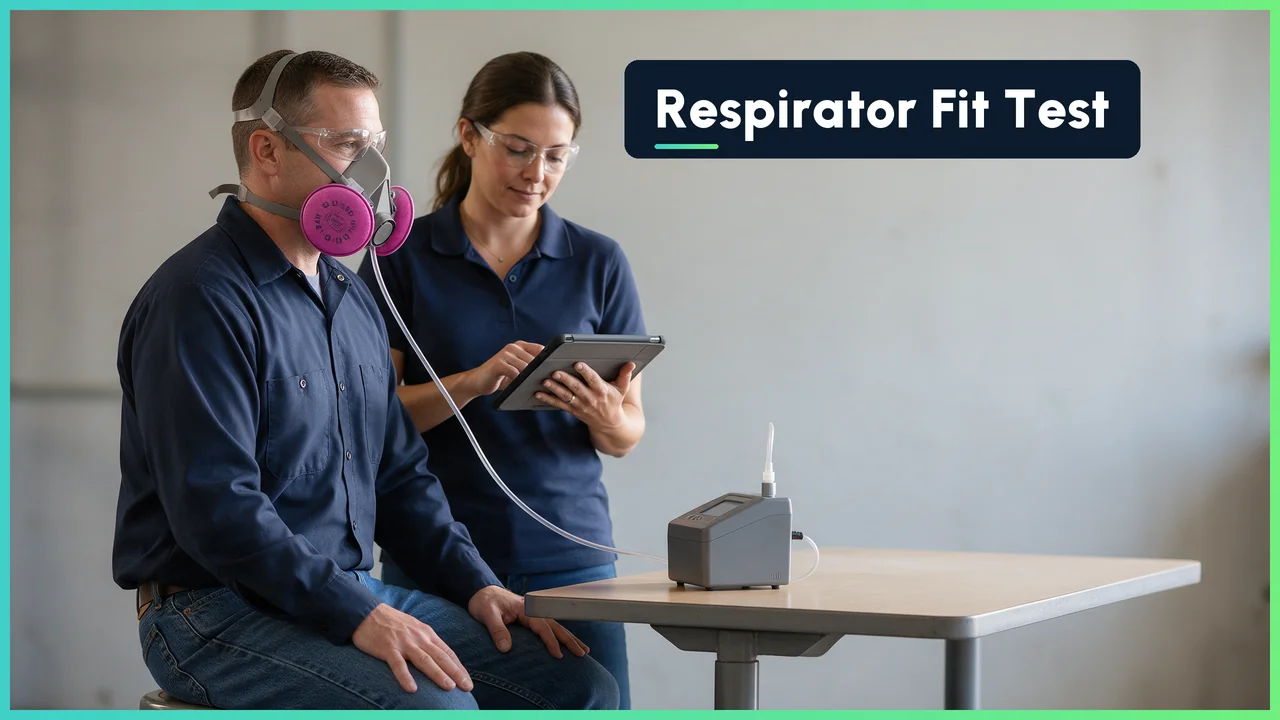
There are 2 kinds: qualitative (pass or fail, by taste, smell or reaction) and quantitative (an instrument measures the leak).
What Is a Respirator Fit Test?
A respirator fit test is a set procedure that checks one respirator, in one size, on your face. Faces come in different shapes, so a half mask that seals on one painter can leak on the next. Air that gets past the seal skips the filter.
It has to follow a protocol from Appendix A of the standard (1910.134(f)(5)). You’re tested in the same make, model, style and size you’ll wear on the job (1910.134(f)). Our FAQ answers what a fit test for respirators is in a few lines.
Who Needs One?
You’ll need a fit test if your employer requires you to wear a tight-fitting respirator (1910.134(f)(1)). Tight-fitting means the facepiece forms a complete seal with your face (1910.134(b)). N95s and rubber half masks are both tight-fitting. A loose-fitting facepiece forms only a partial seal, and the fit test rule is written for tight-fitting facepieces.
If you wear an N95 by choice and the air isn’t hazardous, you don’t need a fit test. OSHA said so in a February 6, 2006 letter. Your employer still has to give you Appendix D, the standard’s basic advice for voluntary users (1910.134(c)(2)(i)).
In construction, 29 CFR 1926.103 says its requirements are identical to 1910.134. Table 1 of the silica rule calls for a respirator for indoor handheld saw cuts. That respirator has to meet 1910.134 (29 CFR 1926.1153(c)(1), (e)(1)).
These respirator fit test requirements are federal. States that run an OSHA State Plan must have rules at least as effective (29 CFR 1902.3(c)(1)). Check yours.
OSHA’s preliminary Top 10 list for fiscal year 2026 puts respiratory protection 6th among its most frequently cited standards. That list covers October 1, 2025 to August 31, 2026.
When Is a Fit Test Required?
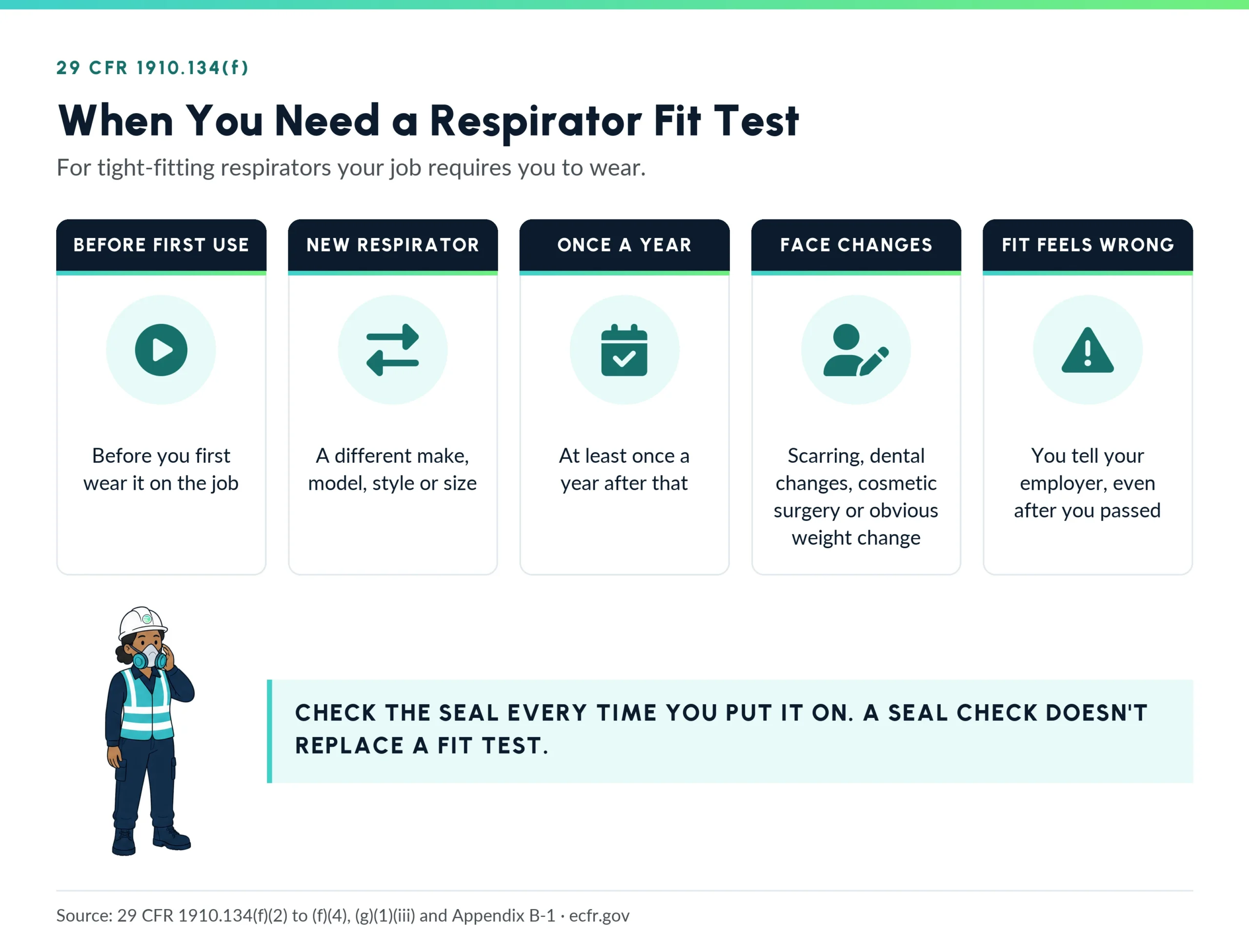
If your job requires a tight-fitting respirator, your employer must fit test you in these 5 cases:
- Before you first wear the respirator on the job (1910.134(f)(2))
- Whenever you switch to a different make, model, style or size (1910.134(f)(2))
- At least once a year after that (1910.134(f)(2))
- When facial scarring, dental changes, cosmetic surgery or obvious weight change could affect the fit (1910.134(f)(3))
- When you tell your employer the fit feels wrong, even after you passed (1910.134(f)(4))
If the fit feels wrong, you get a reasonable chance to pick a different facepiece and test again.
Qualitative vs. Quantitative Respirator Fit Test
A qualitative fit test is pass or fail and relies on your senses. A quantitative fit test uses an instrument to measure leakage and gives a number called the fit factor (1910.134(b)).
| Qualitative fit test | Quantitative fit test | |
|---|---|---|
| How it works | A tester puts a test agent in the air around you. If you taste, smell or react to it, the seal leaks. | An instrument measures how much air leaks into the facepiece. |
| Result | Pass or fail | A fit factor (a number) |
| Accepted methods (Appendix A) | 4 agents: isoamyl acetate (banana smell; organic vapor cartridges only), saccharin (sweet), Bitrex (bitter), irritant smoke (makes you cough; high efficiency particulate air (HEPA) or P100 filters only) | 6 protocols: generated aerosol; ambient aerosol condensation nuclei counter (CNC); modified CNC for rubber half and full facepieces; modified CNC for filtering facepieces such as N95s; controlled negative pressure (CNP); CNP REDON |
| Respirators it can test | Negative-pressure air-purifying respirators that need a fit factor of 100 or less (1910.134(f)(6)) | Any tight-fitting respirator |
| Pass level | You don’t detect the agent during the exercises | Fit factor of 100 or more for half facepieces, 500 or more for full facepieces (1910.134(f)(7)) |
| Your own respirator | Uses your respirator, with the cartridges or filters the agent needs | Some tests use a probed respirator kept for testing. Adapters let the CNC and CNP tests use your own. |
OSHA explained the 100 limit in a January 15, 1999 letter. Qualitative tests are for negative-pressure air-purifying respirators only where the air is below 10 times the permissible exposure limit (PEL).
A quantitative test doesn’t always use up your respirator (Appendix A, I.C.3, I.C.6).
What Happens During a Respirator Fit Test
You’ll get a medical evaluation first. Then a tester checks the seal while you do short exercises.
- Your employer must provide a medical evaluation for respirator use before you’re fit tested (1910.134(e)(1)).
- The test won’t run with hair between your skin and the seal (Appendix A, I.A.9). That includes stubble, a beard, a mustache or sideburns that cross the seal. If stubble grows where the seal sits, shave first. The same rule applies on the job, and no hair can interfere with the valve (1910.134(g)(1)(i)(A)).
- Wear any job gear that could affect the fit, such as safety glasses or goggles (Appendix A, I.A.13).
- You wear the respirator for at least 5 minutes. Most protocols then use 7 exercises of 1 minute each. They include deep breathing, turning your head side to side, nodding, talking and bending over. In that set, quantitative tests add a 15-second grimace. Adjusting the respirator after the exercises start voids the test (Appendix A, I.A.12 and I.A.14).
- Your employer records the result. If you fail, you’ll try a different respirator and test again.
Testers must know how to run the test and spot invalid results (Appendix A, I.B.1, I.C.1). Problems seen during the fit test can also trigger a new medical evaluation (1910.134(e)(7)(iii)).
Respirator Fit Test vs. User Seal Check
A user seal check is a quick check you’ll do whenever you put the respirator on (1910.134(g)(1)(iii)). Appendix B-1 gives 2 checks, positive pressure and negative pressure, and says a seal check doesn’t replace a fit test.
For the positive check, cover the exhalation valve and breathe out gently. The facepiece should puff out a little with no air leaking at the seal. For the negative check, cover the cartridges and breathe in gently. The facepiece should pull in slightly and stay that way while you hold your breath for 10 seconds. The respirator maker’s method also counts if it’s as effective.
What Your Employer Keeps on File
Your employer keeps a record of each fit test until your next one (1910.134(m)(2)(ii)). The record shows (1910.134(m)(2)(i)):
- Your name or other identification
- The type of fit test
- The make, model, style and size tested
- The date
- Pass or fail for a qualitative test, or the fit factor and a recording for a quantitative one
Your employer’s written respiratory protection program also has to include fit testing procedures (1910.134(c)(1)(iii)). If you keep the records, check that the model and size match what each worker actually wears.
Training for Respirator Users
Your employer must train you before your first required use and every year after (1910.134(k)(3), (k)(5)). You’re retrained sooner if your skills slip. The same goes for a change at work or in your respirator that makes your training out of date. Here’s more on how often respiratory protection training is required.
Say you run a body shop and require your 6 painters to wear half-mask respirators. Each painter needs a medical evaluation, then a fit test before first use and at least once a year. Each also needs training before first use and every year. Training for the crew is 6 painters x $25 = $150 (Nov 2026). We’d book the yearly fit tests and training in the same week, so one calendar reminder covers both.
Our Respiratory Protection course helps meet the training requirements in 1910.134(k) and explains how fit testing works. It’s $25 (Nov 2026), takes about 90 minutes and is self-paced. It can’t fit test you. That takes a trained tester with the test agent or instrument, which your employer arranges.
Frequently Asked Questions
How often is a fit test for a respirator required?
At least once a year. You also need one before first use and with any different make, model, style or size (1910.134(f)(2)).
Does OSHA require fit testing for N95?
Yes, when your employer requires you to wear one. Then you need a fit test before first use and at least once a year (1910.134(f)(2)). Wearing one by choice in air that isn’t hazardous doesn’t require a fit test (OSHA letter, February 6, 2006).
What happens if you fail a respirator fit test?
You’ll try a different respirator and test again (Appendix A). You have to pass in the respirator you’ll wear on the job (1910.134(f), (f)(1)).
Is the N95 fit test qualitative or quantitative?
Either one. An N95 counts as a half mask, which needs a fit factor of 100. That’s low enough for a qualitative test (1910.134(f)(6)). For an N95, that means the sweet or bitter test. The banana and smoke tests need cartridges or filters it doesn’t have. Appendix A also has a quantitative protocol made for filtering facepieces like N95s.
Sources: OSHA