

Crane safety depends on the best communications. The crane signal person is the “great communicator,” who has to be in contact with the crane operator at all times while the crane is moving. If for some reason the communication is disrupted, the crane operator has to come to a “full stop” and wait until communications are restored.
The National Commission for the Certification of Crane Operators (NCCCO) has developed the performance and safety standards for crane operations and has published a Signalperson Reference Manual. What follows are some brief excerpts:
How the Operator and Signal Person Communicate
Hand signals for controlling mobile cranes: There are standard hand signals, and a placard illustration must be displayed in a conspicuous place on the job site.
Some examples of hand signals are:
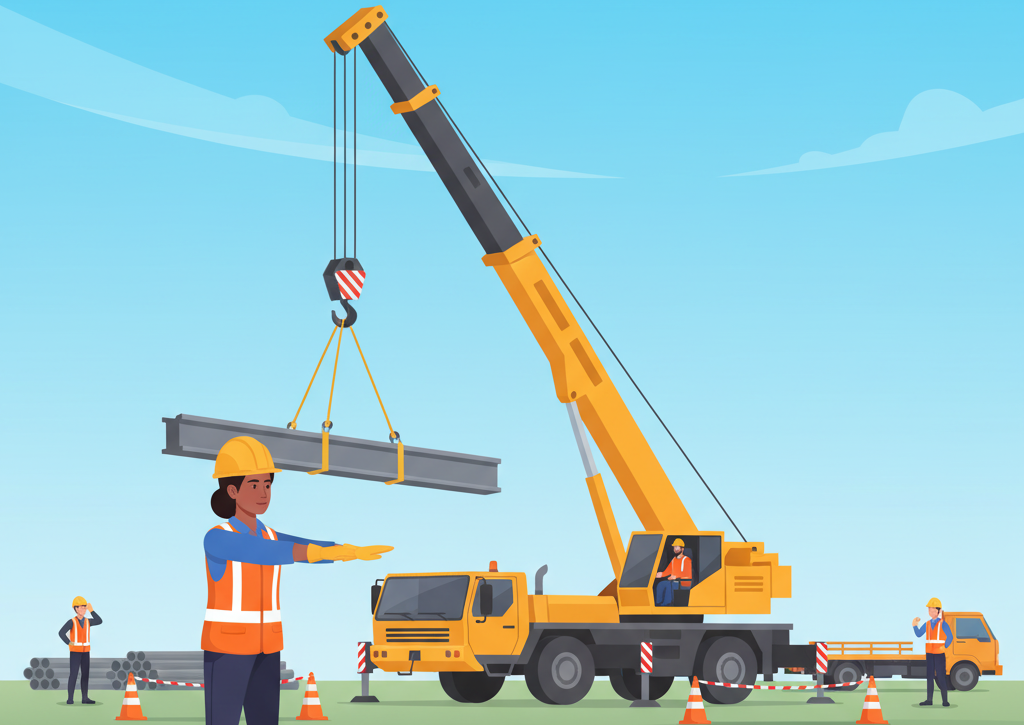
- Stop: Signaler extends one arm with the palm down and moves the arm back and forth horizontally.
- Emergency stop: Same as stop, except both arms are extended and moved back and forth horizontally.
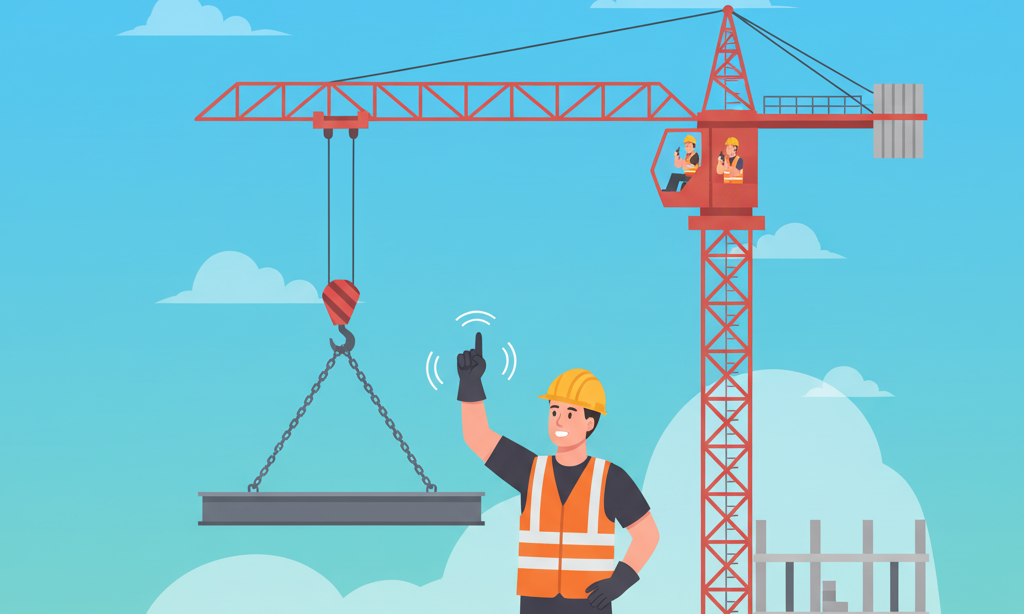
- Hoist: Signaler holds forearm vertical, points forefinger up and moves the hand in small horizontal circles. (Similar to a stage director telling everyone to speed up the action.)
- Lower: Similar to hoist, but forearm is pointed down while forefinger points toward the ground and makes the small circular movements.
- Raise boom: Signaler extends arm, closes fingers and points thumb upward.
- Lower boom: Similar to raising boom, but thumb is pointed downward.
The foregoing and all other hand signals need to be discussed and agreed upon by everyone involved in crane lifting operations.
Voice Signals for Crane Operating
There are also specific guidelines on voice signaling, specifically:
- Communications devices (telephones, radios, etc.) when used must be tested before lifting operations begin.
- If battery operated, device batteries must be readily available at the work site.
- The crane signal person must give direction signals from the operator’s perspective (e.g. swing right, would be the operator’s right).
- Voice signals must have elements that are stated in the order of (1) what the crane operator needs to do and in what direction; (2) the distance and speed of the action, and (3) an order to stop the action.
- Before beginning lifting operations using voice signals, everyone concerned must discuss and agree on the signals. Communications protocol includes the operator and signal person addressing each other by name and the crane operator having a hands-free communication system.
Some Standard Voice Signals
- “Lower load 50 feet, 25 feet, 20 feet, 10 feet, 2 feet, lower, stop”
- “Hoist load slow, slow, keep hoisting, slow, hoist, stop.” (Again, when giving a swing command, the signal person must give directions from the operator’s perspective.)
Get the best crane signals training on line at e-Training. Contact us and see how our online crane safety courses can help your crane operators, signal persons and supervisors meet all OSHA standards for crane safety and training.