

Featured Courses
Previously trained hazardous waste workers complete required OSHA annual refresher certification training

2026 8 Hour HAZWOPER Refresher

Annual 8-hour HAZWOPER refresher meeting OSHA 29 CFR 1910.120(e)(8) requirements.
Comprehensive lithium battery safety safety training for workers and workplace for workplace compliance

Lithium Battery Safety

Covers what happens when lithium batteries fail and how to prevent fires and explosions.

View All OSHA Courses

image

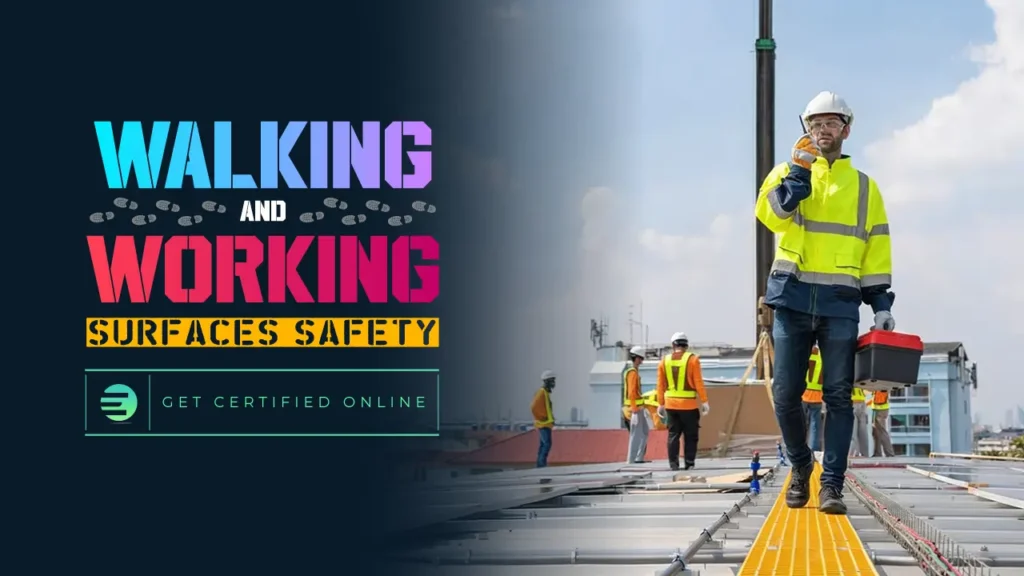
Walking and Working Surfaces Safety

5(2 reviews)
Walking and Working Surfaces Safety

Course Overview

Walking and Working Surfaces Safety Training is a six module online course on preventing slips, trips and falls. It covers the fall statistics, OSHA Subpart D duties, guardrails and fall arrest, hazard assessment, training duties and worked case studies.

  • Learn where the four foot line falls in general industry, and what 29 CFR 1910.28(b)(1)(i) then requires.
  • Read a surface the way an inspector does: load, slip resistance, stair geometry, ladders and housekeeping.
  • Work six site scenarios on missing guardrails, blocked aisles and uneven floors, and pick the first move.
  • 1-2 hours, self-paced
  • Instant certificate
  • Mobile friendly
$19.99

Per seat. One-time payment, no subscription.

Total (1 seats x $19.99)
$19.99
− +

30-day satisfaction guarantee. No hidden fees.

Everything You Need to Know
About This Course

The course runs six modules, each closing with a quiz, and finishes with a final quiz and workplace scenarios.

  • Why Surface Safety Reaches Every Industry, Not Only Construction
  • Five Reasons Surface Safety Is Treated as a Priority
  • Fall Injury and Fatality Statistics, and What They Cost
  • Subpart D General Requirements for All Walking-Working Surfaces
  • Inspection, Maintenance and Repair Duties
  • The Duty to Have Fall Protection and Falling Object Protection
  • Floors, Aisles, Passageways, Platforms and Raised Work Areas
  • Load Rating and Strength Requirements
  • Slip Resistance and Where Traction Fails
  • Stairways: Illumination, Uniform Treads and Handrails
  • Ladders: Types, Load Capacities and Prohibitions
  • Seven Employer Responsibilities, From Design to Record Keeping
  • Trigger Heights of 4, 5, 6 and 8 Feet Across Industries
  • Guardrail Systems, Safety Nets and Personal Fall Arrest
  • Four Categories of Fall Hazard and How to Spot Them
  • Hazard Identification, Analysis and Prioritisation
  • Engineering Controls, Administrative Controls and PPE
  • Training Content, Competency and Retraining Triggers
  • Tailoring Training to Environment, Language and Role
  • Case Studies, Simulation Exercises and Role Playing

OSHA StandardOSHA 29 CFR 1910 Subpart D
Course Duration1-2 hours
Format100% online, fully narrated with photos and interactivity
Passing Score70% on final exam
CertificatePersonalized certificate, printable immediately upon passing
LanguagesEnglish
Device CompatibilityDesktop, tablet, and smartphone
ProgressProgress saved automatically, stop and restart without losing your place
Instructor SupportAccess professional instructors for guidance and answers to your course-related questions.
AcceptedOur courses meet federal standards, but state requirements may vary. Please verify before purchase.

Anyone who walks a floor, climbs a ladder or works near an open edge, and the supervisors who have to keep those surfaces safe and show the crew was trained.

  • Production and warehouse floor staff
  • Maintenance and facilities technicians
  • Construction and trade crews
  • Supervisors and foremen
  • Safety coordinators and committee members
  • Janitorial and housekeeping teams
  • Retail, grocery and hospitality staff
  • New hires during onboarding

The exposure follows the surface rather than the trade. Stairs, ladders, loading docks, mezzanines, wet floors and open edges are what put a workplace in scope.

  • Construction and specialty trades
  • Manufacturing and fabrication
  • Warehousing and distribution
  • Retail, grocery and hospitality
  • Healthcare and long term care
  • Facilities and building maintenance
  • Utilities and telecommunications
  • Food processing and cold storage

Walking and Working Surfaces or a Focused Fall Hazard Course?

Surface safety and fall protection overlap, but they are scoped differently. This course starts from the surface and works outward.

  • Walking and Working Surfaces Safety. The page you are on. Subpart D duties, surface conditions, stairs and ladders, guardrails, hazard assessment and training.
  • OSHA Focus Four: Fall Hazards. Construction focused, built around 1926 Subpart M rather than 1910 Subpart D. View the OSHA Focus Four: Fall Hazards
  • Introduction to Stairways and Ladders. Narrower and deeper on the two access routes behind most short falls. View the Introduction to Stairways and Ladders
  • Scaffold Safety. Erection, inspection and use of scaffolds, where the working surface is temporary. View the Scaffold Safety

Take this one for general industry floors, stairs, ladders and edges. Take the Focus Four course where the work is construction and falls are one of four named killers.


Why Falls on Working Surfaces Still Lead the Fatality Count

Module 1 opens on the numbers, because the case for everything that follows is built on them.

  • 844 deaths. The Bureau of Labor Statistics counted 844 fatal falls, slips and trips in 2024, out of 5,070 fatal work injuries in all.
  • 666 from height. Of those, the Bureau of Labor Statistics attributes 666 to a fall to a lower level and 150 to a slip, trip or fall on the same level.
  • 150 on the flat. The course makes the point most crews miss: the flat floor is not the safe one. Same level falls get treated as bad luck rather than as a hazard with an owner and a fix.
  • Almost all preventable. It then sets out five reasons the subject is worth an hour, running from injury prevention and regulatory compliance through productivity, direct and indirect cost, and a safety culture that outlasts any single inspection.

That is the argument the rest of the course answers. The surface you cross every day without thinking is the one nobody inspects.

Verified Course Reviews

Add a review
You must be logged in to post a review Log In
5.0
Based on 2 reviews
5
100
100%
4
0%
3
0%
2
0%
1
0%
1-2 of 2 reviews
  1. very much needed and I appreciate the opportunity to gain more knowledge.

    (0) (0)
  2. great lesson

    (0) (0)

Frequently Asked Questions

Everything you need to know about the Walking and Working Surfaces Safety.

Yes. Upon passing the final exam with a score of 70% or higher, you can immediately print a certificate of completion. This certificate serves as proof of training for your employer.

Yes. The course is accessible on desktop computers, laptops, tablets, and smartphones. Progress saves automatically on the same device, so you can stop and resume where you left off.

There is no federally mandated expiration date for this training certificate. However, health and safety plans should be reviewed and updated annually, and whenever workplace conditions, hazards, or regulations change. Refresher training is recommended to stay current with evolving OSHA standards and best practices for safety program management.

You must score at least 70% on the final exam to pass and receive your certificate of completion. The course includes knowledge-check quizzes that do not count toward your final grade but help prepare you for the exam. If you do not pass on your first attempt, you can retake the exam.

Walking and Working Surfaces Safety training teaches you how to identify risks and hazards associated with walking on and working from elevated and level working surfaces. The course covers OSHA 29 CFR 1910.22 standards and focuses on fall prevention, hazard assessment, and safe work practices to prevent accidents and injuries.

Walking and Working Surfaces Safety training teaches you how to identify risks and hazards associated with walking on and working from elevated and level working surfaces. The course covers OSHA 29 CFR 1910.22 standards and focuses on fall prevention, hazard assessment, and safe work practices to prevent accidents and injuries.

Topics include: identifying the risk and implications of jobsite falls, 5 areas of walking and working surface safety importance, statistics on walking and working surface injuries and fatalities, understanding OSHA standards for walking and working surfaces, employer's duties regarding fall protection and falling object protection, factors for evaluating requirements for on-site safety, fall protection systems, and preventative safety measures.

Yes. The course covers federal OSHA standards (29 CFR 1910.22) that apply nationwide across all 50 states. Some states may have additional requirements beyond federal standards.

Fall protection systems include guardrails, safety nets, personal fall arrest systems (harnesses and lanyards), and other mechanisms designed to prevent workers from falling or to arrest a fall after it occurs. The course covers each system in detail.

Anyone who works in or around elevated or level working surfaces that have a potential for falls should take this training. This includes construction workers, maintenance personnel, warehouse employees, and workers on platforms, catwalks, scaffolds, or slippery surfaces.

The course is self-paced and can be completed in multiple sessions. Most workers finish within 1-2 hours, depending on their familiarity with the material. You have 6 months from enrollment to complete all course materials. Progress saves automatically.

A hazard assessment is required to determine what fall protection is needed. The course teaches you how to conduct these assessments and what controls to implement based on hazard level and workplace conditions.

Better Training. Better Outcomes.

Fifteen years, 200,000+ professionals certified, and a completion rate roughly double the industry average.

OSHA citation printed on every certificate

Your employer and site safety officer can verify compliance at a glance, with no phone calls and no lookups.

No setup. No LMS. Training in minutes.

Pay once, get instant access. No account setup, no downloads, no IT involvement. Works in any browser.

Built for field workers, not classrooms

Grounded in real jobsite operations. Scenarios reflect the work your crew actually does.

Trusted by safety managers & contractors

Used by EHS managers, general contractors and federal site supervisors to keep crews certified on time.

200,000+
Professionals certified
87%
Completion rate (industry avg <45%)
10M+
Hours of training delivered
15
Years in business

Your go-to source for workplace safety updates.

Join our monthly newsletter covering industry stories, news & timely updates, and get a free 110-page OSHA manual covering the latest training requirements.

eTraining and the eTraining logo copyright 2026 eTraining, Inc. All Rights Reserved.