

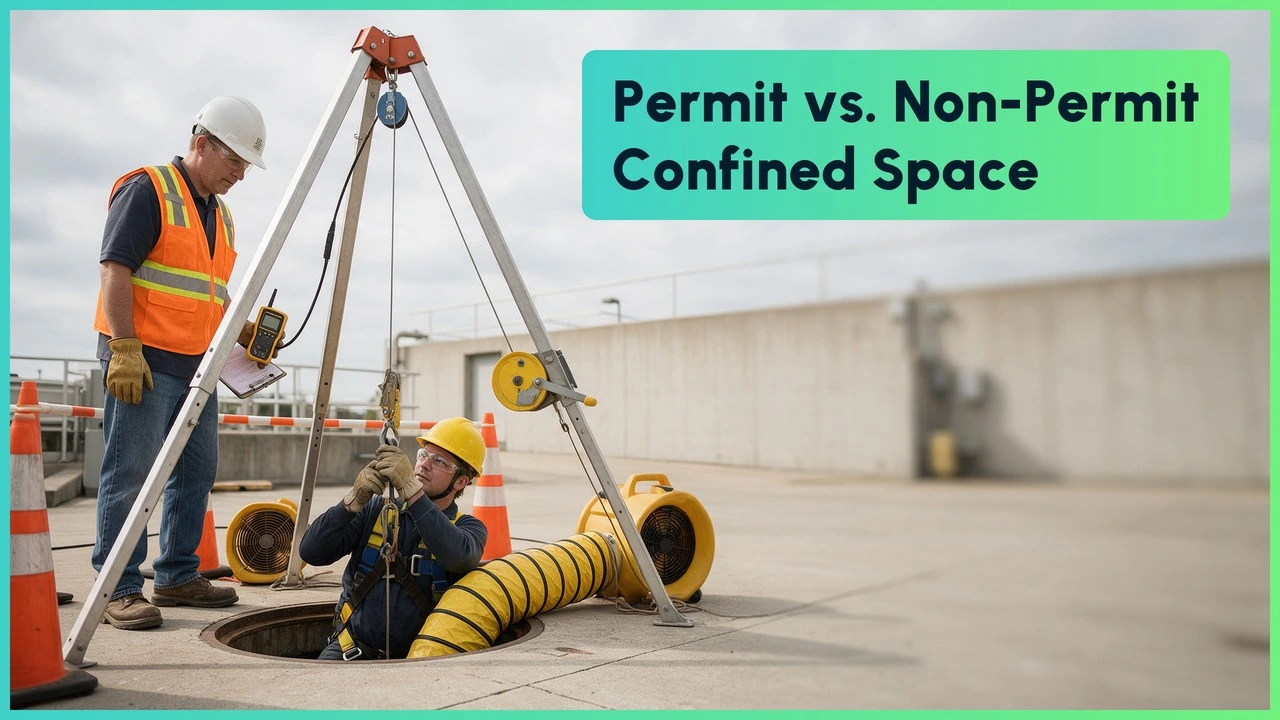
A confined space needs a permit when something inside it could kill or seriously hurt the person who goes in. That means a hazardous atmosphere, material that could bury them, a shape that could trap them, or another serious hazard (29 CFR 1910.146(b)). Every permit-required space is a confined space, but not every confined space needs a permit. The same tank can be either one, depending on the job.
OSHA Confined Space Definition
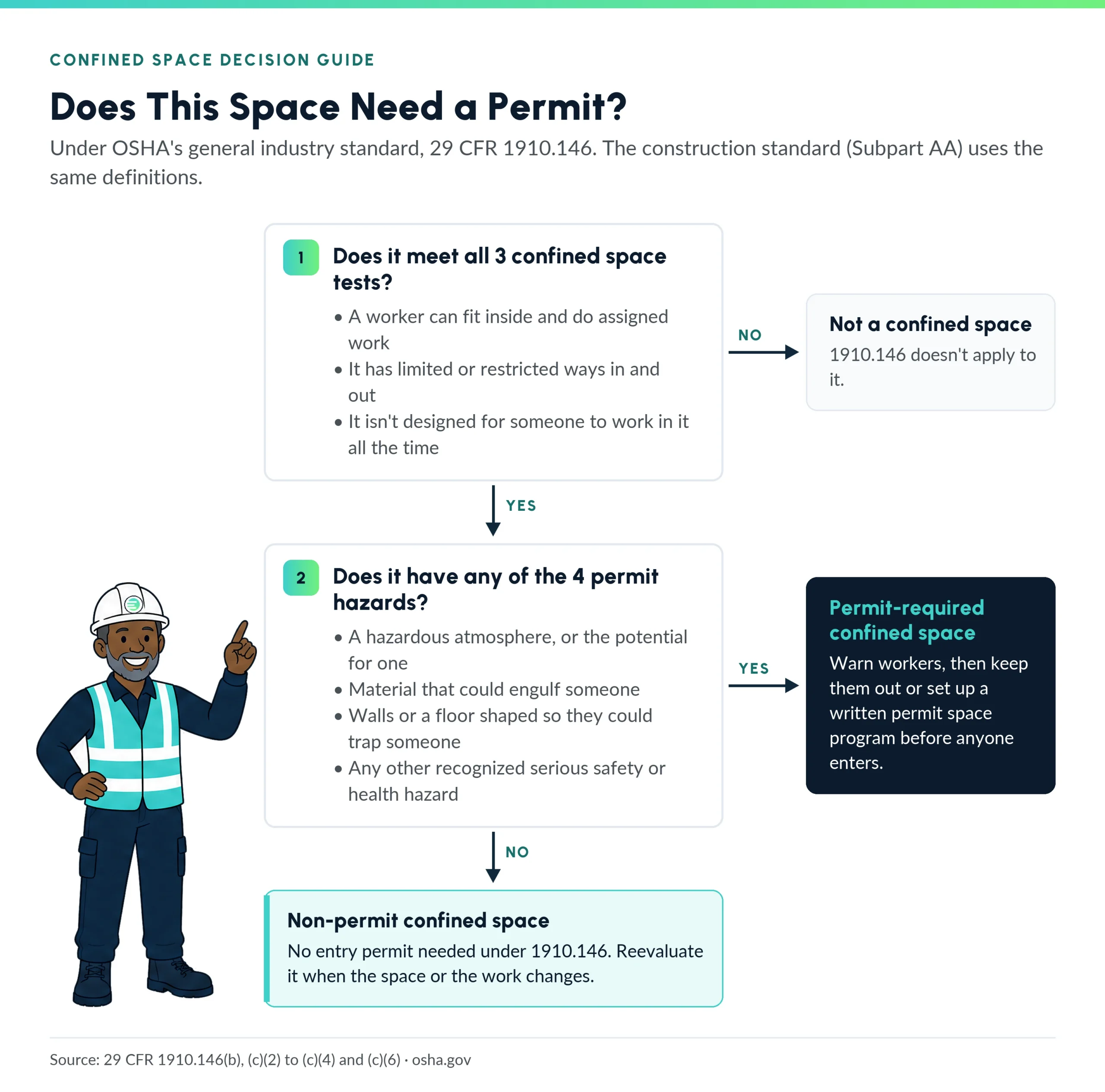
The Occupational Safety and Health Administration (OSHA) calls a space confined when it meets all 3 of these tests (1910.146(b)):
- A worker can fit inside it and do assigned work.
- It has limited or restricted ways in and out.
- It isn’t designed for someone to work in it all the time.
OSHA’s own examples include tanks, vessels, silos, storage bins, hoppers, vaults and pits. A confined space with none of the hazards below is a non-permit confined space.
What Is a Permit-Required Confined Space?
A permit-required confined space (“permit space” for short) has one or more of these hazards (1910.146(b)):
- A hazardous atmosphere, or the potential for one
- Material that could engulf someone, like a liquid or a fine solid that flows, such as grain or sand
- Walls that slope inward or a floor that slopes down and narrows, which could trap or suffocate someone
- Any other recognized serious safety or health hazard
Once you find one, warn exposed workers with danger signs or another equally effective way (1910.146(c)(2)). Then keep everyone out, or set up a written permit space program before anyone enters (1910.146(c)(3) and (c)(4)).

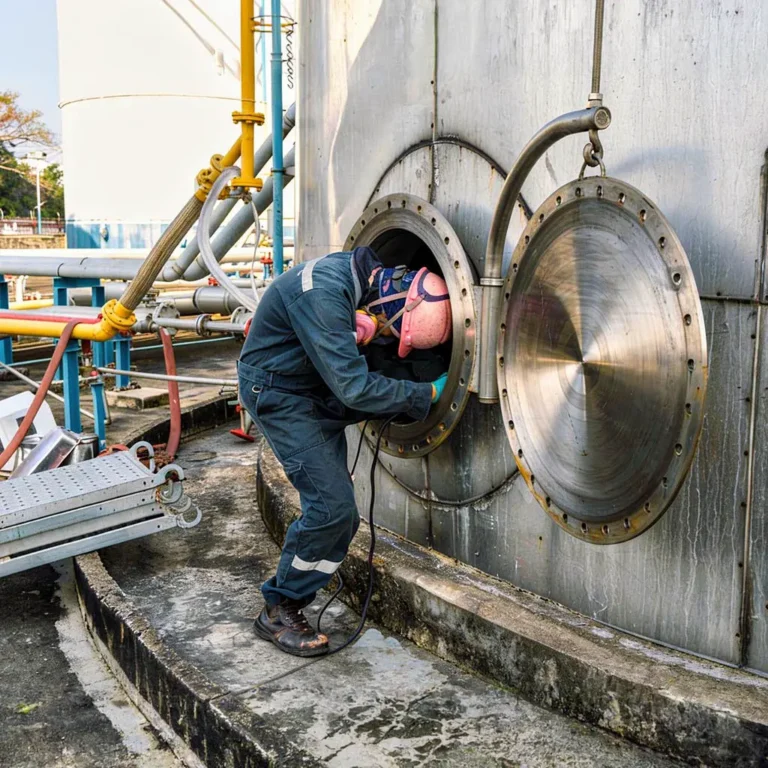
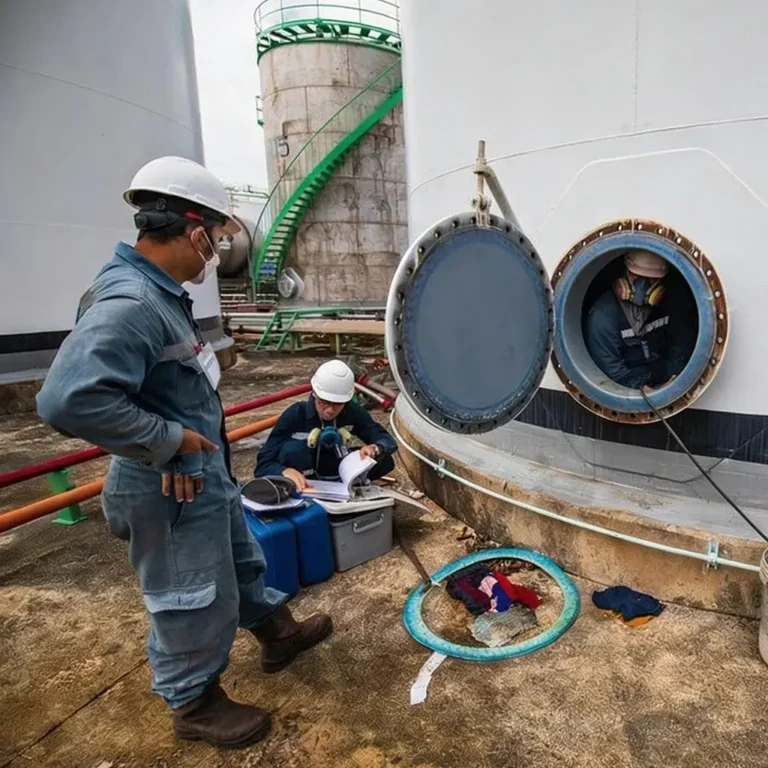
Say your crew needs to repaint the inside of an empty water storage tank. It’s a confined space. A worker fits through the manway, that’s the only way in or out, and nobody works in there day to day. Paint and solvent vapors can build up in a closed tank, which gives this job the potential for a hazardous atmosphere. So it’s a permit space for this job, even if your team treats the tank as non-permit for routine inspections. The permit would also list how the fill and drain lines are blanked or locked out so water can’t come back in.
Permit-Required vs. Non-Permit Confined Spaces at a Glance
Under the general industry standard (1910.146), here’s how the two compare:
| Permit-required confined space | Non-permit confined space | |
|---|---|---|
| What makes it one | One or more of the 4 hazards above | Meets the 3-part definition, with no hazard that could cause death or serious harm |
| Danger signs or other warning | Required (1910.146(c)(2)) | Not required by 1910.146 |
| Written program | Required if workers enter (1910.146(c)(4)) | Not required by 1910.146 |
| Entry permit signed before entry | Required (1910.146(e)(2)) | Not required by 1910.146 |
| Attendant outside the space | Required (1910.146(d)(6)) | Not required by 1910.146 |
| Rescue procedures | Required (1910.146(d)(9)) | Not required by 1910.146 |
| Training under 1910.146(g) | Required for entrants, attendants, entry supervisors and air testers | Not required by 1910.146 |
There’s one exception. If a permit space’s only hazard is its atmosphere, and continuous forced air ventilation alone keeps it safe, you can skip the permit, attendant and rescue procedures (1910.146(c)(5)). You’ll need monitoring data to prove it. Signs, training and an air test before each entry still apply.
In general industry, if your crew services equipment inside that could start up unexpectedly or release stored energy, the lockout/tagout standard applies too (29 CFR 1910.147). Some states run their own OSHA programs and can be stricter, so check whether your state has a State Plan.
Non-Permit Confined Space Checklist
Before anyone enters a space you’ve classed as non-permit, check these. Rules carry their citation; the rest are our recommendations.
- Your company has evaluated the space for all 4 permit hazards (1910.146(c)(1)).
- Nothing about the space or the work has changed since then. If it has, reevaluate it (1910.146(c)(6)).
- If it used to be a permit space, the signed certification is there for everyone going in (1910.146(c)(7)(iii)).
- Equipment you’ll service inside is locked out.
- Everyone knows to get out and report it if a hazard shows up.
Hot work, painting and cleaning with solvents are the jobs we’d always reevaluate for. If you’re not sure which category a space falls into, treat it as a permit space until someone has evaluated it.
Confined Spaces in Construction (29 CFR 1926 Subpart AA)
Since August 3, 2015, construction work has had its own standard: 29 CFR 1926 Subpart AA (1926.1201 to 1926.1213), summarized on OSHA’s construction confined spaces page. It uses the same definitions of confined space and permit space, and adds rules for how job sites run:
- Before work starts, a competent person must identify every confined space your crew may work in and which ones are permit spaces (1926.1203(a)). A competent person can spot the hazards and has the authority to fix them right away (1926.1202).
- The site owner (host employer), the controlling contractor and each entry employer must share what they know about each permit space before entry (1926.1203(h)).
- In permit spaces, the entry employer must monitor air hazards nonstop (1926.1204(e)(2)). It can check at intervals instead only if no one sells a nonstop monitor for that hazard, or the checks come often enough to show the hazard stays at safe levels.
If you’re the general contractor, check your subcontractors’ training before the first entry.
What Goes on a Confined Space Entry Permit?
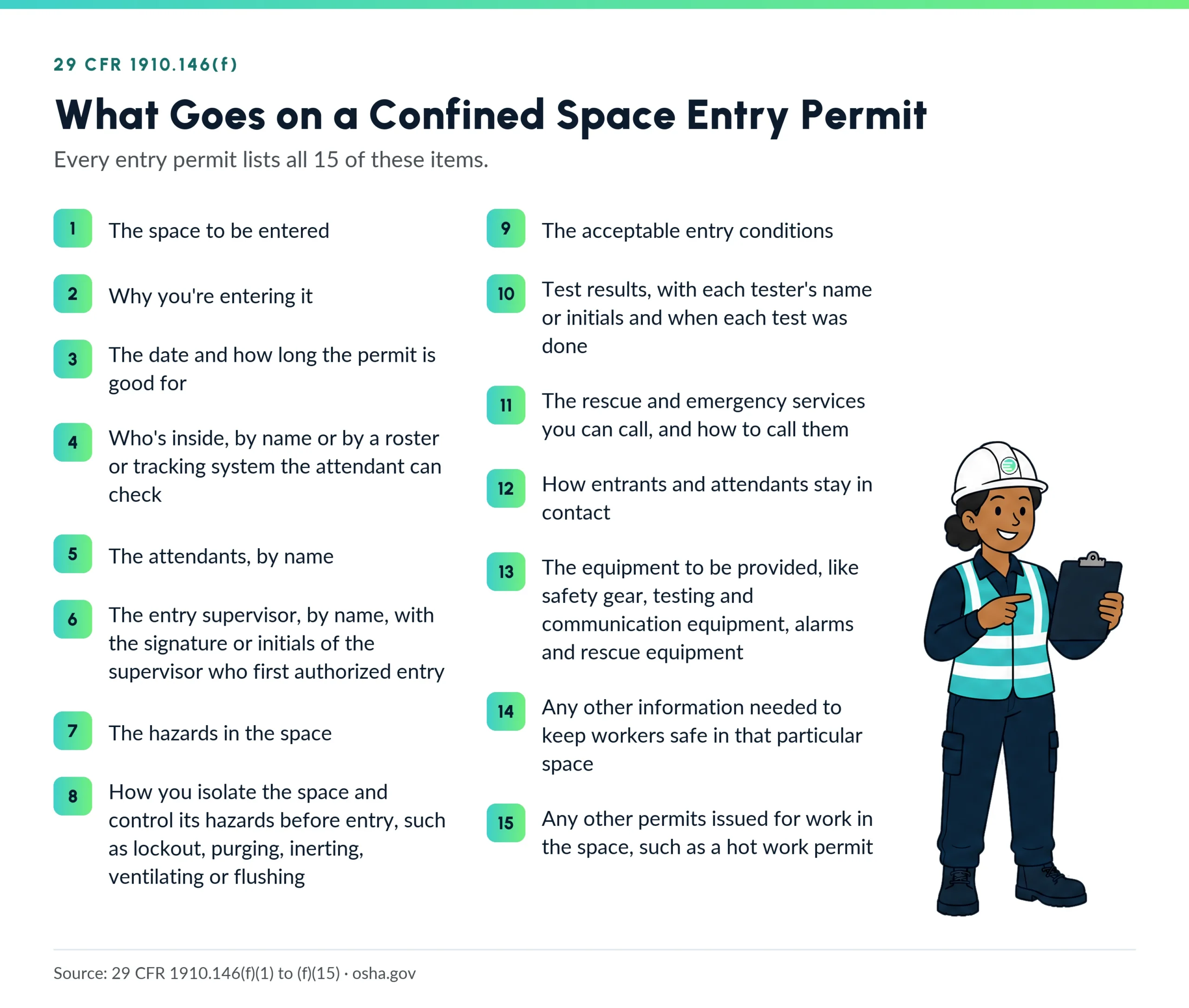
An entry permit is the written or printed document an employer uses to allow and control entry into a permit space (1910.146(b)). It’s posted at the entrance, or shared another way, so entrants can see the prep is done (1910.146(e)(3)). Under 1910.146(f), every permit lists these 15 items:
- The space to be entered
- Why you’re entering it
- The date and how long the permit is good for
- Who’s inside, by name or by a roster or tracking system the attendant can check
- The attendants, by name
- The entry supervisor, by name, with the signature or initials of the supervisor who first authorized entry
- The hazards in the space
- How you isolate the space and control its hazards before entry, such as lockout, purging, inerting, ventilating or flushing
- The acceptable entry conditions
- Test results, with each tester’s name or initials and when each test was done
- The rescue and emergency services you can call, and how to call them
- How entrants and attendants stay in contact
- The equipment to be provided, like safety gear, testing and communication equipment, alarms and rescue equipment
- Any other information needed to keep workers safe in that particular space
- Any other permits issued for work in the space, such as a hot work permit
Here’s an example of a filled-in confined space entry permit:
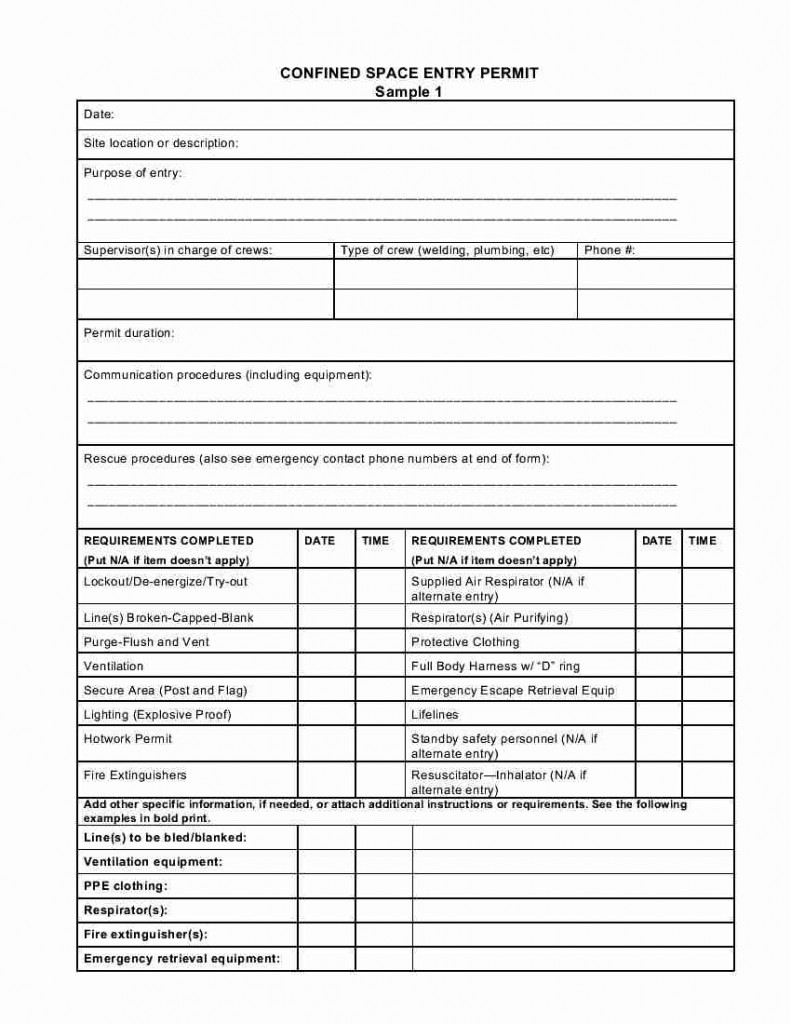
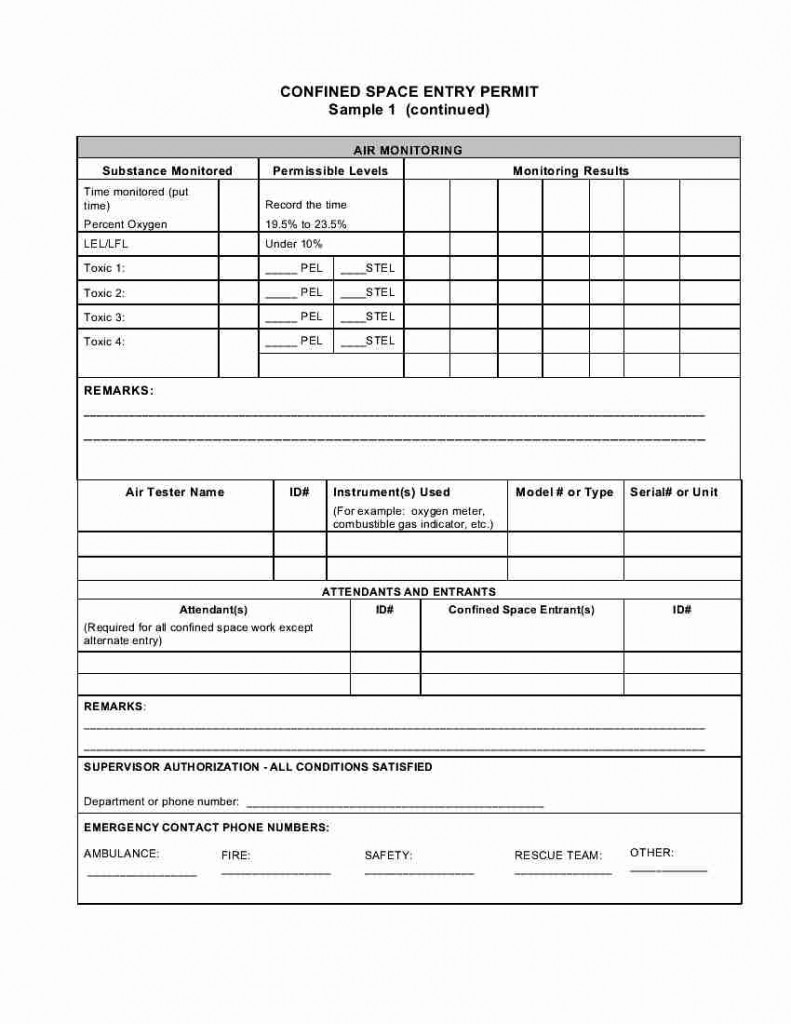
You don’t have to buy a permit template. OSHA publishes free sample permits in Appendix D to 1910.146, and it considers their elements compliant (note to 1910.146(e)(1)).
Why the Distinction Matters
The category decides which safeguards are in place when someone goes in. Call a permit space non-permit, and the testing, the attendant and the rescue plan won’t be there.
The Bureau of Labor Statistics (BLS) counted 1,030 workers killed in incidents involving a confined space from 2011 to 2018 (BLS, July 2020). Breathing in a harmful substance killed 126 of them, and being engulfed by collapsing material (not counting trench collapses) killed 98.
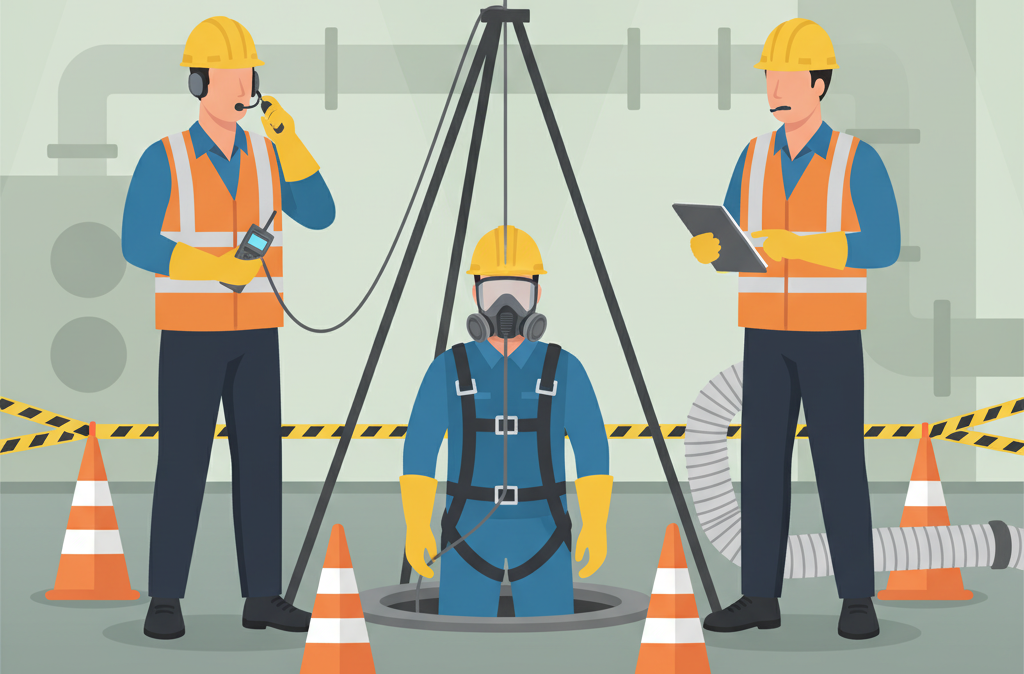
An attendant may go in for a rescue only if your permit program allows it, they’re trained and equipped for rescue, and another attendant has taken over (1910.146(i)(4)). Each person on the entry team has a defined job, and here’s who does what.
Training for Permit Space Work
Your employer must train everyone whose work 1910.146 regulates before they’re first assigned those duties (1910.146(g)). That includes entrants, attendants, entry supervisors and the people who test the air. If no one on your team does any of those jobs, you may not need confined space training. Here’s how to tell.
Entrants and attendants can start with our 2-hour Confined Space course, which covers 1910.146 and Subpart AA. Entry supervisors have more duties, and the 8-hour Confined Space Supervisor course covers them. Crews who only work in construction can take Confined Space in Construction, built on Subpart AA.
Online training covers the knowledge. Your employer still has to make sure people have the skills for your own spaces, and certify the training with names, trainer initials and dates (1910.146(g)(1) and (g)(4)).
The Confined Space course is $20 a seat (October 2026), so 10 people cost $200 before the volume discount for teams of 5 or more. It includes a sample entry permit and written program you can download.
Frequently Asked Questions
Who is responsible for authorizing entry into a permit-required confined space?
The entry supervisor. They check that the tests are done and the procedures and equipment are in place, then sign the permit (1910.146(e)(2) and (j)(2)).
Who is responsible for monitoring the atmosphere in a permit-required confined space?
The people your employer designates to test or monitor the air (1910.146(d)(8)). They test before entry and keep testing or monitoring during the work (1910.146(d)(5)). Test oxygen first, then combustible gases and vapors, then toxic ones. The entry supervisor checks the tests before signing the permit.
How long does a confined space permit last?
No longer than the job it covers (1910.146(e)(4)). The entry supervisor cancels it when the work is done or a condition the permit doesn’t allow comes up. Keep canceled permits for at least 1 year (1910.146(e)(5) and (e)(6)).
Can a permit-required confined space be reclassified as non-permit?
Yes. Once every hazard in it is eliminated, it can be reclassified for as long as the hazards stay eliminated (1910.146(c)(7)). If someone has to go in to remove a hazard, that entry follows the full permit rules. Document the change with a signed certification. Running a fan to control bad air doesn’t count as eliminating that hazard.
Sources: OSHA, BLS