

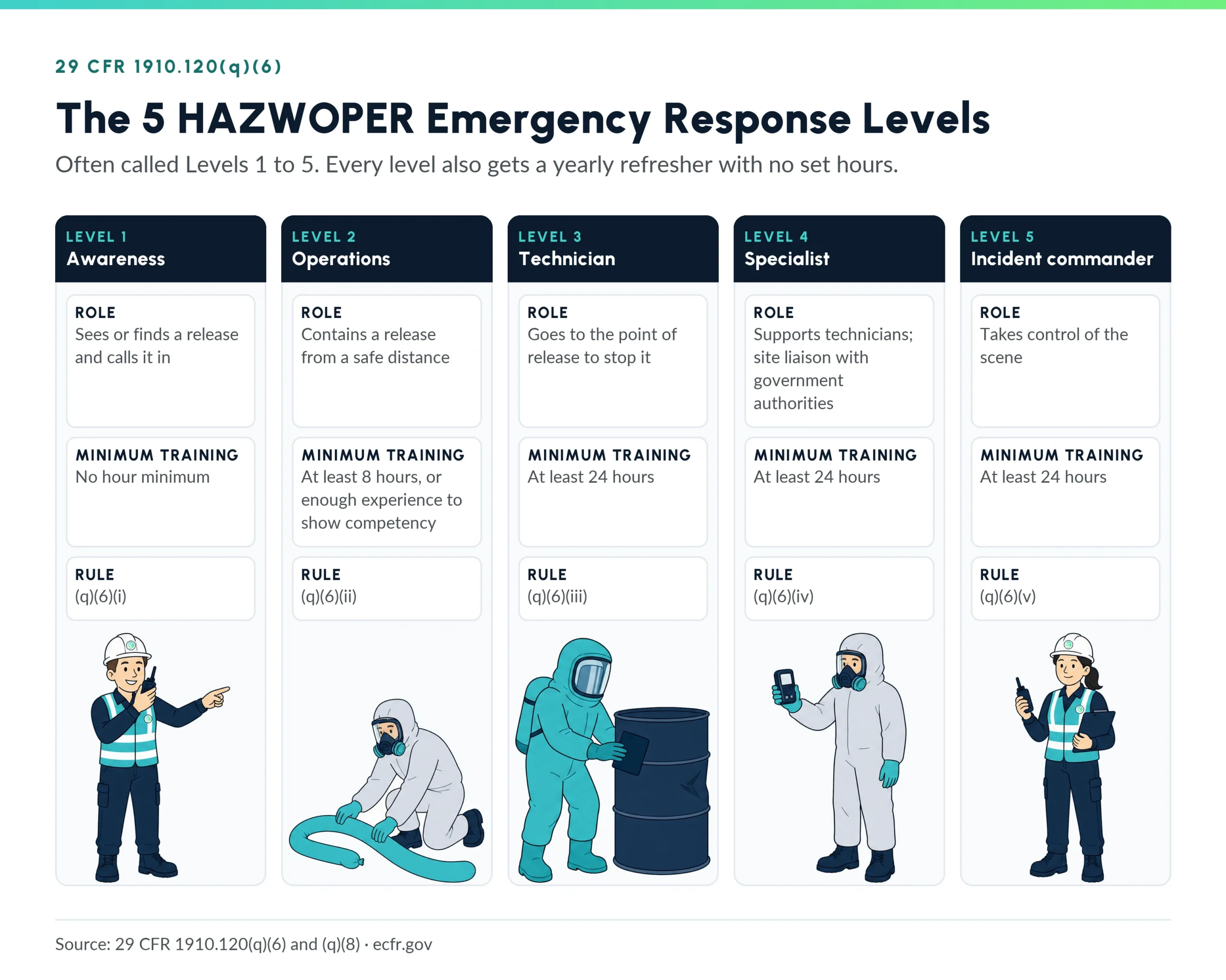
There are 5 HAZWOPER training levels for emergency responders, set by the Hazardous Waste Operations and Emergency Response standard in 29 CFR 1910.120(q)(6). Awareness has no hour minimum, and operations takes at least 8 hours (or enough experience to show competency). Technician, specialist and incident commander each take at least 24 hours. The phrase “HAZWOPER levels” can also mean the site cleanup worker courses under 1910.120(e). Those take 40 or 24 hours, plus an 8-hour refresher every year.
The Occupational Safety and Health Administration (OSHA) lists the responder levels by name. They’re often called Level 1 to 5.
HAZWOPER covers emergency response to hazardous substance releases, wherever they happen (1910.120(a)(1)(v)). It also covers some hazardous waste site cleanups and treatment, storage and disposal (TSD) facilities. Our guide to HAZWOPER training requirements by worker type explains who’s covered in each group.
The Levels of HAZWOPER Training at a Glance
Hours are minimums. Each citation is a paragraph of 1910.120.
| Level or tier | Role | Minimum hours | Refresher | Citation |
|---|---|---|---|---|
| Emergency responders, 1910.120(q) | ||||
| Awareness | Sees or finds a release and calls it in | No hour minimum | Yearly, no set hours | (q)(6)(i), (q)(8) |
| Operations | Contains a release from a safe distance | 8, or enough experience to show competency | Yearly, no set hours | (q)(6)(ii), (q)(8) |
| Technician | Goes to the point of release to stop it | 24 | Yearly, no set hours | (q)(6)(iii), (q)(8) |
| Specialist | Supports technicians; site liaison with government authorities | 24 | Yearly, no set hours | (q)(6)(iv), (q)(8) |
| Incident commander | Takes control of the scene | 24 | Yearly, no set hours | (q)(6)(v), (q)(8) |
| Cleanup site and TSD facility workers, 1910.120(e) and (p) | ||||
| 40-hour site worker | General site worker at a cleanup site | 40, plus 3 days of supervised field experience | 8 hours a year | (e)(3)(i), (e)(8) |
| 24-hour site worker | Occasional or low-exposure site worker | 24, plus 1 day of supervised field experience | 8 hours a year | (e)(3)(ii) and (iii), (e)(8) |
| Site manager or supervisor | Supervises cleanup site workers | 40 and 3 field days (or 24 and 1), plus 8 more | 8 hours a year | (e)(4), (e)(8) |
| TSD facility worker | Exposed worker at a TSD facility | 24 | 8 hours a year | (p)(7) |
The 5 HAZWOPER Training Levels for Emergency Responders
Your employer trains each responder for their duties before their first real emergency (1910.120(q)(6)). You’ll also see these called hazmat training levels, short for hazardous materials. If you’re in construction, 29 CFR 1926.65 sets the same 5 levels.
1. First Responder Awareness Level
This level is for people likely to see or find a hazardous substance release. They start the response by notifying the proper authorities. After that, they don’t take any further action (1910.120(q)(6)(i)).
There’s no hour minimum. They need enough training or experience to objectively show they can:
- Explain what hazardous substances are and their risks in an incident
- Understand what can happen in an emergency involving them
- Recognize hazardous substances in an emergency
- Identify them, if possible
- Know their role in your emergency response plan, including site security and the Department of Transportation’s Emergency Response Guidebook
- See when more help is needed and notify the communication center
Example: a lab worker finds a leaking container. They pull the alarm, call security or 911, and alert the on-site hazmat team.
2. First Responder Operations Level
Operations responders are part of the first response to a release (1910.120(q)(6)(ii)). They protect nearby people, property or the environment from it. They work defensively and don’t try to stop the release. Their job is to contain it from a safe distance, keep it from spreading and prevent exposures.
They need at least 8 hours of training, or enough experience to objectively show competency. They keep the 6 awareness skills and add these:
- Basic hazard and risk assessment
- Picking and using the personal protective equipment (PPE) they’re given
- Basic hazardous materials terms
- Basic control, containment or confinement with the gear their unit has
- Basic decontamination
- The standard operating procedures and termination procedures that apply
Your employer certifies their competency.
Example: an operator shuts off a pump remotely, covers a drain and lays absorbent around the spill.
3. Hazardous Materials Technician
Technicians respond to stop the release (1910.120(q)(6)(iii)). They go to the point of release to plug, patch or stop it, not contain it from a distance.
They need at least 24 hours of training equal to the operations level. They also need these 9 skills:
- Carrying out your emergency response plan
- Classifying, identifying and verifying known and unknown materials with field survey instruments
- Working in an assigned role in the Incident Command System (ICS)
- Picking and using specialized chemical PPE
- Hazard and risk assessment
- Advanced control, containment or confinement
- Decontamination
- Termination procedures
- Basic chemical and toxicological terms and behavior
Your employer certifies each technician’s competency.
Example: 2 technicians in chemical protective suits walk up to a leaking tote and patch the hole.
4. Hazardous Materials Specialist
Specialists respond with technicians and support them (1910.120(q)(6)(iv)). Their duties parallel the technician’s, with more specific knowledge of the substances involved. They also act as the site liaison with federal, state, local and other government authorities.
They need at least 24 hours of training equal to the technician level, plus these 9 skills:
- Carrying out the local emergency response plan
- Classifying, identifying and verifying materials with advanced survey instruments
- Knowing about the state emergency response plan
- Picking and using specialized chemical PPE
- In-depth hazard and risk techniques
- Specialized control, containment or confinement
- Choosing and carrying out decontamination procedures
- Developing a site safety and control plan
- Chemical, radiological and toxicological terms and behavior
Your employer certifies them. Specialists also get a baseline physical exam and medical surveillance (1910.120(q)(9)(i)).
Example: a plant chemist trained as a specialist tells the technicians which neutralizer to use, then briefs the fire chief.
5. On-Scene Incident Commander
The incident commander takes control of the scene beyond the awareness level (1910.120(q)(6)(v)). In a response, the senior emergency response official on scene takes charge of your site’s ICS (1910.120(q)(3)(i)).
They need at least 24 hours of training equal to the operations level, plus these 6 skills:
- Knowing and running your incident command system
- Carrying out your emergency response plan
- The hazards of working in chemical protective clothing
- Carrying out the local emergency response plan
- Knowing about the state emergency response plan and the Federal Regional Response Team
- Why decontamination matters
Your employer certifies them.
Example: when the alarm sounds, the plant’s emergency coordinator takes command, sends in the technicians and calls the fire department.
Annual Refresher Training
Responders at all 5 levels get refresher training every year (1910.120(q)(8)(i)). There’s no set number of hours. The training just has to keep their skills current, or they can show competency at least once a year instead. Your employer writes a statement of the training or competency. If it’s a competency statement, they also record how it was shown (1910.120(q)(8)(ii)).
Cleanup site workers and their supervisors take 8 hours of refresher training a year (1910.120(e)(8)). TSD workers take 8 hours a year too (1910.120(p)(7)). For site workers, that’s what our 2026 8 Hour HAZWOPER Refresher is for.
HAZWOPER Training Levels vs. the 40-, 24- and 8-Hour Courses
The 40-hour, 24-hour and 8-hour courses train hazardous waste cleanup site workers under 1910.120(e). They’re a separate track from the 5 responder levels. Which one applies depends on the work and the exposure. Our HAZWOPER Training Requirements by Worker Type guide walks you through it.
Our OSHA 40 Hour HAZWOPER and OSHA 24 Hour HAZWOPER courses cover the off-site hours online. You’ll do the supervised field days on the job, under a trained, experienced supervisor (1910.120(e)(3)).
Which Level Do You Need?
Each person needs the HAZWOPER level that matches what they’ll do in a release (1910.120(q)(6)). First, decide whether your people will respond at all.
If you’ll evacuate and won’t let any employee help handle the emergency, paragraph (q) doesn’t apply. You need an emergency action plan under 29 CFR 1910.38 instead (1910.120(q)(1)). Not sure which side you’re on? Read Does Your Facility Need HAZWOPER Training?
Some releases don’t count as emergency response (1910.120(a)(3)). These are incidental releases. Workers in the immediate area or maintenance staff can absorb, neutralize or control them at the time.
Skilled support personnel don’t need a level. That’s someone like a crane or earthmoving operator brought in for urgent work your crew can’t do in time. Before they start, they get a site briefing on PPE, the chemical hazards and their duties (1910.120(q)(4)).
Then match each person to the most they’ll do. Someone who only calls it in needs awareness. If they’ll contain it from a distance, that’s operations. Going to the source to stop it takes technician training. Whoever takes control of the scene trains as incident commander. We’d write each person’s level into your emergency response plan, so nobody has to guess during a spill.
Training a Plant Spill Team
Say you run a plant and want your own team to handle chemical spills. Your operators train to the operations level. They’ll shut off pumps, cover drains and keep a spill from spreading. You pick 2 people to train as technicians, so there’s someone to go to the leak and stop it. As your designated hazmat team, they also get a baseline physical and medical surveillance (1910.120(q)(9)(i)). Your shift supervisor trains as incident commander and takes control when the alarm sounds.
Our 24-Hour Hazmat Technician Training is $179 a seat (Nov 2026). For your 2 technicians, that’s 2 x $179 = $358.
Where to Start
If someone on your team will stop leaks at the source, start with our 24-Hour Hazmat Technician Training. It covers the 24 hours of training online. As the employer, you still certify each technician’s competency (1910.120(q)(6)(iii)). We recommend a hands-on check with your own equipment before anyone signs.
We don’t sell awareness, operations, specialist or incident commander courses, so you’ll need another source for those.
Frequently Asked Questions
How many hours of training does a hazmat technician need?
At least 24 hours of training equal to the operations level (1910.120(q)(6)(iii)). They also need 9 skills, and their employer certifies their competency.
What’s the difference between 24-hour and 40-hour HAZWOPER?
16 hours of training and 2 days of field experience. General site workers need 40 hours plus 3 supervised field days (1910.120(e)(3)(i)). Occasional or low-exposure workers need 24 hours plus 1 day (1910.120(e)(3)(ii) and (iii)). A 24-hour worker who becomes a general site worker or needs a respirator adds the difference (1910.120(e)(3)(iv)).
How often do emergency responders need refresher training?
Every year (1910.120(q)(8)(i)). There’s no set number of hours, as long as the training keeps their skills current. The 8-hour yearly rule is for site workers.
Is there a minimum number of hours for awareness level training?
No. Awareness responders need enough training or experience to objectively show 6 skills (1910.120(q)(6)(i)).
What training does an incident commander need?
At least 24 hours of training equal to the operations level, plus 6 skills (1910.120(q)(6)(v)). They cover the incident command system, the employer’s, local and state response plans, protective clothing hazards and decontamination. Their employer certifies their competency.
Sources: OSHA