

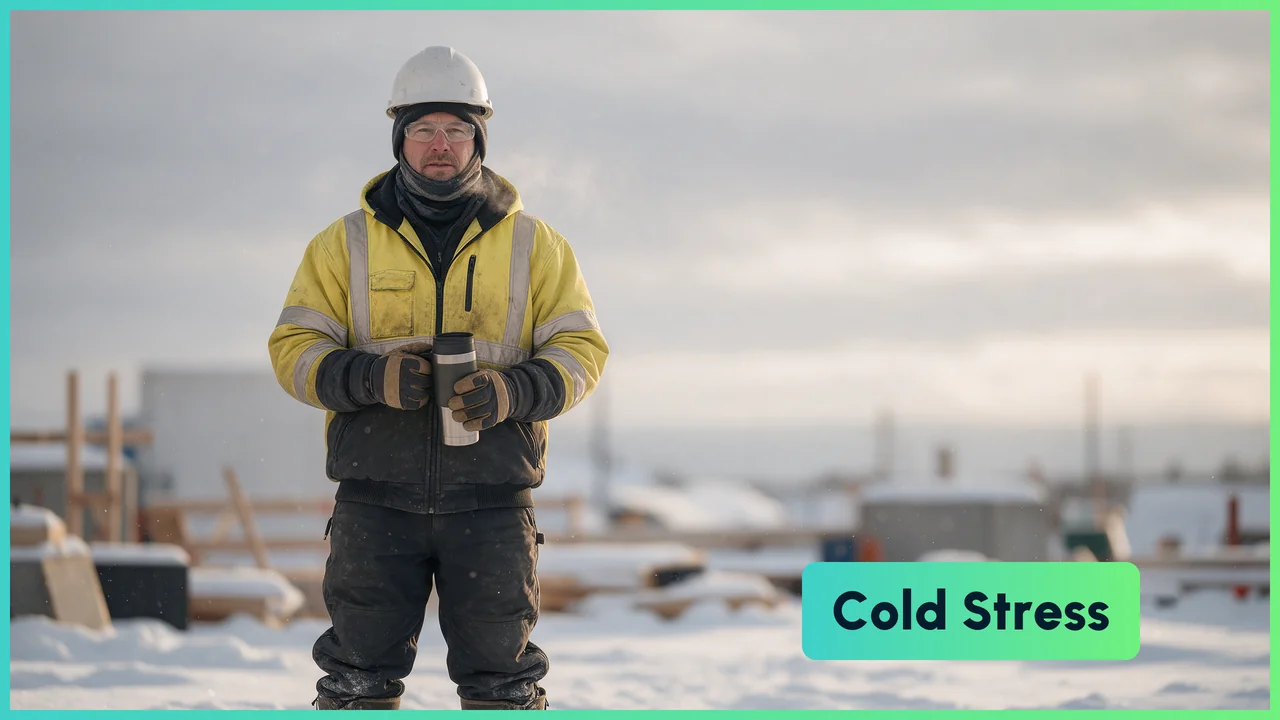
Cold stress is what happens when your body loses heat faster than it can make it. It starts well above freezing. The Occupational Safety and Health Administration (OSHA) says hypothermia can set in above 40°F if you’re wet. Rain, sweat or cold water all count. There are 4 kinds of cold stress: hypothermia, frostbite, trench foot and chilblains. Each has its own warning signs, and the first ones are easy to brush off as “just cold.”
This post is for the foreman deciding whether the crew keeps working and the safety lead writing the winter plan. It’s also for the human resources manager who needs to show training happened, and the worker standing in the sleet. For clothing layers, icy footing and keeping equipment running, read our winter safety tips for construction workers. This one stays on recognizing cold stress and what to do about it.
What Is Cold Stress?
Cold stress is the strain on your body when the air, wind and wetness around you pull heat away. They pull it faster than you can replace it. OSHA describes it as cold driving down your skin temperature first, then your core temperature. Wind speeds that up (that’s wind chill), and so does wet clothing, including the sweat from hard work.
The OSHA cold stress page names 3 things that raise your risk. They’re wet or damp clothing, dressing wrong for the conditions, and exhaustion. Health conditions such as high blood pressure, hypothyroidism and diabetes add to it, and so does poor physical conditioning. The National Institute for Occupational Safety and Health (NIOSH) adds one more. In regions that don’t get much winter, near-freezing weather is enough to count as a risk.
Cold Stress Symptoms by Type
The 4 types show up differently. The first signs matter most, because that’s when a warm truck cab still fixes the problem.
| Condition | What it is | Early signs | Serious signs |
|---|---|---|---|
| Hypothermia | Core body temperature falls below 95°F (normal is 98.6°F) | Uncontrollable shivering while still alert | Shivering stops, confusion, slurred speech, clumsy movements, slow pulse and breathing, passing out |
| Frostbite | Skin and tissue freeze, usually hands and feet, nose or ears. It can occur above freezing because of wind chill | Numbness, tingling, aching, reddened skin | Gray or white patches, skin that feels firm or hard, blisters. Severe cases can mean amputation |
| Trench foot | A non-freezing injury from feet that stay wet and cold for hours. Possible at air temperatures up to 60°F | Redness, tingling, numbness, swelling | Leg cramps, blisters, bleeding under the skin, gangrene |
| Chilblains | Painful inflammation of small blood vessels after repeated exposure to cold from just above freezing up to 60°F | Redness, itching | Blistering, inflammation, ulcers in severe cases |
Sources: OSHA, Winter Weather: Cold Stress, and OSHA Quick Card 3156, Protecting Workers from Cold Stress.
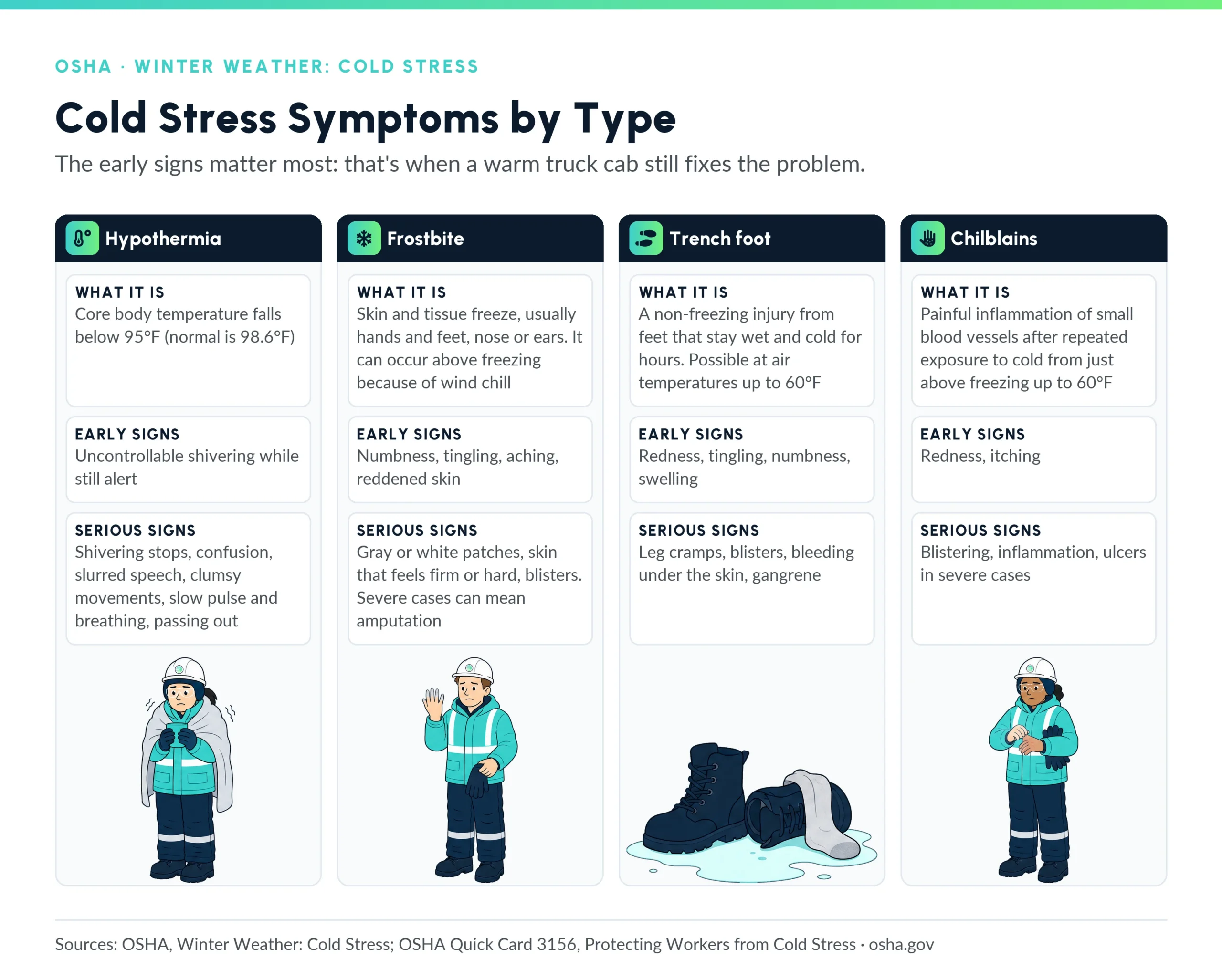
Shivering is the one to watch. It’s your body’s first defense. When it stops without the worker warming up, hypothermia has moved from mild to serious.
What to Do in the First 10 Minutes
Call 911 for anyone with the serious signs above, then start warming them while you wait. OSHA’s Quick Card lays out the steps.
For hypothermia:
- Move the worker somewhere warm. A heated cab counts.
- Get wet clothes off and dry ones on.
- Cover the whole body, head and neck included, with blankets and a wind barrier such as a tarp. Leave the face uncovered.
- If medical help is more than 30 minutes away and the worker is alert, give warm, sweet drinks. No alcohol.
- Put heat packs in the armpits, on the sides of the chest, at the neck and in the groin. Call 911 for further rewarming instructions.
For frostbite, follow the hypothermia steps, then protect the frozen part:
- Don’t rub it.
- Don’t walk on frostbitten feet.
- Don’t put snow or water on it, and don’t break blisters.
- Cover it loosely. Don’t try to rewarm it unless medical personnel tell you to.
For trench foot, get the wet boots and socks off and air-dry the feet in a warm area. Keep them raised, keep the worker off them, and get medical attention.
If your crew is remote, the 30-minute rule in step 4 is the one to plan around. Know before the shift starts how far help is. When no clinic or hospital is near the work, OSHA requires trained first aid personnel and supplies on site (29 CFR 1910.151(b)). In construction, 1926.50 says the same. Our First Aid & CPR Essentials course covers first aid and cardiopulmonary resuscitation (CPR) for any cold-weather emergency.
A quick example
Picture a utility crew restoring lines after an ice storm. It’s 38°F with sleet, and one lineman has been in a bucket for 3 hours with a soaked jacket. He’s shivering hard and says he’s fine. That’s mild hypothermia. The fix is a warm truck, dry clothes and a hot drink before he goes back up. An hour later, if the shivering has stopped and he’s fumbling his tools and slurring, it’s an emergency. Call 911 and start the steps above.
The crew’s buddy system is what catches it in the first hour instead of the second. Nobody spots their own confusion.
If you’re the worker, the duty to plan for cold is your employer’s. You don’t need to buy a course to work in the cold. Ask your supervisor what the plan is, and watch your partner.
Does OSHA Require Cold Stress Training?
No, there’s no specific OSHA cold stress standard. OSHA still expects you to protect workers from recognized hazards. That duty comes from Section 5(a)(1) of the Occupational Safety and Health Act, the General Duty Clause. Cold stress is a recognized hazard.
What OSHA recommends is specific enough to build a plan from. Its cold stress page says employers should:
- train workers to recognize cold stress conditions and symptoms, prevent them, and help a coworker who’s affected. Train them to pick clothing for cold, wet and windy work
- monitor workers’ physical condition, especially new workers and anyone coming back after time away
- schedule frequent short breaks in warm, dry areas and schedule the work for the warmest part of the day
- use a buddy system
- provide warm, sweet drinks (no alcohol) and high-carbohydrate snacks
- keep bare skin off cold metal and wet surfaces
- add engineering controls such as radiant heaters where the work allows
Some states run their own OSHA state plans, and a state plan can be stricter than federal OSHA. Check your state’s rule before you write yours, and treat the federal list as the floor.
What a Cold Stress Plan Looks Like
A workable plan fits on one page and answers 4 questions.
Who’s exposed? OSHA’s Quick Card names freezer work, outdoor agriculture and construction. NIOSH adds anyone in poorly insulated or unheated areas, or outdoors without shelter. Utility and loading dock crews belong on your list too, whether or not it snows where you are.
When does the plan kick in? Pick a trigger before the season, so the foreman isn’t deciding in the moment. OSHA sets no number. We recommend a wind chill reading your crews already check, plus any day the work is wet. Below it, the shorter rotations and warm breaks start.
What changes on a cold day? Shorter rotations, a heated break area and warm drinks on site. Each worker gets a buddy, and anyone working alone gets a check-in schedule.
What’s in the kit? NIOSH recommends adding a thermometer and chemical hot packs to the first aid kit. Keep spare socks, gloves, hats, jackets and blankets on the truck.
Clothing is its own topic, and our winter safety post covers layering. The short version from OSHA’s Quick Card is loose, insulating layers and an insulated jacket. Add gloves and a hat (waterproof if needed) and insulated, waterproof boots.
If your crews also work through summer heat, the same planning habit applies in reverse. Our Heat Illness Prevention course covers that side.
Training Your Crew for Cold Stress
Our Cold Stress course covers the 4 conditions and their stages and the risk factors. It teaches the early warning signs in yourself and a coworker. It also covers first aid, work and warm-up schedules, and supervisor duties. It’s self-paced, runs 1.5 to 2 hours, in English only, and costs $29 per seat (November 2026). Pass the final exam at 70% and the certificate prints right away. It’s part of what you’ll show an inspector who asks how you addressed the hazard.
Say that utility crew has 12 people heading into storm season. That’s 12 seats at $29, or $348. A business account lets you buy the seats together, watch progress on one dashboard, and export the report. The buddy assignments and the heated truck are still yours to arrange. The course makes sure everyone on the crew knows what they’re watching for.
Frequently Asked Questions
Does OSHA require cold stress training?
No. OSHA has no specific cold stress standard. The General Duty Clause (Section 5(a)(1) of the OSH Act) still requires a workplace free from recognized hazards. OSHA recommends prevention programs that include training.
What is the difference between hypothermia and frostbite?
Hypothermia is a whole-body drop in core temperature below 95°F and can be fatal. Frostbite is localized freezing of skin and tissue, usually fingers, toes, ears or nose. Both need prompt first aid.
What are the first signs of cold stress?
Uncontrollable shivering, for hypothermia, and numbness or tingling with reddened skin, for frostbite. Both are the point to get the worker warm and dry. Confusion, slurred speech or shivering that stops means call 911 (OSHA, Winter Weather: Cold Stress).
At what temperature does cold stress start?
There’s no single number. OSHA says hypothermia can occur above 40°F when a worker is wet. Trench foot can occur at air temperatures up to 60°F with constantly wet feet. Frostbite can occur above freezing in wind chill. Wetness and wind matter as much as the thermometer.
Sources: OSHA, NIOSH