

Electrocution Awareness or Full Electrical Safety Training?
This course is written for the worker who is not an electrician. The longer electrical safety course goes after the people who actually open panels.
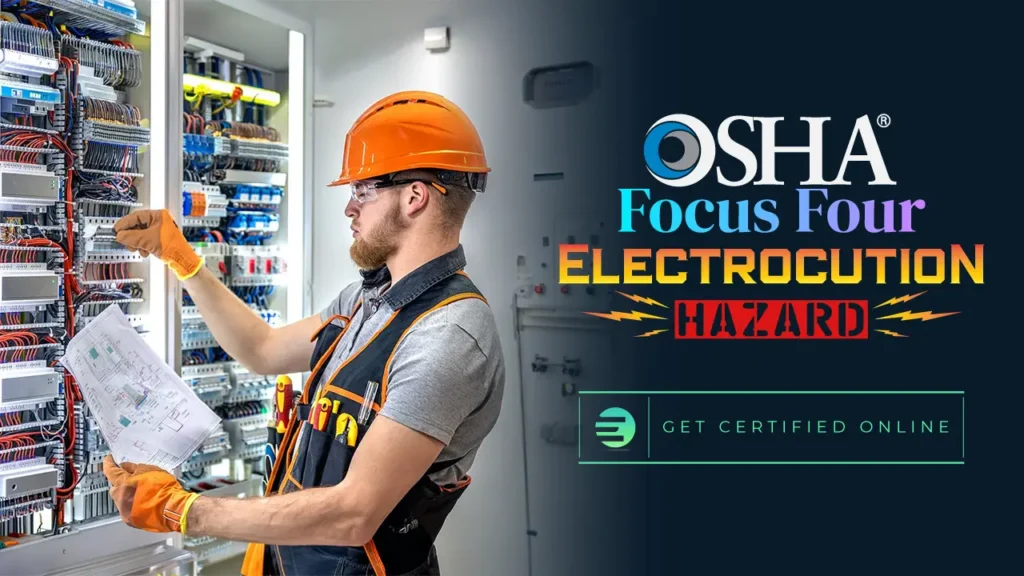
- OSHA Focus Four: Electrocution. The page you are on. 30 minutes on the three ways construction workers get electrocuted, and how to stay clear.
- Electrical Safety Course. The longer course, covering arc flash, approach boundaries, PPE and safe work practices in more depth. View the Electrical Safety Course
- OSHA's Construction Focus Four. This course plus the other three Focus Four hazards, in one 3-hour enrollment. View the OSHA's Construction Focus Four
Awareness first for the whole crew, then the deeper course for anyone who works on or near energized equipment as part of the job.
What Does OSHA Require Against Electrocution on a Jobsite?
Subpart K of the construction standards carries most of the duties, and the course is built around the four that come up most.
- Ground-fault protection is not optional. The employer must use either ground-fault circuit interrupters or an assured equipment grounding conductor program on construction sites (29 CFR 1926.404(b)(1)(i)).
- Guard the live parts. Live parts operating at 50 volts or more must be guarded against accidental contact, including by elevation of 8 feet or more above the floor (1926.403(i)(2)).
- Lock it out. Controls that are to be deactivated during work on energized or de-energized equipment must be tagged, and de-energized circuits must be rendered inoperative with tags attached (1926.417).
- Only qualified people work it live. Only qualified persons may work on electric circuit parts or equipment that have not been de-energized (1926.416(a)(1) and the definition in 1926.449).
The AEGCP route is the harder one: it needs a written program, daily visual inspections and recorded continuity and terminal tests (1926.404(b)(1)(iii)).