

Featured Courses
Previously trained hazardous waste workers complete required OSHA annual refresher certification training

2026 8 Hour HAZWOPER Refresher

Annual 8-hour HAZWOPER refresher meeting OSHA 29 CFR 1910.120(e)(8) requirements.
Comprehensive lithium battery safety safety training for workers and workplace for workplace compliance

Lithium Battery Safety

Covers what happens when lithium batteries fail and how to prevent fires and explosions.

View All OSHA Courses

image
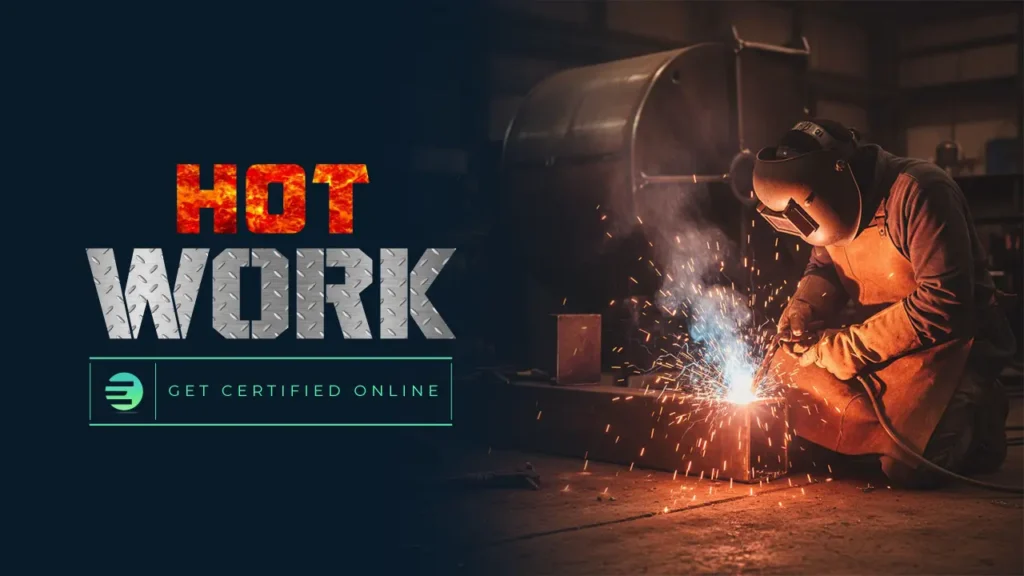
Hot Work

Course Overview

eTraining's Hot Work Training course is built to 29 CFR 1910.251 through 1910.255, OSHA's Subpart Q for welding, cutting and brazing. Four parts cover what counts as hot work and the hazards it carries, fire prevention and the permit system, welding fumes and ventilation, and the compressed gas cylinders, hoses and torches the work runs on.

  • Learn the hot work permit system, who signs it, and what NFPA 51B puts on the form.
  • Work through cylinder storage, hose and regulator rules, and the torch check before each shift.
  • Take it online at your own pace, pass the final exam at 70% and print your Certificate of Completion.

Note: This is an awareness-level program. It is assumed that participants already possess the necessary skills to perform hot work operations. eTraining also offers a separate Fire Watch course for workers assigned specifically to fire watch duties.

  • 2 hours, self-paced
  • Instant certificate
  • Mobile friendly
$25.00

Per seat. One-time payment, no subscription.

Total (1 seats x $25.00)
$25.00
− +

30-day satisfaction guarantee. No hidden fees.

Course Clips

Everything You Need to Know
About This Course

The course runs four parts. Each one closes with its own quiz at 70% to pass, and the quiz can be retaken until you pass it.

  • What counts as hot work: welding, cutting, brazing, soldering, grinding and pipe thawing.
  • The hazards: fire, explosion, welding fumes, toxic coatings, electric shock and falls.
  • The chemistry of fire, flash point, and the lower and upper explosive limits.
  • Eye and face protection: welding lenses, shade numbers, goggles and face shields.
  • Leather clothing, gloves, head protection and metatarsal boots for hot work.
  • Electrical hazards: grounding, cable condition and shutting down unattended leads.
  • Fall protection, and keeping cables and hoses clear of walkways and stairs.
  • Basic fire prevention: safe location, removing or shielding combustibles, sweeping the floor.
  • Designated hot work areas, and the conditions where hot work is not permitted at all.
  • Fire extinguishing equipment, the PASS method and what an incipient stage fire is.
  • Fire watch duties, the 35 foot rule and the half hour after the work stops.
  • Welding fumes, metal fume fever and stripping toxic coatings back from the heat.
  • When ventilation is required, and the types of ventilating system.
  • The hot work permit, the Permit Authorizing Individual, and what NFPA 51B puts on the permit.
  • Compressed gas cylinders: marking, storage separation, transport and valve handling.
  • Hoses, regulators and gauges, and inspecting torches at the start of each shift.
  • Employer and employee responsibilities under a written hot work plan.

OSHA Standard29 CFR 1910.251-1910.255
Course Duration2 hours
Format100% online, fully narrated with photos and interactivity
Passing Score70% on final exam
CertificatePersonalized certificate, printable immediately upon passing
LanguagesEnglish
Device CompatibilityDesktop, tablet, and smartphone
ProgressProgress saved automatically, stop and restart without losing your place
Instructor SupportAccess professional instructors for guidance and answers to your course-related questions.
AcceptedOur courses meet federal standards, but state requirements may vary. Please verify before purchase.

Designed for the people who do hot work, the people who authorize it, and the people who happen to be working nearby while it happens.

  • Welders, cutters, braziers and solderers
  • Maintenance workers who perform hot work during repairs
  • Pipefitters and plumbers who solder and braze
  • HVAC technicians who braze and solder
  • Ironworkers and structural steel workers
  • Shipyard workers performing welding and cutting
  • Facility maintenance staff who support hot work
  • Safety officers who run the hot work permit program
  • Supervisors who authorize hot work and sign the permit
  • Anyone working in the vicinity of spark-producing activity

Anywhere a torch, a grinder or a welding arc is part of the working day.

  • Construction and structural steel erection
  • Manufacturing and metal fabrication
  • Oil and gas refining and petrochemical operations
  • Shipbuilding and maritime maintenance
  • Power generation and utility maintenance
  • Pipeline construction and repair
  • HVAC installation and maintenance
  • Automotive and heavy equipment repair
  • Mining and mineral processing
  • Chemical processing and industrial plant maintenance

Hot Work or Fire Watch Training?

A hot work job needs more than one kind of trained person. This course covers the work itself, and a separate course covers the person posted to watch for fires.

  • Hot Work Training. You are on it. Two hours across 29 CFR 1910.251 to 1910.255 for anyone performing hot work or working near it: hazards, permits, ventilation, cylinders and PPE.
  • Fire Watch - General Industry and Construction. One to two hours for the person posted to watch rather than to work. When a watch is required, what they do while the work runs, and the half hour after it stops. View the Fire Watch - General Industry and Construction
  • Welding, Cutting and Brazing Safety. Thirty minutes on the welding work itself, referenced to 29 CFR 1910 Subpart Q and NFPA 51B. The short refresher rather than the full awareness course. View the Welding, Cutting and Brazing Safety
  • Confined Space. Hot work inside a tank, boiler or vessel is two hazards at once. This course says plainly to be confined space trained first, and that a confined space permit may be needed alongside the hot work permit. View the Confined Space

Most crews need this course for the operators and the fire watch course for whoever takes the watch. A worker who does both jobs takes both.


What Goes on a Hot Work Permit?

The permit is the control the whole system hangs on. 29 CFR 1910.252(a)(2)(iv) requires the area to be inspected before cutting or welding is permitted, with the precautions designated preferably as a written permit.

  • Somebody signs it, and that somebody has a name. The course calls them the Permit Authorizing Individual. They inspect the area, confirm it is free of combustibles, review the job safety analysis with the operators and the fire watch, and sign before any work begins.
  • It is good for one day. NFPA 51B has the permit dated and valid for a single day of work, with the location, the floor level and the type of hot work recorded on it. A permit is not a standing arrangement.
  • It records the fire watch decision. The permit confirms the fire watch is present during the work and for 30 minutes after, that they have extinguishers, that they can raise the alarm and reach the fire department, and whether more than one watch is needed above, below or next door.
  • It closes out. The fire watch inspects the area and the adjacent areas 30 minutes after the work, confirms it is safe, and the completed permit goes back to management with the PAI signing off the date and time.

If your site does hot work without that paperwork, the permit is the first thing to fix. The course includes a sample permit to work from.
Verified Course Reviews

Add a review
Hot Work Hot Work
Overall rating*
0/5
* Rating is required
The course clearly stated what I would be able to do after completing it.*
0/5
* Rating is required
By the end of the course, I could do what it said I would be able to do.*
0/5
* Rating is required
The course was easy to navigate and worked reliably on my device.*
0/5
* Rating is required
Write A Review
* Review is required
Name
* Name is required
4.6
Based on 14 reviews
5
86
86%
4
7
7%
3
0%
2
0%
1
7
7%
1-5 of 14 reviews
  1. “In Part 4, on the Employer Responsibilities slide, the text inside the main circle is incorrect. It should be Employer, not Employee. Please fix this. Thank you.”

    (0) (0)
  2. Good course

    (0) (0)
  3. Good

    (0) (0)
  4. effective

    (0) (0)
  5. Great

    (0) (0)

Frequently Asked Questions

Everything you need to know about the Hot Work.

Yes. Upon passing the final exam with a score of 70% or higher, you can immediately print a certificate of completion. This certificate serves as proof of training for your employer.

Yes. The course is accessible on desktop computers, laptops, tablets, and smartphones. Progress saves automatically on the same device, so you can stop and resume where you left off.

No. There's no federal expiration date for this certificate. OSHA expects retraining when your job, equipment or hazards change, or when you show you don't understand the training. Check whether your employer or site sets a refresher schedule.

Hot work training is a safety awareness program that teaches workers how to recognize hazards associated with welding, cutting, brazing, soldering, and other spark-producing activities, and how to comply with OSHA regulations. eTraining’s course provides approximately 2 hours of instruction covering OSHA 29 CFR 1910.251 through 1910.255 (Subpart Q), including hot work hazards, fire prevention, the hot work permit system, ventilation requirements, compressed gas cylinder safety, PPE requirements, fire watch duties, and employee and employer responsibilities. Upon completion, participants receive a printable certificate of completion.

OSHA requires that all employees who perform hot work (welding, cutting, brazing, and other spark-producing activities) or who work in the vicinity of hot work operations be trained on the associated hazards and safe practices. This training is also required for supervisors who authorize hot work through the permit system and for fire watch personnel. Employers must ensure that all workers involved in or near hot work operations understand their responsibilities under OSHA 29 CFR 1910 Subpart Q.

The course takes approximately 2 hours to complete. Because it is self-paced, you can complete it over multiple sessions at your convenience. Most students finish within 1 week. You have 6 months from your enrollment date to complete all coursework. Progress is saved automatically on the same device, so you can stop and resume at any time.

A hot work permit is a written authorization document that must be issued before welding, cutting, or other spark-producing work is performed in areas that are not specifically designated as safe for hot work. The permit documents the location, date, type of work, fire prevention measures in place, and the name of the authorized worker. It also confirms that a fire watch is in place when required. The permit system ensures that all necessary precautions are taken before hot work begins and that responsible personnel are aware of the activity.

The course covers: types and sources of hot work hazards (fire, explosion, fumes, radiation, electrical shock); OSHA 29 CFR 1910.251 through 1910.255 requirements; the hot work permit system; fire prevention measures during hot work; ventilation requirements for welding fumes and gases; compressed gas cylinder safety (storage, handling, and use); personal protective equipment for hot work (welding helmets, gloves, protective clothing); fire watch requirements and responsibilities; employee and employer responsibilities; and designated hot work areas vs. non-designated areas.

Yes. eTraining’s Hot Work Training course covers OSHA 29 CFR 1910.251 through 1910.255 (Subpart Q) standards for welding, cutting, and brazing and is accepted nationwide. You receive a printable certificate of completion that documents your training. Employers, general contractors, and industrial facilities across all 50 U.S. states accept this training for hot work safety compliance.

Hot work training is an awareness-level program for workers who perform or work around welding, cutting, brazing, and other spark-producing operations. It covers the full range of OSHA Subpart Q requirements including hazard recognition, permits, ventilation, cylinder safety, and PPE. Fire watch training specifically focuses on the role and responsibilities of the designated fire watch person, including fire extinguisher use, the 30-minute post-work watch period, and emergency procedures. Workers who serve as both hot work operators and fire watches should complete both courses.

You must score at least 70% on the final exam to pass and receive your certificate of completion. The course includes knowledge-check quizzes that do not count toward your final grade but help prepare you for the exam. If you do not pass on your first attempt, you can retake the exam.

Questions about this course

Didn't find your answer in the FAQ? Ask our team. We'll reply here so other learners can see it too.

Q & A

Ask a question
Your question
* Question is required
Name
* Name is required
There are no questions yet

Better Training. Better Outcomes.

Fifteen years, 200,000+ professionals certified, and a completion rate roughly double the industry average.

OSHA citation printed on every certificate

Your employer and site safety officer can verify compliance at a glance, with no phone calls and no lookups.

No setup. No LMS. Training in minutes.

Pay once, get instant access. No account setup, no downloads, no IT involvement. Works in any browser.

Built for field workers, not classrooms

Grounded in real jobsite operations. Scenarios reflect the work your crew actually does.

Trusted by safety managers & contractors

Used by EHS managers, general contractors and federal site supervisors to keep crews certified on time.

200,000+
Professionals certified
87%
Completion rate (industry avg <45%)
10M+
Hours of training delivered
15
Years in business

Your go-to source for workplace safety updates.

Join our monthly newsletter covering industry stories, news & timely updates, and get a free 110-page OSHA manual covering the latest training requirements.

eTraining and the eTraining logo copyright 2026 eTraining, Inc. All Rights Reserved.