


Construction Appreciation Week · 10% Off Sitewide · Ends Sept 18 · Code
Featured Courses
Previously trained hazardous waste workers complete required OSHA annual refresher certification training

2026 8 Hour HAZWOPER Refresher

Annual 8-hour HAZWOPER refresher meeting OSHA 29 CFR 1910.120(e)(8) requirements.
Comprehensive lithium battery safety safety training for workers and workplace for workplace compliance

Lithium Battery Safety

Covers what happens when lithium batteries fail and how to prevent fires and explosions.

View All OSHA Courses

image

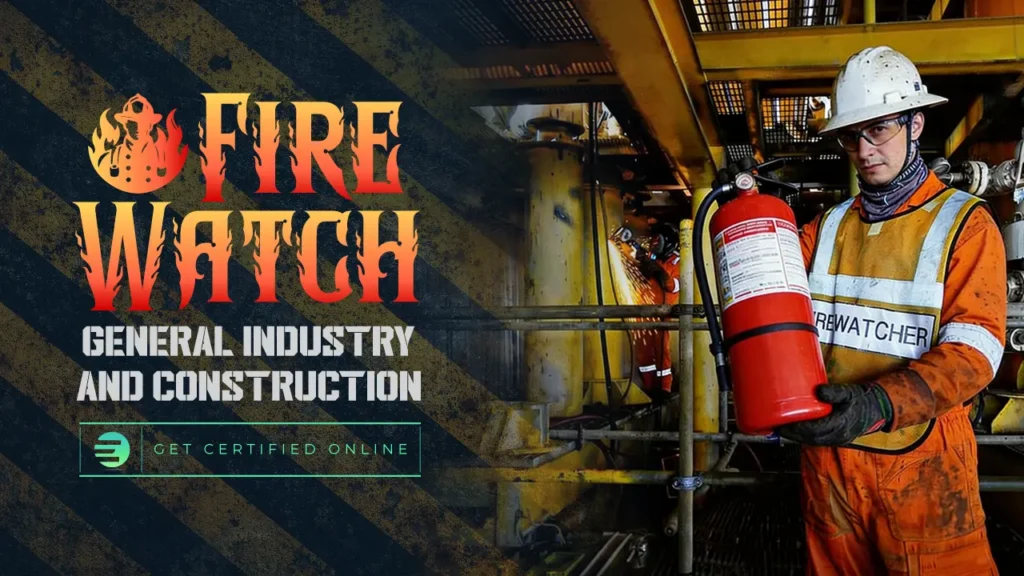
Fire Watch - General Industry and Construction

4.7(9 reviews)
Fire Watch - General Industry and Construction

Course Overview

eTraining's Fire Watch course is built to 29 CFR 1910.252 for general industry and 29 CFR 1926.352 for construction, the two standards that put a fire watch on hot work. Four modules cover when a watch has to be posted, what the watcher does while welding, cutting or brazing is under way, how long they stay after it stops, and which extinguisher to reach for.

  • Learn when OSHA requires a fire watch, including the 35 foot rule and openings in walls and floors.
  • Work through the watcher's duties: area inspection, hot work permits, alarms and post-work monitoring.
  • Take it online at your own pace, pass the final exam at 70% and print your Certificate of Completion.


  • 1-2 hours, self-paced
  • Instant certificate
  • Mobile friendly
$25.00

Per seat. One-time payment, no subscription.

+

30-day satisfaction guarantee. No hidden fees.

Course Clips

Everything You Need to Know
About This Course

The course runs four modules. Each one closes with its own quiz, and a final exam follows the last module.

  • OSHA fire watch rules for general industry: 29 CFR 1910.252.
  • OSHA fire prevention rules for construction: 29 CFR 1926.352 and 29 CFR 1926.24.
  • The role and responsibilities of a fire watch during hot work.
  • When a fire watch has to be posted, including the 35 foot rule.
  • Hot work permits and who authorizes the work.
  • Inspecting the area, then removing or shielding combustible materials.
  • Watching for fires while the work runs and after it stops.
  • Fire extinguisher classes and picking the right one for the fire.
  • Sounding the alarm and calling for emergency response.
  • Emergency action plans and fire prevention plans: 29 CFR 1910.38.
  • Eye, face, body and respiratory protection for hot work: 29 CFR 1910.133.
  • How NFPA 51B lines up with the OSHA standards.
  • What the employer has to provide, brief and document.

OSHA Standard29 CFR 1910.252, 29 CFR 1910.38
Course Duration1-2 hours
Format100% online, fully narrated with photos and interactivity
Passing Score70% on final exam
CertificatePersonalized certificate, printable immediately upon passing
LanguagesEnglish
Device CompatibilityDesktop, tablet, and smartphone
ProgressProgress saved automatically, stop and restart without losing your place
Instructor SupportAccess professional instructors for guidance and answers to your course-related questions.
AcceptedOur courses meet federal standards, but state requirements may vary. Please verify before purchase.

Designed for the person posted on the watch, and for whoever decides that a watch is needed before the torch comes out.

  • Workers designated as fire watch during welding, cutting or brazing
  • Welders, cutters and braziers who take a turn on the watch
  • Safety officers who run the hot work permit program
  • Construction site supervisors overseeing hot work
  • Maintenance workers who perform or support hot work
  • Shipyard and maritime workers performing hot work
  • Oil and gas refinery workers involved in hot work
  • Facility staff who support welding and cutting contractors
  • Industrial plant workers in areas where hot work happens
  • Anyone assigned fire watch duties during spark-producing work

Anywhere a spark can land on something that burns.

  • Commercial and industrial construction
  • Oil and gas refining and petrochemical operations
  • Shipbuilding and maritime operations
  • Manufacturing and fabrication shops
  • Power generation and utility plants
  • Pipeline construction and maintenance
  • Mining and mineral processing
  • Government and military facility maintenance
  • Demolition and site remediation
  • Chemical processing plants

Fire Watch or Hot Work Training: Which One?

Four eTraining courses cover the same welding and cutting work from different angles. What the person does on site decides which one they need.

  • Fire Watch - General Industry and Construction. You are on it. One to two hours for the person posted to watch: when a watch is required, what the watcher does while the work runs, and how long they stay after it stops.
  • Hot Work Training. Two hours for the people holding the torch, across 29 CFR 1910.251 to 1910.255. Wider than this course: permits, ventilation, gas cylinders and PPE as well as fire watch duties. View the Hot Work Training
  • Welding, Cutting and Brazing Safety. Thirty minutes on the welding work itself, referenced to 29 CFR 1910 Subpart Q and NFPA 51B. The short refresher for a crew that already knows the job. View the Welding, Cutting and Brazing Safety
  • OSHA Emergency Action Plans. Thirty minutes on 29 CFR 1910.38(a), the plan a fire watch follows once the alarm sounds. For the person writing that plan rather than the person watching. View the OSHA Emergency Action Plans

One person watches, the others work. Buy this course for whoever is posted on the watch, and the hot work course for the crew doing the cutting.


What Does OSHA Require a Fire Watch to Be Trained In?

One sentence puts the duty in place. 29 CFR 1910.252(a)(2)(iii)(B) says fire watchers shall have fire extinguishing equipment readily available and be trained in its use.

  • Trained in the equipment, not just handed it. The standard pairs the extinguisher with the training in the same sentence. Putting a worker next to a fire extinguisher they have never used does not meet it.
  • Posted whenever the work is near what burns. 29 CFR 1910.252(a)(2)(iii)(A) calls for a fire watch where more than a minor fire might develop, including combustibles within 35 feet and wall or floor openings that expose combustibles next door.
  • Kept there after the torch goes off. The same paragraph holds the fire watch for at least a half hour after the welding or cutting ends. That window is when slag and heated metal are still capable of starting something.
  • Construction says it differently. 29 CFR 1926.352(e) asks for personnel to guard against fire during the work and for a sufficient period after it, instructed on the anticipated fire hazards and how the firefighting equipment is used. No fixed half hour.

Two standards, one job. The course teaches both because the product is sold for both.
Verified Course Reviews

Add a review
You must be logged in to post a review Log In
4.7
Based on 9 reviews
5
78
78%
4
11
11%
3
11
11%
2
0%
1
0%
1-2 of 9 reviews
  1. Helpful and understanding

    (0) (0)
  2. First time doing a fine training, ? learned alot of information

    (0) (0)

Frequently Asked Questions

Everything you need to know about the Fire Watch - General Industry and Construction.

Yes. Upon passing the final exam with a score of 70% or higher, you can immediately print a certificate of completion. This certificate serves as proof of training for your employer.

Yes. The course is accessible on desktop computers, laptops, tablets, and smartphones. Progress saves automatically on the same device, so you can stop and resume where you left off.

There is no federally mandated expiration date for this training certificate. However, health and safety plans should be reviewed and updated annually, and whenever workplace conditions, hazards, or regulations change. Refresher training is recommended to stay current with evolving OSHA standards and best practices for safety program management.

   OSHA 29 CFR 1910.252(d)(1)(vi) requires that fire watchers be trained in the use of fire extinguishing equipment. Any worker who may be designated as a fire watch during hot work operations should complete this training. This includes workers on construction sites, in manufacturing plants, at refineries, in shipyards, and in any facility where welding, cutting, or brazing is performed. Employers are responsible for ensuring that fire watch personnel are properly trained before they are assigned fire watch duties.

The course covers: OSHA regulations for fire watch (29 CFR 1910.252, 1910.38); the role, duties, and responsibilities of a fire watch person; when a fire watch is required during hot work; fire prevention and hazard identification during welding, cutting, and brazing; the 30-minute minimum post-hot-work watch period; types of fire extinguishers and their proper use; the hot work permit system; emergency response procedures; and the relationship between fire watch requirements and the employer’s Emergency Action Plan.

  OSHA 29 CFR 1910.252(d)(1)(v) requires that a fire watch be maintained for at least 30 minutes after welding, cutting, or brazing operations are completed. This is because sparks, slag, and heat from hot work can smolder in combustible materials and ignite a fire after the work has stopped. The fire watch must remain in the area, alert and ready to use extinguishing equipment, for the full 30-minute period.

  Fire watch training is a safety education program that teaches workers the role and responsibilities of a fire watch person during hot work operations (welding, cutting, brazing, and other spark-producing activities). eTraining’s course provides approximately 1–2 hours of instruction covering OSHA 29 CFR 1910.252 and 29 CFR 1910.38 standards, including the fire watch person’s duties, fire prevention during hot work, hazard identification, the 30-minute post-hot-work watch period, fire extinguisher types and use, emergency procedures, and the hot work permit system. Upon completion, participants receive a printable certificate of completion.

  Yes. eTraining’s Fire Watch course covers OSHA 29 CFR 1910.252 and 29 CFR 1910.38 standards and is accepted nationwide. You receive a printable certificate of completion that documents your training. Employers, general contractors, and refineries across all 50 U.S. states accept this training for fire watch compliance during hot work operations.

  A fire watch is a designated person whose sole responsibility during hot work operations is to watch for fires and be ready to use fire extinguishing equipment. Under OSHA 29 CFR 1910.252, a fire watch is required whenever welding, cutting, brazing, or other spark-producing work is performed in locations where more than a minor fire could develop, where combustible materials are closer than 35 feet, where wall or floor openings could allow sparks to reach combustible materials, or where combustible materials on the other side of walls or ceilings could be ignited by conduction or radiation.

You must score at least 70% on the final exam to pass and receive your certificate of completion. The course includes knowledge-check quizzes that do not count toward your final grade but help prepare you for the exam. If you do not pass on your first attempt, you can retake the exam.

Better Training. Better Outcomes.

Fifteen years, 200,000+ professionals certified, and a completion rate roughly double the industry average.

OSHA citation printed on every certificate

Your employer and site safety officer can verify compliance at a glance, with no phone calls and no lookups.

No setup. No LMS. Training in minutes.

Pay once, get instant access. No account setup, no downloads, no IT involvement. Works in any browser.

Built for field workers, not classrooms

Grounded in real jobsite operations. Scenarios reflect the work your crew actually does.

Trusted by safety managers & contractors

Used by EHS managers, general contractors and federal site supervisors to keep crews certified on time.

200,000+
Professionals certified
87%
Completion rate (industry avg <45%)
10M+
Hours of training delivered
15
Years in business

Your go-to source for workplace safety updates.

Join our monthly newsletter covering industry stories, news & timely updates, and get a free 110-page OSHA manual covering the latest training requirements.

eTraining and the eTraining logo copyright 2026 eTraining, Inc. All Rights Reserved.