

Featured Courses
Previously trained hazardous waste workers complete required OSHA annual refresher certification training

2026 8 Hour HAZWOPER Refresher

Annual 8-hour HAZWOPER refresher meeting OSHA 29 CFR 1910.120(e)(8) requirements.
Comprehensive lithium battery safety safety training for workers and workplace for workplace compliance

Lithium Battery Safety

Covers what happens when lithium batteries fail and how to prevent fires and explosions.

View All OSHA Courses

image

Materials Handling

4.4(8 reviews)
Materials Handling

Course Overview

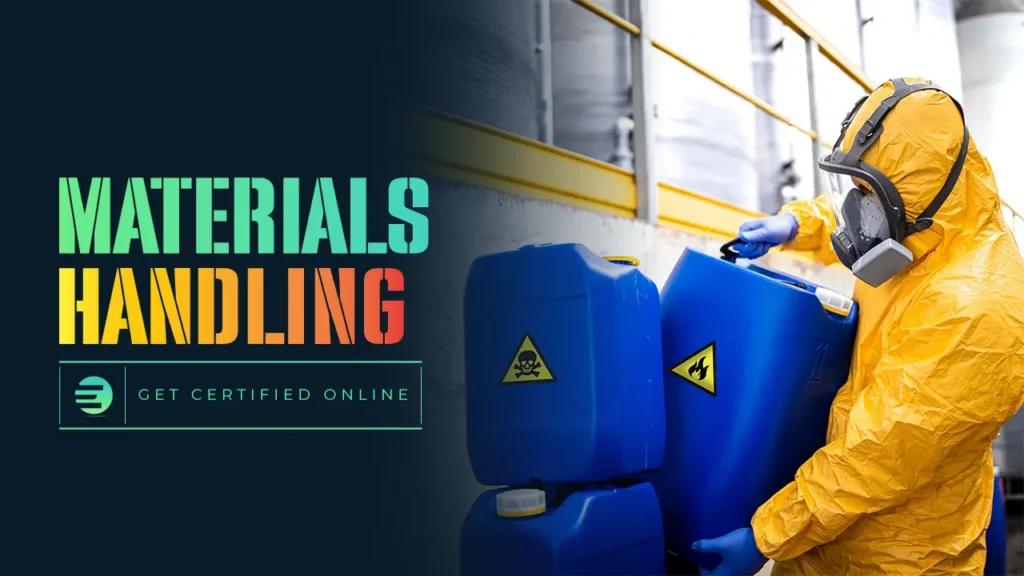
Materials Handling Course for crews that move drums, containers and loads by hand and by machine. Four parts cover the hazards, the crane and rigging requirements, conveyors and forklifts, and the limits a stack has to be built to.

  • Covers drum and container handling, including toxics, shock-sensitive wastes and partly filled drums.
  • Walks through rigging hardware and sling angles, and why a 30 degree angle triples the load on a leg.
  • Gives the stacking numbers for lumber, brick, block, bags and drums that a storage area is judged on.
  • Self-Paced
  • Instant certificate
  • Mobile friendly
$39.00

Per seat. One-time payment, no subscription.

+

30-day satisfaction guarantee. No hidden fees.

Course Clips

Everything You Need to Know
About This Course

The Materials Handling course runs in four parts, and each part ends with a quiz. Parts 1 and 2 cover the basic concepts and the hazards, Part 3 the requirements and definitions for cranes, hoists and slings, and Part 4 conveyors, forklifts and storage.

  • Manual handling: lifting technique, hand trucks, pallet jacks, winches, hoists and lift tables.
  • Mechanical handling: cranes, slings, powered industrial trucks, conveyors and earth-moving equipment.
  • Specialty handling: drums and containers, hazardous waste, shock-sensitive materials, tanks and flammables.
  • Housekeeping and loading dock hazards, including dockboards, wheel chocks and corner mirrors.
  • Hazards by equipment type, from conveyor nip points to crane tip-overs and power line contact.
  • Hazard controls for conveyors, motor vehicles and the three sling materials.
  • Definitions used in the regulations: slings, rigging, hoists, derricks, winches and lift trucks.
  • Crane requirements: load charts, boom radius, outriggers, and pre-lift checks.
  • Hoist and auxiliary equipment: wire rope care, eyebolts, shackles, hooks, wire rope clips and spreader beams.
  • Sling types, hitches, sling angles and how angle multiplies the load on each leg.
  • Sling inspection, removal-from-service criteria and storage.
  • Conveyor guarding, emergency stops, lockout and tagout, and safe start-up.
  • Forklift basics: the stability triangle, load limits, ramps, trailers and daily operator checks.
  • Stacking and storage limits for lumber, brick, masonry block, bags, baled paper and drums.

OSHA StandardOSHA 29 CFR 1910 Subpart N
Format100% online, self-paced
Passing Score70% on final exam
CertificatePrintable certificate of completion available immediately upon passing
LanguagesEnglish
Device CompatibilityDesktop, tablet, and smartphone
ProgressProgress saved automatically, stop and restart without losing your place
Instructor SupportAccess professional instructors for guidance and answers to your course-related questions.
AcceptedOur courses meet federal standards, but state requirements may vary. Please verify before purchase.

The Materials Handling course is for anyone who moves material, whether by hand, by sling or by machine, and for the supervisors running those operations.

  • Workers who handle drums and containers, including toxic and hazardous contents.
  • Riggers, signal crews and anyone working on or near cranes.
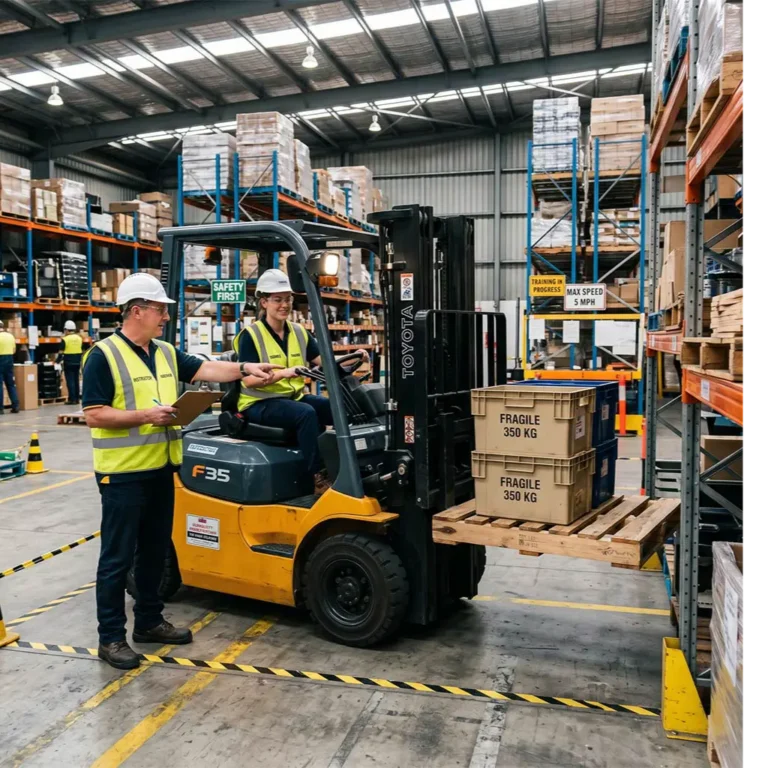
  • Forklift and powered industrial truck operators.
  • Loading dock, shipping and shipyard workers.
  • Warehouse and storage facility staff handling bulk materials.
  • Conveyor operators and the maintenance crews who service them.
  • Workers on hazardous waste cleanup and remediation sites.
  • Earth-moving and excavation equipment operators.
  • Laborers doing manual lifting, stacking and carrying.
  • Supervisors overseeing material handling at industrial or construction sites.

These are the operations where material moves constantly, and where a dropped load, a shifting drum or a collapsing stack is the injury waiting to happen.

  • Hazardous waste cleanup and remediation
  • Chemical manufacturing and processing
  • Construction and demolition
  • Warehousing and distribution centres
  • Oil and gas extraction and refining
  • Shipping, loading docks and shipyards
  • Mining and earth-moving operations
  • Steel erection and heavy civil work
  • Environmental services and consulting
  • Industrial maintenance and facility management

Materials Handling for Hazardous Waste Crews

On a cleanup site, moving drums is the job. These three courses cover the handling, the site-wide training and the lifting technique behind it.

  • Materials Handling Course. The page you are on. Covers drum and container handling, shock-sensitive wastes, rigging, and how to stack and store what comes off the site.
  • OSHA 40-Hour HAZWOPER Training Online. The full site worker course for hazardous waste operations, covering the wider requirements of working on a cleanup. View the OSHA 40-Hour HAZWOPER Training Online
  • Ergonomics Training for the Site Worker. Covers lifting technique and the body mechanics behind the manual handling injuries this course flags. View the Ergonomics Training for the Site Worker

Materials Handling is the drum and load course. The other two cover the site around it and the worker doing the lifting.


OSHA Stacking and Storage Limits for Materials

A storage area is one of the few parts of a site with hard numbers attached. 29 CFR 1926.250 gives them, and the Materials Handling course teaches each one.

  • Brick and block. Brick stacks stop at 7 feet, tapering back 2 inches per foot above the 4-foot mark. Masonry blocks taper back half a block per tier above 6 feet.
  • Lumber. Lumber stops at 16 feet by hand and 20 feet with a forklift, stacked level on solidly supported sills, with nails pulled from used stock.
  • Bags and baled paper. Bagged material is stepped back and cross-keyed at least every 10 bags high. Baled paper and rags stay 18 inches clear of walls, partitions and sprinkler heads.
  • Drums, barrels and kegs. Stacked symmetrically, blocked on the bottom tier if stored on their sides, and separated by planks or pallets between tiers when stacked on end.

Those numbers are what an inspector measures against, and what the course puts in front of a crew.


Verified Course Reviews

Add a review
You must be logged in to post a review Log In
4.4
Based on 8 reviews
5
50
50%
4
37
37%
3
13
13%
2
0%
1
0%
1-2 of 8 reviews
  1. It was a effective course

    (0) (0)
  2. Good course for the right job…

    (0) (0)

Frequently Asked Questions

Everything you need to know about the Materials Handling.

Yes. Upon passing the final exam with a score of 70% or higher, you can immediately print a certificate of completion. This certificate serves as proof of training for your employer.

Yes. The course is accessible on desktop computers, laptops, tablets, and smartphones. Progress saves automatically on the same device, so you can stop and resume where you left off.

  eTraining’s Materials Handling course is an online training program that teaches workers how to safely handle drums and containers, including those containing toxic substances. The course covers hazard recognition, hazard controls, storage requirements, cranes, hoists and auxiliary equipment, excavation equipment, and regulatory definitions. It is designed to help workers avoid accidents by recognizing unsafe conditions and preventing personal injury during manual and mechanical material movement.

   This course is a good fit for anybody who handles drums and containers, works on or near cranes, performs any form of earth moving, transports or moves materials (specifically hazardous materials), loading dock and shipyard workers, and others in similar roles.

  The course covers hazards, hazard controls, requirements, definitions, cranes, hoists and auxiliary equipment, storage, and excavation equipment. It teaches workers how to recognize potential hazards associated with material handling tasks and avoid personal injury from manually and mechanically moving materials.

The course is self-paced and can be completed at your own speed. The total time depends on the individual learner. You can pause and resume as needed.

  Yes. The course is relevant for employees and employers in manufacturing, construction, warehousing, and logistics. It is designed for individuals who handle, move, or store materials as part of their job responsibilities.  

Better Training. Better Outcomes.

Fifteen years, 200,000+ professionals certified, and a completion rate roughly double the industry average.

OSHA citation printed on every certificate

Your employer and site safety officer can verify compliance at a glance, with no phone calls and no lookups.

No setup. No LMS. Training in minutes.

Pay once, get instant access. No account setup, no downloads, no IT involvement. Works in any browser.

Built for field workers, not classrooms

Grounded in real jobsite operations. Scenarios reflect the work your crew actually does.

Trusted by safety managers & contractors

Used by EHS managers, general contractors and federal site supervisors to keep crews certified on time.

200,000+
Professionals certified
87%
Completion rate (industry avg <45%)
10M+
Hours of training delivered
15
Years in business

Your go-to source for workplace safety updates.

Join our monthly newsletter covering industry stories, news & timely updates, and get a free 110-page OSHA manual covering the latest training requirements.

eTraining and the eTraining logo copyright 2026 eTraining, Inc. All Rights Reserved.