

Featured Courses
Previously trained hazardous waste workers complete required OSHA annual refresher certification training

2026 8 Hour HAZWOPER Refresher

Annual 8-hour HAZWOPER refresher meeting OSHA 29 CFR 1910.120(e)(8) requirements.
Comprehensive lithium battery safety safety training for workers and workplace for workplace compliance

Lithium Battery Safety

Covers what happens when lithium batteries fail and how to prevent fires and explosions.

View All OSHA Courses

image

Barricade Safety

Barricade Safety

Course Overview

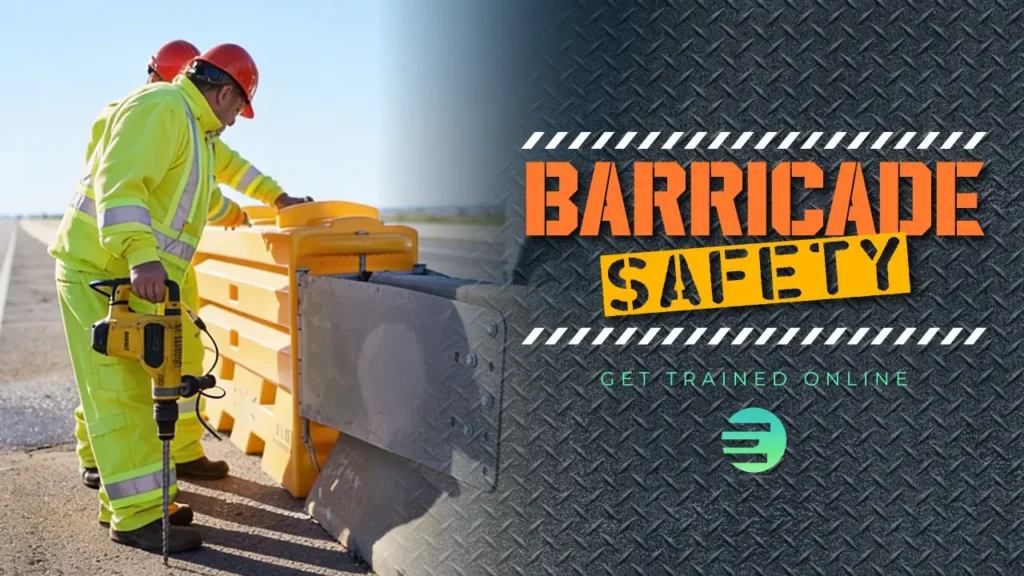
Barricade Safety is a 75 minute online course built to 29 CFR 1926.200 for construction and 29 CFR 1910.145 for general industry. It covers barricade types, ANSI Z535 safety colors, hazards that need barricading, setback distances and installation.

  • Match the barrier to the hazard, from caution tape and cones right up to guardrails and concrete barriers.
  • Read a site by its colors, working from the ANSI Z535 scheme of red, orange, yellow and blue safety signs.
  • Set the barriers back the right distance, including the 10 foot overhead line rule in 29 CFR 1910.333(c).
  • 1-1.5 hours, self-paced
  • Instant certificate
  • Mobile friendly
$29.99

Per seat. One-time payment, no subscription.

Total (1 seats x $29.99)
$29.99
− +

30-day satisfaction guarantee. No hidden fees.

Everything You Need to Know
About This Course

The course runs four modules, each ending in its own quiz. The narration puts the full run time at 75 minutes.

  • Why Barricades Are the Last Line of Defense
  • OSHA 1926 Subpart G and 29 CFR 1910.145
  • ANSI Z535 Safety Colors: Danger, Warning, Caution and Notice
  • Hazards That Have to Be Barricaded
  • Access Control, Hazard Isolation and Traffic Control
  • MUTCD Type I, Type II and Type III Barricades
  • Physical Barriers: Guardrails, Jersey Barriers and Fencing
  • Visual Barriers: Caution, Warning, Danger and Barricade Tape
  • Safety Cones and Delineators, and Where They Stop Working
  • Pre Installation Hazard Assessment and Planning
  • Setbacks for Excavations, Crane Swing and Energized Equipment
  • What Happens When a Barricade Is Bypassed or Removed

OSHA Standard29 CFR 1926.200 (construction) and 29 CFR 1910.145 (general industry)
Course Duration1-1.5 hours
Format100% online, narrated with photos, video, and interactivity
Passing Score70% on final exam
CertificatePersonalized certificate, printable immediately upon passing
LanguagesEnglish
Device CompatibilityDesktop, tablet, and smartphone
ProgressProgress saved automatically, stop and restart without losing your place
Instructor SupportAccess professional instructors for guidance and answers to your course-related questions.
AcceptedOur courses meet federal standards, but state requirements may vary. Please verify before purchase.

The course names its audience on every module title slide: construction and industrial workers, and anyone who sets up or has to respect a barrier.

  • Construction crews working near active work zones
  • Manufacturing personnel around machinery and restricted areas
  • Maintenance technicians servicing equipment in controlled zones
  • Site supervisors and foremen placing barriers
  • Equipment operators and spotters
  • Traffic control workers and flaggers
  • Utility and infrastructure crews
  • Anyone entering an area with a barricade in place

Barricades turn up wherever a hazard has to be kept away from people who are not part of the work.

  • Commercial and residential construction
  • General contracting and subcontracting firms
  • Oil and gas (upstream, midstream, downstream)
  • Utilities and power generation
  • Warehousing and distribution
  • Manufacturing and industrial facilities
  • Road and highway construction
  • Municipal and government infrastructure projects
  • Mining and quarry operations
  • Telecommunications and fiber installation

Barricade Safety or the Hazard Behind the Barricade?

This course teaches the barrier. The hazard courses teach what the barrier is holding back, and most crews need both.

  • Barricade Safety. The page you are on. Barricade types, colors, setback distances, installation and the rules on crossing a barrier.
  • OSHA Focus Four: Struck-By Hazards. The hazard barricades exist to stop on most sites: vehicles, swinging loads and flying objects. View the OSHA Focus Four: Struck-By Hazards
  • Trenching and Excavation Safety. Excavation work in depth, where setback and edge protection come from the soil and the depth. View the Trenching and Excavation Safety
  • Electrical Safety. Energized work, approach boundaries and the clearances a barricade has to enforce. View the Electrical Safety

Take this one for the barrier itself, then add the course for whichever hazard your site runs into most.


How Far Back Does a Barricade Have to Sit?

Setback is the question crews get wrong most often, and the answer is different for every hazard. These are the distances written into the standards.

  • Overhead power lines. Unqualified people, and anything conductive they are holding, must stay 10 feet away from unguarded energized overhead lines at 50 kV or below, under 29 CFR 1910.333(c)(3)(i)(A).
  • Excavation edges. Excavated spoil and equipment must be kept at least 2 feet from the edge of an excavation, or held back by retaining devices, under 29 CFR 1926.651(j)(2). Many sites work to a wider setback as their own practice.
  • Fall exposure. Fall protection is owed from 4 feet in general industry under 29 CFR 1910.28(b)(1) and from 6 feet in construction under 29 CFR 1926.501(b)(1), and a guardrail used as that protection must take 200 pounds at the top rail under 29 CFR 1926.502(b)(3).
  • Crane swing. For crane swing, 29 CFR 1926.1424 requires control lines, warning lines, railings or similar barriers marking the boundary of the hazard area, and leaves the distance to the assessment rather than fixing a number.

Where a standard sets no number, the setback comes from the hazard assessment the course teaches in Module 4, and it gets written down.

Verified Course Reviews

Add a review
You must be logged in to post a review Log In
0.0
Based on 0 reviews
5
0%
4
0%
3
0%
2
0%
1
0%
0 of 0 reviews

Sorry, no reviews match your current selections

Frequently Asked Questions

Everything you need to know about the Barricade Safety.

Yes. Upon passing the final exam with a score of 70% or higher, you can immediately print a certificate of completion. This certificate serves as proof of training for your employer.

Yes. The course is accessible on desktop computers, laptops, tablets, and smartphones. Progress saves automatically on the same device, so you can stop and resume where you left off.

eTraining's Barricade Safety course is an online training program that provides a practical overview of proper barricade use in construction and industrial environments. It covers approximately 1 to 1.5 hours of instruction across four modules, including barricade types, color coding and signage, traffic control fundamentals, installation best practices, and employer and employee responsibilities. Participants receive a certificate of completion upon passing the final exam.

  The course is designed for construction workers, contractors, supervisors, and safety personnel who work in environments where barricades are used to control access, protect workers, or manage traffic. It is suitable for anyone responsible for installing, maintaining, or working near barricades on job sites.

The course takes approximately 1 to 1.5 hours to complete. Because it is fully self-paced, learners can complete it in one session or across multiple sittings. Progress saves on the same device, allowing you to pick up where you left off.

 The course covers the purpose and types of barricades, hazard identification, barricade color coding and signage, temporary versus permanent barricades, restricted access zones, traffic control fundamentals, installation and maintenance best practices, common barricade failures, employer and employee responsibilities, and incident prevention strategies.

  The course is organized into four modules: Module 1 covers Introduction to Barricade Safety (purpose, regulatory overview, and common hazards); Module 2 covers Types of Barricades and Controls (physical barricades, caution tape, traffic control devices, and signage); Module 3 covers Installation and Best Practices (proper placement, securing, inspection, and preventing unauthorized access); and Module 4 covers Responsibilities and Incident Prevention (supervisor responsibilities, employee awareness, incident reporting, and site safety culture). A final exam follows the modules.

  Upon passing the final exam, you receive a printable certificate of completion. The certificate includes your name and the course details.

   Improper barricade use can result in unauthorized entry into hazardous areas, worker injuries, traffic incidents, and regulatory violations. This training helps workers and supervisors understand how to properly install, maintain, and inspect barricade systems to prevent accidents and protect everyone on the job site.

Yes. The course includes a dedicated section on traffic control fundamentals as part of Module 2, which covers traffic control devices, signage, and labeling used in construction and work zone environments.

  Yes. Module 4 specifically addresses supervisor responsibilities, including oversight of barricade installation, employee awareness requirements, incident reporting procedures, and fostering a culture of site safety.

Better Training. Better Outcomes.

Fifteen years, 200,000+ professionals certified, and a completion rate roughly double the industry average.

OSHA citation printed on every certificate

Your employer and site safety officer can verify compliance at a glance, with no phone calls and no lookups.

No setup. No LMS. Training in minutes.

Pay once, get instant access. No account setup, no downloads, no IT involvement. Works in any browser.

Built for field workers, not classrooms

Grounded in real jobsite operations. Scenarios reflect the work your crew actually does.

Trusted by safety managers & contractors

Used by EHS managers, general contractors and federal site supervisors to keep crews certified on time.

200,000+
Professionals certified
87%
Completion rate (industry avg <45%)
10M+
Hours of training delivered
15
Years in business

Your go-to source for workplace safety updates.

Join our monthly newsletter covering industry stories, news & timely updates, and get a free 110-page OSHA manual covering the latest training requirements.

eTraining and the eTraining logo copyright 2026 eTraining, Inc. All Rights Reserved.