

Safety Data Sheets are rarely a single source of truth. When two sheets for the same chemical show conflicting hazard classes, your storage compatibility charts become useless. Managing SDS Inconsistencies & Chemical Storage requires operationalizing a reconciliation rule to avoid dangerous segregation errors. These 6 field-tested checks align with OSHA HazCom expectations under 29 CFR 1910.1200. They translate messy paperwork into defensible floor logic. We start with why these classifications diverge in the first place.
1. Solve the “GHS Classification Gap”: Why Identical Chemicals Have Different SDSs
On the ground, you’ll find SDSs for the identical chemical that flatly disagree. One supplier marks a substance as a Category 1 Corrosive (Danger), while another labels it a Category 2 Irritant (Warning). This isn’t an employee error. It’s a classification variability problem that occurs because manufacturers use diverging data and regulatory lenses:
- Different inputs: One lab relies on pH, while another tests reserves alkalinity or buffering capacity.
- Testing methods: Some use “read-across” data, which estimates hazards from similar chemicals instead of direct testing.
- Regulatory filters: OSHA mixture criteria often clash with EPA corrosivity concepts used for waste characterization.
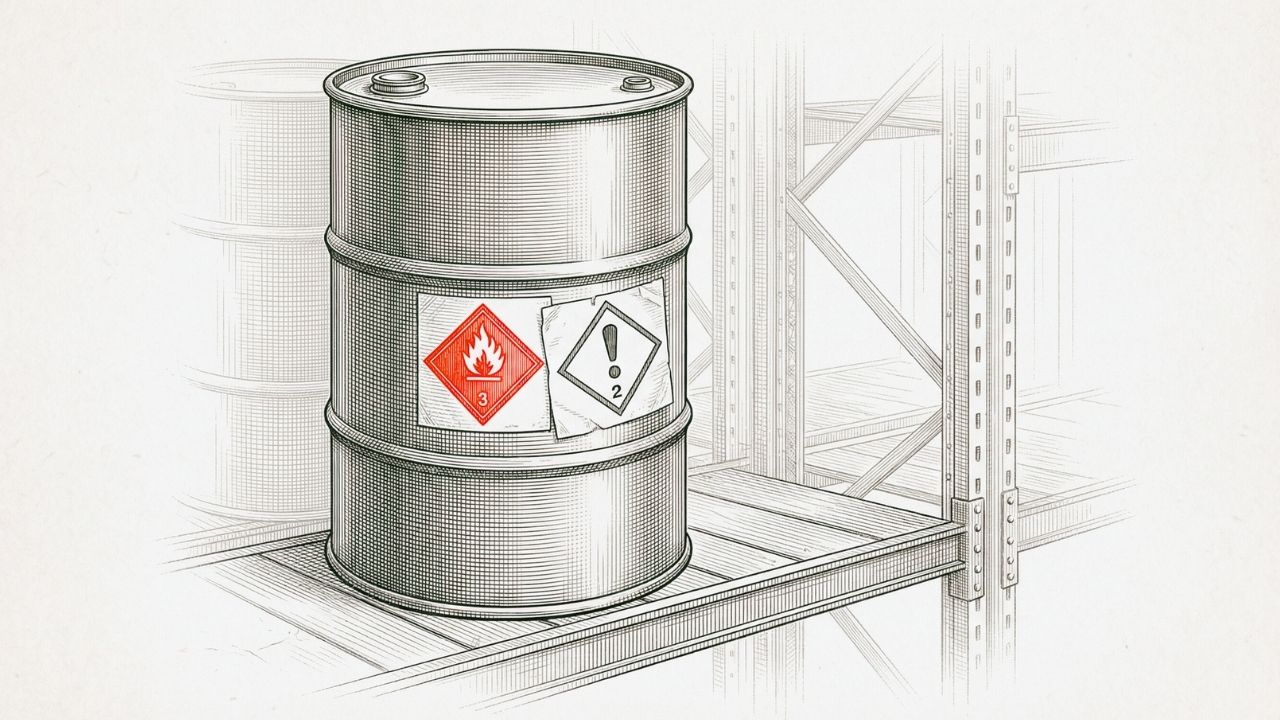
If your segregation chart relies on the less restrictive SDS, you risk placing incompatible chemicals together and creating a reaction pathway. Adopt this rule: When SDSs conflict, store to the most conservative compatible category until reconciled and documented. This prevents storage decisions from being based on a single supplier’s classification when data legitimately diverges.
Emergency Response During SDS Conflicts: The same conservative logic applies during emergencies. If a spill or exposure occurs and your team is staring at two conflicting SDSs, default to Section 4 (First Aid) and Section 6 (Accidental Release) from the more restrictive sheet. Don’t average hazards mid-crisis. Your emergency responders need a single, worst-case protocol, not a judgment call between two documents while someone is on the ground. Build this default into your Emergency Action Plan so the decision is already made before the alarm sounds.
2. Run the “Internal Logic” Audit: Reconcile Sections 2, 3, and 9
Safety managers often face an “Internal SDS Conflict” where Section 2 claims a product is non-hazardous but Section 9 lists a pH of 13.5. This creates legal and physical vulnerabilities. Use this three-point heuristic to audit your inventory without a chemistry degree:
- Section 2: Verify the Hazard Class and Pictograms.
- Section 3: Review ingredients, percentages, and trade secret flags. Check if these concentrations justify the hazard classification.
- Section 9: Check pH, flash point, and boiling point. Ensure these physical properties support the hazard claims.
If Section 9 shows an 80°F flash point but Section 2 lacks a flame pictogram, you have a conflict. Flag it as a “Classification Conflict” in your inventory, request supplier clarification, and document the exchange. Store the material per the worst-case hazard group until resolved. OSHA HazCom requires a functional hazard communication program, not the blind acceptance of contradictory paperwork.
3. Bridge the “Loading Dock Gap”: Identifying Mismatched Chemicals
Your database might list “Isopropyl Alcohol,” but the loading dock just received a branded blend or a specific ACS-grade variant. When an exact match is missing, staff often pull the closest generic SDS. This creates SDS inconsistencies before the container even hits the shelf. Close this gap with a receiving checklist including:
- Manufacturer and full product name
- Catalog number and concentration/grade
- CAS number and specific SDS revision date
Match the SDS revision date to the physical identifier rather than generic web PDFs. For same-CAS conflicts, follow these reconciliation rules:
- Section 3 Variance: If impurities or stabilizers differ, treat as a distinct product for storage grouping.
- Section 2 Variance: If classification differs despite equivalent chemistry, escalate to a “classification variance” and store conservatively.
Reliable segregation is impossible without precise identification. Effective chemical storage starts at intake, preventing product-ID ambiguity from ever reaching your shelves.
4. Deploy a “Certainty Hierarchy” for Matching Containers to Records
Standard safety advice says “read the SDS,” but that fails when labels are scraped, decanted, or missing. You cannot manage SDS Inconsistencies & Chemical Storage if you cannot prove which record matches the physical fluid. This identity gap makes your storage compatibility charts worthless. Use this hierarchy of decision logic to close the gap between your digital library and physical floor stock:
| Reliability | Matching Criteria | Action |
| Best | Manufacturer + Product ID + Lot # + Concentration | Verified Match |
| OK | Manufacturer + Product ID + Concentration | Probable Match |
| Risky | Common Name only (“Solvent,” “Acid”) | Quarantine |
- Label secondary containers at the exact moment of transfer.
- Ensure workplace labels link directly to a digital SDS record.
- Isolate uncertain containers in a designated quarantine area for rapid verification.
Identity control is the foundation of storage safety. If your team cannot identify a container with certainty, they cannot access the safety data required for safe handling or emergency response.
5. Standardize Internal Storage Groups to Neutralize SDS Inconsistencies & Chemical Storage
You cannot train your way out of a data integrity problem. Receiving documents from multiple suppliers means managing conflicting GHS revisions and inconsistent label conventions. This classification noise makes pictogram logic a moving target. To stay compliant under OSHA HCS, your HazCom program must be internally coherent. Stop relying on supplier-specific visual styling. Map storage logic to a standardized internal schema to avoid mixing logic ad hoc.
What to Normalize:
- Storage Groups: Map Section 2 data into categories like Acids, Bases, Oxidizers, Flammables, Reactives, and Toxics.
- Segregation Triggers: Define protocols for missing pH or incomplete composition ranges.
- Compatibility Charts: Base these on normalized groupings, not supplier styling.
Add a module to SDS safety data sheet training explaining why compliant sheets might disagree. Set a tie-breaker rule: when paperwork conflicts, your site’s internal standard always wins. This reduces mis-segregation risk driven by inconsistent imported data.
Employee Training Under 1910.1200(h): Employers must train workers on how to read labels and SDSs, understand hazard categories, and protect themselves accordingly. When your sheets conflict, your crew needs to know the escalation path. Train them on your site’s tie-breaker rule, your quarantine procedure, and who to notify when something doesn’t match. If they can’t execute the reconciliation logic on the floor, the written program is just paper.
6. Establish Regulatory Boundaries for Sections 14 and 15
Sections 14 and 15 are frequently the most unreliable parts of an SDS. Treating them as comprehensive manuals leads to the SDS inconsistencies that jeopardize chemical storage safety. Most manufacturers treat these fields as secondary administrative notes rather than high-stakes technical data.
Don’t let Section 14 drive shipping decisions. While it lists UN numbers and hazard classes, transport classification remains a DOT and PHMSA responsibility requiring independent verification before signing a manifest. Section 15 is equally incomplete: it rarely accounts for state-specific Right-to-Know laws or site reporting obligations like Tier II and EPCRA workflows.
State-Level Right-to-Know Variations: States like New Jersey, California (Prop 65), and Pennsylvania impose chemical reporting and labeling requirements that go beyond federal HazCom. These state-level obligations can compound SDS inconsistencies, especially when a product triggers a Prop 65 warning in one jurisdiction but not another. Factor your site’s state-specific requirements into the reconciliation process, not just the federal baseline.
Avoid the “transport-first” storage trap. Storing materials solely by UN class is a dangerous shortcut if it ignores chemical reactivity groups. Update your written HazCom program to define which fields are authoritative for storage:
- Section 7 (Handling and Storage)
- Section 8 (Exposure Controls/Personal Protection)
- Section 10 (Stability and Reactivity)
- Your internal compatibility matrix
This systematic boundary prevents incorrect procedures caused by over-trusting unverified SDS sections instead of the relevant regulatory authority.
Implementing a Chemical SDS Reconciliation System
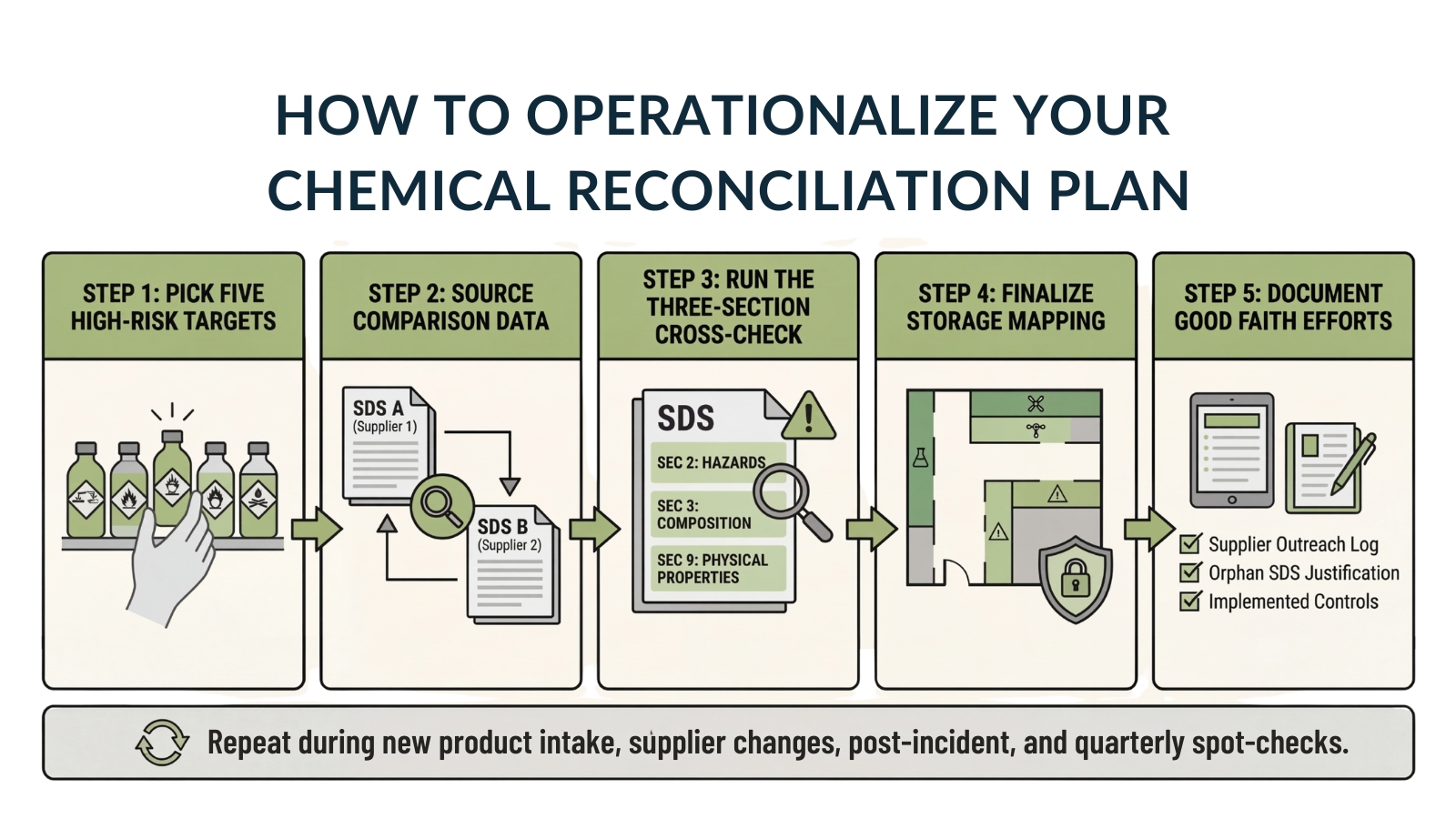
Treat SDS management as a repeatable system rather than a manual filing task. Run this SOP during new product intake, supplier changes, after incidents or near-misses, or during quarterly spot-checks to mitigate risk.
Step 1: Pick five high-risk targets: Prioritize corrosives, oxidizers, flammables, and water-reactives. These categories address the most volatile chemicals in your facility inventory and present the highest danger if paperwork errors lead to incorrect segregation.
Step 2: Source comparison data: Pull two SDSs per chemical from different suppliers or third-party databases. Record revision dates to identify outdated GHS classifications or obsolete safety benchmarks that no longer meet modern compliance standards.
Step 3: Run the Three-Section Cross-Check: Audit your data by comparing Section 2 (Hazards), Section 3 (Composition), and Section 9 (Physical Properties). Flag contradictions, such as Section 9 flash points that lack corresponding flame pictograms in Section 2.
Step 4: Finalize storage mapping: Apply the conservative tie-breaker rule. If sources conflict, adopt the most restrictive hazard class. Update physical storage maps and compatibility charts immediately to reflect these verified classifications.
Step 5: Document good faith efforts: Log all supplier outreach regarding data discrepancies. For orphan SDS files from defunct manufacturers, record why you selected the best-available data and identify the specific administrative controls you implemented.
📘 Ensure your team understands these protocols by enrolling them in GHS/HazCom Training. For broader site safety strategies, use our comprehensive Chemical Safety Course.
Frequently Asked Questions
Why can two SDSs for the same chemical show different hazard ratings?
Diverging test methods, different data sets, and varying mixture assumptions cause these discrepancies. One manufacturer might rely on raw pH values while another tests for buffering capacity or reserve alkalinity. Supplier classification is not always identical even when both versions are legally compliant with GHS standards. To maintain safety, standardize your internal storage group mapping and use conservative tie-breakers. Defaulting to the more severe hazard category ensures you do not inadvertently create a reaction pathway based on a supplier’s less restrictive data.
What does OSHA 29 CFR 1910.1200 actually require from employers?
As a downstream user, OSHA requires you to maintain a written Hazard Communication program and a chemical inventory that accurately reflects your physical stock. You must ensure Safety Data Sheets are readily accessible to all employees during their work shifts. Employers are also responsible for training staff on hazard label elements and the 16-section SDS format. Compliance is judged on the effectiveness of your internal communication and your ability to prove employees understand the specific risks present in their work area.
Does OSHA enforce SDS Section 14?
The Hazard Communication Standard requires the 16-section format to be present, but OSHA does not typically enforce the technical accuracy of transport information. Section 14 is primarily the jurisdiction of the DOT and PHMSA for shipping decisions. Treat this section as an administrative note rather than a technical manual. Never ship chemicals based on Section 14 alone. You should always verify transport data through relevant shipping authorities to ensure compliance with specialized hazardous material regulations.
If SDSs conflict, how should I store the chemical today?
Implement the worst-case scenario by storing the chemical according to the most conservative hazard group identified across the conflicting documents. Quarantine any containers with significant data gaps or unknowns rather than attempting to average the hazards. If one SDS identifies a corrosive risk that the other misses, store the product with your corrosives until the discrepancy is resolved. See the section on Standardizing Internal Storage Groups above for the full breakdown of how to map these logic groups.
What if the manufacturer is out of business and I can’t get an updated SDS?
Document all outreach attempts to prove due diligence for your written HazCom program. If an updated SDS is unavailable, you must use the best-available record and supplement it with an internal risk assessment. Implement conservative handling and storage controls and treat the document as an “orphan” SDS. Establish a periodic review cadence to check for newer versions from similar suppliers or third-party databases. This systematic approach shows regulators you are managing risks based on the highest quality information available.
Sources: OSHA, DOT, PHMSA