



Struck-By or Caught-In: Which Course Fits the Incident?
These two hazards are counted separately by OSHA but happen in the same places, so it is worth knowing which one your site keeps producing.
- OSHA Focus Four: Struck-By Hazards. The page you are on. Impact injuries from flying, falling, swinging and rolling objects.
- OSHA Focus Four: Caught-In or -Between Hazards. Crushing injuries: cave-ins, machine guarding, lockout and being pinned between objects. View the OSHA Focus Four: Caught-In or -Between Hazards
- OSHA's Construction Focus Four. Both of these plus falls and electrocution, in one 3-hour enrollment. View the OSHA's Construction Focus Four
If your near misses involve moving vehicles, lifted loads or tools throwing material, start here. If they involve trenches or machinery pinch points, start with caught-in.
What Does OSHA Require Against Struck-By Hazards?
There is no single struck-by standard. The duties sit across the vehicle, tool, signage and PPE rules, and the course pulls out the ones that matter most.
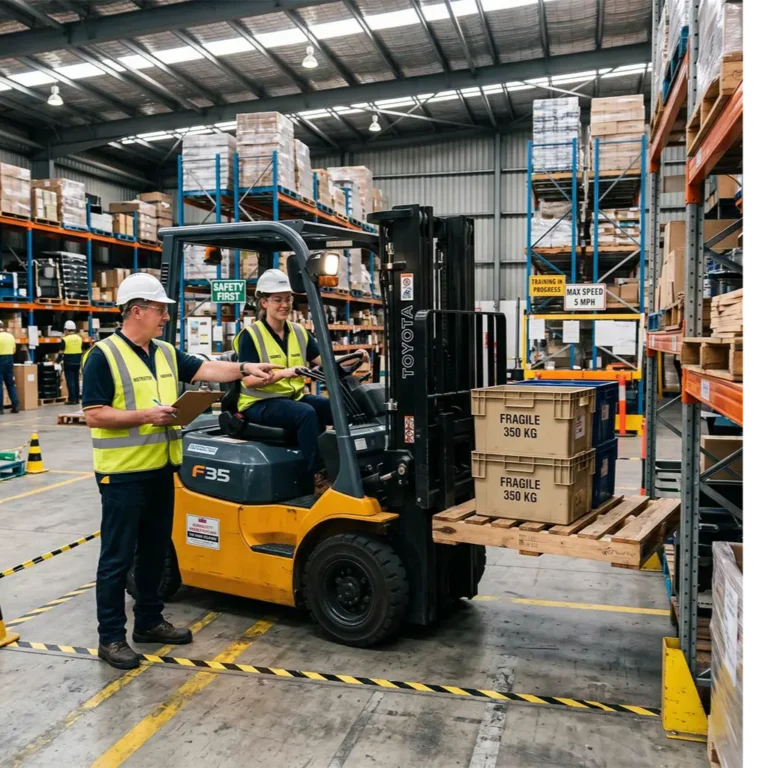
- Alarm it or post a spotter. A vehicle with an obstructed view to the rear may not be used unless it has a reverse signal alarm audible above the surrounding noise, or is backed only when an observer signals it is safe (29 CFR 1926.601(b)(4)).
- Keep the air pressure down. Compressed air may not be used for cleaning except where reduced to less than 30 psi, and then only with chip guarding and PPE (1926.302(b)(4)).
- Store material back from the edge. Material stored inside a building under construction must stay 6 feet from any hoistway or floor opening and 10 feet from an exterior wall it rises above (1926.250(b)(1)).
- Protect the head and eyes. Crane operators must be trained, certified or licensed, and evaluated before operating (1926.1427(a)).
Head protection, eye protection and high-visibility clothing are the last line, not the first. Layout and separation come first.





Giod