

Featured Courses
Previously trained hazardous waste workers complete required OSHA annual refresher certification training

2026 8 Hour HAZWOPER Refresher

Annual 8-hour HAZWOPER refresher meeting OSHA 29 CFR 1910.120(e)(8) requirements.
Comprehensive lithium battery safety safety training for workers and workplace for workplace compliance

Lithium Battery Safety

Covers what happens when lithium batteries fail and how to prevent fires and explosions.

View All OSHA Courses

image

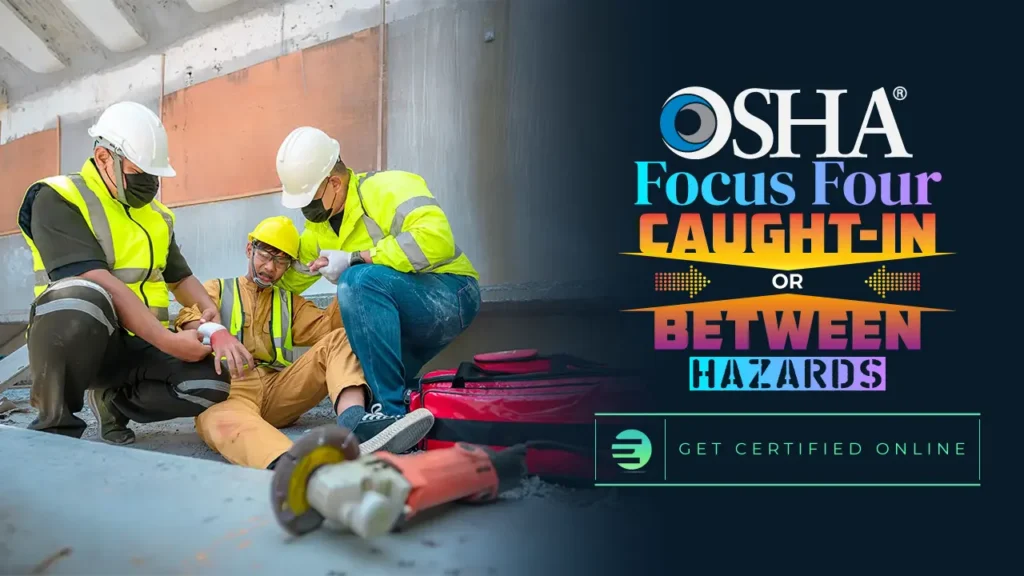
OSHA Focus Four: Caught-In or -Between Hazards

5(1 reviews)
OSHA Focus Four: Caught-In or -Between Hazards

Course Overview

Caught-In or -Between Hazards is a 30-minute course built on 29 CFR 1926 Subparts P and I. It covers trench cave-ins, unguarded machinery, lockout and tagout, heavy equipment tip-overs, demolition and being pinned between solid objects.

  • Tell a caught-in event from a struck-by event using the question OSHA uses: what actually caused the injury.
  • Name the three groups: caught in machinery, buried in or by a cave-in, and pinned between two solid objects.
  • Learn the trench rules, the guarding rules and the lockout steps that keep each of those three from happening.
  • 30 minutes, self-paced
  • Instant certificate
  • Mobile friendly
$20.00

Per seat. One-time payment, no subscription.

Total (1 seats x $20.00)
$20.00
− +

30-day satisfaction guarantee. No hidden fees.

Course Clips

Everything You Need to Know
About This Course

The course runs two modules, each with its own quiz. A final knowledge assessment follows Module 2.

  • How OSHA Defines a Caught-In or -Between Hazard
  • The Test That Separates Caught-In from Struck-By
  • Real Incident Reports and Injury Data
  • Machinery With Unguarded Moving Parts
  • Buried In or By: Trenches, Scaffolds and Demolition
  • Pinned Between Equipment, Materials and Fixed Objects
  • Guarding Belts, Gears, Shafts, Pulleys and Pinch Points
  • Lockout and Tagout Before Maintenance or Repair
  • Blocking and Lowering Blades, Buckets and Dump Bodies
  • Rollover Protective Structures and Seat Belts
  • Crane Swing Radius and Load Capacity
  • Trenching and Excavation: The Competent Person
  • Sloping, Benching, Trench Boxes and Shoring
  • Keeping Spoil and Equipment Back From the Edge
  • Scaffold Foundations, Components and Supervision
  • Demolition: Wall Bracing, Jacks and Cribbing
  • Engineering Surveys and Demolition Inspections
  • Employer Training Duties for Caught-In Hazards

OSHA Standard29 CFR 1926
Course Duration30 minutes
Format100% online, fully narrated with photos and interactivity
Passing Score70% on final exam
CertificatePersonalized certificate, printable immediately upon passing
LanguagesEnglish
Device CompatibilityDesktop, tablet, and smartphone
ProgressProgress saved automatically, stop and restart without losing your place
Instructor SupportAccess professional instructors for guidance and answers to your course-related questions.
AcceptedOur courses meet federal standards, but state requirements may vary. Please verify before purchase.

This course suits anyone working around trenches, heavy equipment or machinery with moving parts.

  • Excavation and utility crews
  • Equipment operators
  • Pipe layers and laborers
  • Demolition workers
  • Maintenance and repair technicians
  • Concrete and masonry workers
  • Foremen and crew leads
  • Safety coordinators

Cave-ins, pinch points and pinning hazards follow the equipment, so the risk spreads well beyond one trade.

  • Heavy and civil engineering construction
  • Excavation and site work
  • Water, sewer and utility contracting
  • Demolition
  • Residential and commercial building
  • Road and highway work
  • Concrete and masonry
  • Landscaping and grading

Caught-In or Struck-By: Which Course Do You Need?

These two hazards are the pair workers most often confuse, and eTraining sells a course for each plus a combined course covering all four.

  • OSHA Focus Four: Caught-In or -Between Hazards. The page you are on. Crushing and compression hazards: cave-ins, machine guarding, lockout and pinning.
  • OSHA Focus Four: Struck-By Hazards. The other half of the pair. Flying, falling, swinging and rolling objects, work zones and traffic control. View the OSHA Focus Four: Struck-By Hazards
  • OSHA's Construction Focus Four. All four hazards in one 3-hour enrollment, with a 30-question final assessment. View the OSHA's Construction Focus Four


What Does OSHA Require Against Caught-In or -Between Hazards?

There is no single caught-in standard. The duties sit in the excavation, tool, demolition and equipment rules, and the course walks each one.

  • Protect every trench. Each employee in an excavation must be protected from cave-ins by an adequate protective system, unless the excavation is entirely in stable rock or is less than 5 feet deep and a competent person finds no cave-in potential (29 CFR 1926.652(a)(1)).
  • Guard the moving parts. Belts, gears, shafts, pulleys, sprockets, spindles, drums, flywheels and chains must be guarded where employees can contact them (1926.300(b)(2)).
  • Lock it out. Circuits and equipment must be locked out or tagged before work begins, and controls that are deactivated must be tagged (1926.417).
  • Brace the walls. No wall section more than one story high may stand alone without lateral bracing during demolition unless it was designed to be self-supporting (1926.854(b)).
Verified Course Reviews

Add a review
You must be logged in to post a review Log In
5.0
Based on 1 review
5
100
100%
4
0%
3
0%
2
0%
1
0%
1-1 of 1 review
  1. very helpful

    (0) (0)

Frequently Asked Questions

Everything you need to know about the OSHA Focus Four: Caught-In or -Between Hazards.

Yes. Upon passing the final exam with a score of 70% or higher, you can immediately print a certificate of completion. This certificate serves as proof of training for your employer.

Yes. The course is accessible on desktop computers, laptops, tablets, and smartphones. Progress saves automatically on the same device, so you can stop and resume where you left off.

OSHA Focus Four: Caught-In or -Between Hazards is an OSHA-compliant online safety training program that provides workers with essential knowledge to identify and prevent workplace hazards. The course covers What is a caught-in or -between hazard and  What are the common types of caught-in or -between hazards in construction in accordance with OSHA standards (OSHA Focus Four Hazards (29 CFR 1926)). Upon completion, participants receive a personalized certificate of completion.

  While this course may not be federally mandated for all workers, many employers require this training as a condition of employment. OSHA recommends this training for all workers exposed to these hazards. State regulations, union requirements, employer safety policies, and industry standards may also mandate completion of this course.

   The course requires a minimum of 30 minutes of instruction time. Because it is self-paced, you can complete it over multiple sessions at your convenience. You have 6 months from your enrollment date to complete all coursework. Progress is saved automatically, so you can stop and resume on the same device at any time.

  Yes. eTraining's OSHA Focus Four: Caught-In or -Between Hazards is developed in accordance with OSHA standards and best practices for workplace safety training. The course is delivered through eTraining's fully narrated, interactive platform. You receive a personalized certificate of completion upon passing, which documents your training and is accepted by employers nationwide.

  The course covers: What is a caught-in or -between hazard, What are the common types of caught-in or -between hazards in construction, How can I protect myself from caught-in or -between hazards, What is my employer required to do to protect workers from caught-in or -between hazards. The course is divided into modules with quizzes at the end of each section, followed by a comprehensive final exam. Interactive content and real-world examples help reinforce learning.

  Yes. This OSHA-compliant course is accepted nationwide across all 50 U.S. states. However, some states and jurisdictions may have additional specific training requirements beyond this course. Workers should verify with their employer or local regulations whether additional training is required.

You must score at least 70% on the final exam to pass and receive your certificate of completion. The course includes knowledge-check quizzes that do not count toward your final grade but help prepare you for the exam. If you do not pass on your first attempt, you can retake the exam.

Better Training. Better Outcomes.

Fifteen years, 200,000+ professionals certified, and a completion rate roughly double the industry average.

OSHA citation printed on every certificate

Your employer and site safety officer can verify compliance at a glance, with no phone calls and no lookups.

No setup. No LMS. Training in minutes.

Pay once, get instant access. No account setup, no downloads, no IT involvement. Works in any browser.

Built for field workers, not classrooms

Grounded in real jobsite operations. Scenarios reflect the work your crew actually does.

Trusted by safety managers & contractors

Used by EHS managers, general contractors and federal site supervisors to keep crews certified on time.

200,000+
Professionals certified
87%
Completion rate (industry avg <45%)
10M+
Hours of training delivered
15
Years in business

Your go-to source for workplace safety updates.

Join our monthly newsletter covering industry stories, news & timely updates, and get a free 110-page OSHA manual covering the latest training requirements.

eTraining and the eTraining logo copyright 2026 eTraining, Inc. All Rights Reserved.