


Which Aerial and Scissor Lift Course Do You Need?
Four eTraining courses touch aerial and scissor lifts, and they are not interchangeable. Here is who each one is for.
- Aerial and Scissor Lift Safety. This is the page you are on, and it is the operator course. It is for the person who gets in the basket or on the platform and runs the machine. Buy it for everyone on the crew who will operate a boom lift or a scissor lift. View the Aerial and Scissor Lift Safety
- Aerial & Scissor Lift Competent Person. The competent person course is for the one person on site with the authority to inspect lifts, spot hazards and stop work. It goes past operating into judgement and correction. Most crews need one or two of these, not one per operator. View the Aerial & Scissor Lift Competent Person
- Aerial and Scissor Lifts Online Course - Spanish. Same operator course, delivered in Spanish. It carries the same content and the same Certificate of Completion. Buy it for Spanish-speaking operators rather than putting them through the English version. View the Aerial and Scissor Lifts Online Course - Spanish
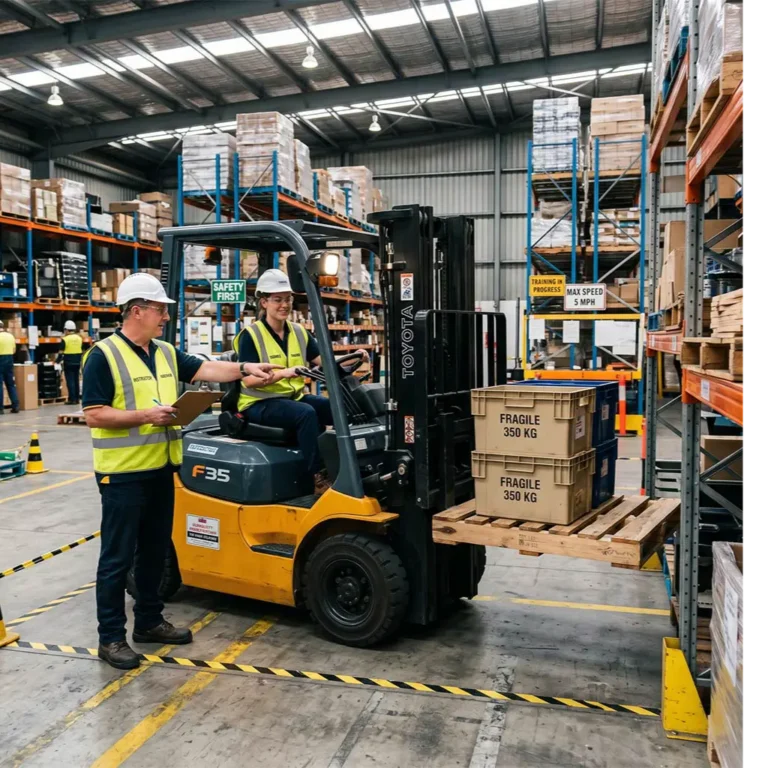
- Forklift Certification: Safety Training. Forklifts are powered industrial trucks, a different machine under a different standard, so lift training does not cover them. If your crew runs both, this is the second course to buy. View the Forklift Certification: Safety Training
What decides it is the job, not the machine. Operators take the operator course. The person who inspects lifts and stops work takes the competent person course.
Why Aerial Lifts and Scissor Lifts Follow Different Rules
The two machines look like variations on one idea and OSHA does not treat them that way. This is the distinction the course is built around.
- The fall protection rules differ between the two machines. In an aerial lift, 29 CFR 1926.453(b)(2)(v) requires fall protection worn and attached to the boom or basket. In a scissor lift the protection OSHA names is the guardrail system, under 29 CFR 1926.451(g). Getting the two the wrong way round is the most common mistake on this topic.
- A scissor lift is a scaffold in OSHA's eyes. OSHA stated in a letter of interpretation in August 2000 that a scissor lift does not meet the ANSI A92.2 definition of an aerial lift, and meets the definition of a scaffold instead. That is why 1926.451, 1926.452(w) and 1926.454 apply to it rather than 1926.453.
- The manufacturer's manual carries real regulatory weight. OSHA says to follow the manufacturer's instructions, and can enforce a manufacturer's harness requirement through the General Duty Clause, Section 5(a)(1). So a scissor lift with a harness requirement in its manual is a scissor lift where a harness is enforceable.
- Both answers are in the same course. Rather than picking a side, the course teaches which paragraph governs which machine and sends operators to the operator's manual for the rest. Crews running a mixed fleet get one answer for the boom lift and a different one for the scissor lift.
Train the crew on both and the question stops coming up on site, which is the point of buying one course for two machines.




great
Great training! Easy to follow.
–
great
Great course! Thanks