


🔥 Fire Prevention Week Sale · 20% Off Fire Safety Courses · Ends Oct 10 · Code Learn More →
Featured Courses
Previously trained hazardous waste workers complete required OSHA annual refresher certification training

2026 8 Hour HAZWOPER Refresher

Annual 8-hour HAZWOPER refresher meeting OSHA 29 CFR 1910.120(e)(8) requirements.
Comprehensive lithium battery safety safety training for workers and workplace for workplace compliance

Lithium Battery Safety

Covers what happens when lithium batteries fail and how to prevent fires and explosions.

View All OSHA Courses

image

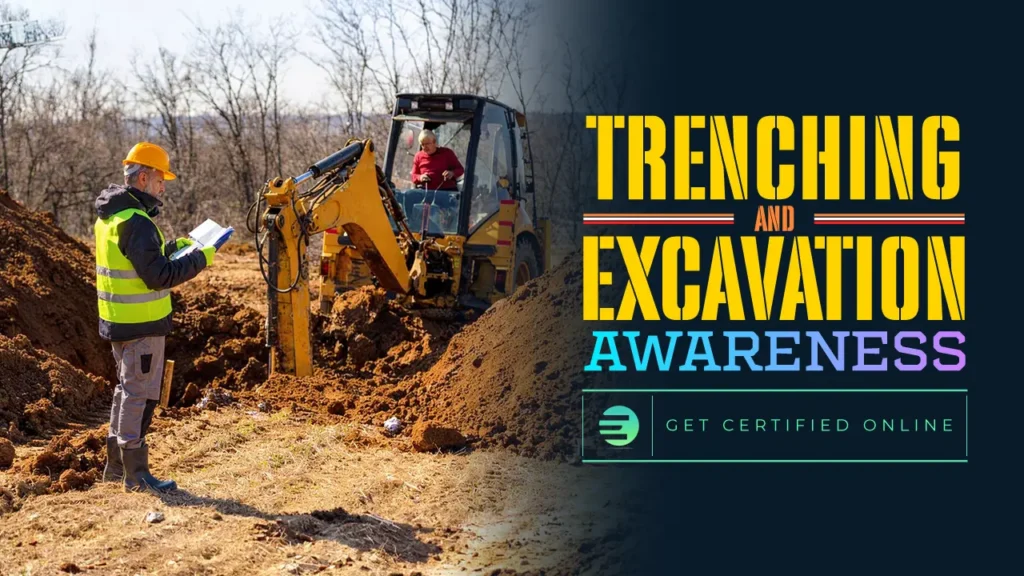
Trenching & Excavation Awareness

4.8(40 reviews)
Trenching & Excavation Awareness

Course Overview

Trenching & Excavation Safety is a four-part awareness course on 29 CFR 1926 Subpart P. It covers excavation hazards, soil classification and testing, the four design options for sloping and shoring, field inspections and cave-in rescue procedures.

  • Name the hazards that kill in a trench, starting with the cave-in and the conditions that bring one about.
  • Classify soil into Type A, B or C, then pick the slope, bench, shore or shield that the soil type calls for.
  • Read a trench for distress: tension cracks, bulging, subsidence, boiling, and what each one is warning you.

Note: eTraining also offers a more in-depth Trenching & Excavation for the Competent Person course for workers who need competent person-level training.

  • 2-3 hours, self-paced
  • Instant certificate
  • Mobile friendly
$39.00

Per seat. One-time payment, no subscription.

− +

30-day satisfaction guarantee. No hidden fees.

Everything You Need to Know
About This Course

The course runs four parts, each ending in a quiz. A final exam follows Part 4.

  • Excavation and Trenching Terms and Definitions
  • Why Cave-Ins Happen, and in What Conditions
  • Fire, Inhalation, Equipment and Utility Hazards
  • Access, Egress and Water Accumulation
  • Protecting Workers From Mobile Equipment
  • The Four Design Options for Sloping and Benching
  • Soil Types A, B and C and What Defines Each
  • Manual Soil Tests: Plasticity, Dry Strength and Thumb Penetration
  • Pocket Penetrometer and Shear Vane Testing
  • Sloping Angles by Soil Type and in Layered Soils
  • Benching, and Why It Is Not Allowed in Type C
  • Shoring, Sheeting and Bracing Systems
  • Hydraulic, Pneumatic and Screw Jack Bracing
  • Trench Shields, Freeboard and Combining With Sloping
  • Protective System Design Requirements and Tabulated Data
  • Competent Person and Registered Professional Engineer Duties
  • Daily Inspections and the Signs of Soil Distress
  • Hazardous Atmospheres, Ventilation and Cave-In Rescue

OSHA Standard29 CFR 1926.650
Course Duration2-3 hours
Format100% online, fully narrated with photos and interactivity
Passing Score70% on final exam
CertificatePersonalized certificate, printable immediately upon passing
LanguagesEnglish
Device CompatibilityDesktop, tablet, and smartphone
ProgressProgress saved automatically, stop and restart without losing your place
Instructor SupportAccess professional instructors for guidance and answers to your course-related questions.
AcceptedOur courses meet federal standards, but state requirements may vary. Please verify before purchase.

This course is awareness level, for the crew in and around the trench rather than the person who signs off on it.

  • Equipment and machinery operators who dig or work near trenches
  • Construction laborers working in or around excavations
  • Underground tank removal and maintenance workers
  • Utility workers (water, sewer, gas, electric, and telecommunications)
  • Oil and gas field workers involved in pipeline work
  • Safety officers overseeing trenching and excavation operations
  • Civil engineers involved in site excavation and grading
  • Municipal and government workers performing roadway and infrastructure work
  • Plumbers and pipefitters who work in trenched areas
  • Any worker who enters, works in, or works near trenches, holes, or below-ground areas

Subpart P applies to all open excavations made in the earth's surface, including trenches.

  • Commercial and residential construction
  • Underground utility installation and maintenance
  • Oil and gas pipeline construction
  • Road and highway construction
  • Municipal water and sewer infrastructure
  • Telecommunications and fiber optic cable installation
  • Demolition and site preparation contractors
  • Environmental remediation and underground tank removal
  • Civil engineering and land development
  • Government and municipal public works departments

Experience the first 5 minutes of the course right here. No account or payment required.

Excavation Awareness or Competent Person Training?

OSHA requires a designated competent person to inspect every excavation daily (29 CFR 1926.651(k)(1)). Everyone else needs to understand what that person is deciding.

Send the crew here. Send whoever will classify the soil, choose the protective system and inspect the trench to the competent person course.


When Does a Trench Need a Protective System?

The trigger is depth, and the exceptions are narrow. The course starts there because almost every fatality traces back to this decision.

  • Five feet. Each employee in an excavation must be protected from cave-ins by an adequate protective system (29 CFR 1926.652(a)(1)).
  • Stable rock is out. The first exception is an excavation made entirely in stable rock.
  • Under five feet still counts. The second is an excavation less than 5 feet deep where a competent person examines the ground and finds no indication of a potential cave-in (1926.652(a)(1)(ii)).
  • Twenty feet needs an engineer. Excavations deeper than 20 feet need a protective system designed by a registered professional engineer (1926.652(b)(4)).

Sloping, benching, shoring and shielding all satisfy the rule. Which one fits depends on the soil, and that is the rest of the course.
Verified Course Reviews

Add a review
You must be logged in to post a review Log In
4.8
Based on 40 reviews
5
85
85%
4
13
13%
3
0%
2
0%
1
2
2%
1-2 of 40 reviews
  1. g

    (0) (0)
  2. Great attention to detail

    (0) (0)

Frequently Asked Questions

Everything you need to know about the Trenching & Excavation Awareness.

Trenching and excavation safety training is a safety education program that teaches workers how to recognize and prevent hazards associated with working in and around trenches and excavations. eTraining’s course provides approximately 2–3 hours of instruction covering OSHA 29 CFR 1926.650 (Subpart P) standards, including soil classification, protective systems (sloping, benching, shoring, and shielding), competent person responsibilities, hazardous atmospheres, and safe work practices. Upon completion, participants receive a printable certificate of completion.

 The course covers: cave-in hazards and excavation statistics; soil classification and testing methods (including visual and manual tests, pocket penetrometer, and shearvane); protective systems including sloping, benching, shoring, sheeting, and shielding; hazardous atmospheres in excavations; competent person requirements and daily inspections; safe work practices including spoil placement, egress requirements, and fall protection; underground utility protection; water accumulation hazards; and cave-in rescue procedures. The course is divided into 4 parts with quizzes throughout.

The course takes approximately 2–3 hours to complete. Because it is self-paced, you can complete it over multiple sessions at your convenience. Most students finish within 1 week. You have 6 months from your enrollment date to complete all coursework. Progress is saved automatically on the same device, so you can stop and resume at any time.

OSHA requires employers to train all workers who will enter or work in and around excavations (OSHA 29 CFR 1926.651). This includes equipment operators, laborers, utility workers, and anyone who works in or near trenches. A competent person must also be designated to inspect excavations daily. This awareness-level course is appropriate for general workers. Competent persons may need additional in-depth training, which eTraining offers as a separate course.

Yes. eTraining’s Trenching & Excavation Safety course covers OSHA 29 CFR 1926.650 (Subpart P) excavation standards and is accepted nationwide. You receive a printable certificate of completion that documents your training. This awareness-level training satisfies the OSHA requirement for worker training in excavation safety across all 50 U.S. states.

The Trenching & Excavation Awareness course is designed for general workers who will work in or around excavations and covers basic hazard recognition and safe practices. The Trenching & Excavation Competent Person course is a more in-depth program designed for individuals who will be designated as the competent person on site, covering detailed soil analysis, protective system design, inspection procedures, and the authority to stop work when hazards are identified.

Yes. Upon passing the final exam with a score of 70% or higher, you can immediately print a certificate of completion. This certificate serves as proof of training for your employer.

Yes. The course is accessible on desktop computers, laptops, tablets, and smartphones. Progress saves automatically on the same device, so you can stop and resume where you left off.

There is no federally mandated expiration date for this training certificate. However, health and safety plans should be reviewed and updated annually, and whenever workplace conditions, hazards, or regulations change. Refresher training is recommended to stay current with evolving OSHA standards and best practices for safety program management.

You must score at least 70% on the final exam to pass and receive your certificate of completion. The course includes knowledge-check quizzes that do not count toward your final grade but help prepare you for the exam. If you do not pass on your first attempt, you can retake the exam.

Better Training. Better Outcomes.

Fifteen years, 200,000+ professionals certified, and a completion rate roughly double the industry average.

OSHA citation printed on every certificate

Your employer and site safety officer can verify compliance at a glance, with no phone calls and no lookups.

No setup. No LMS. Training in minutes.

Pay once, get instant access. No account setup, no downloads, no IT involvement. Works in any browser.

Built for field workers, not classrooms

Grounded in real jobsite operations. Scenarios reflect the work your crew actually does.

Trusted by safety managers & contractors

Used by EHS managers, general contractors and federal site supervisors to keep crews certified on time.

200,000+
Professionals certified
87%
Completion rate (industry avg <45%)
10M+
Hours of training delivered
15
Years in business

Your go-to source for workplace safety updates.

Join our monthly newsletter covering industry stories, news & timely updates, and get a free 110-page OSHA manual covering the latest training requirements.

eTraining and the eTraining logo copyright 2026 eTraining, Inc. All Rights Reserved.