

Machine Guarding or Mechanical Power Presses?
Both courses are about guarding and both run thirty minutes. What separates them is whether you are guarding machines in general or one machine in particular.
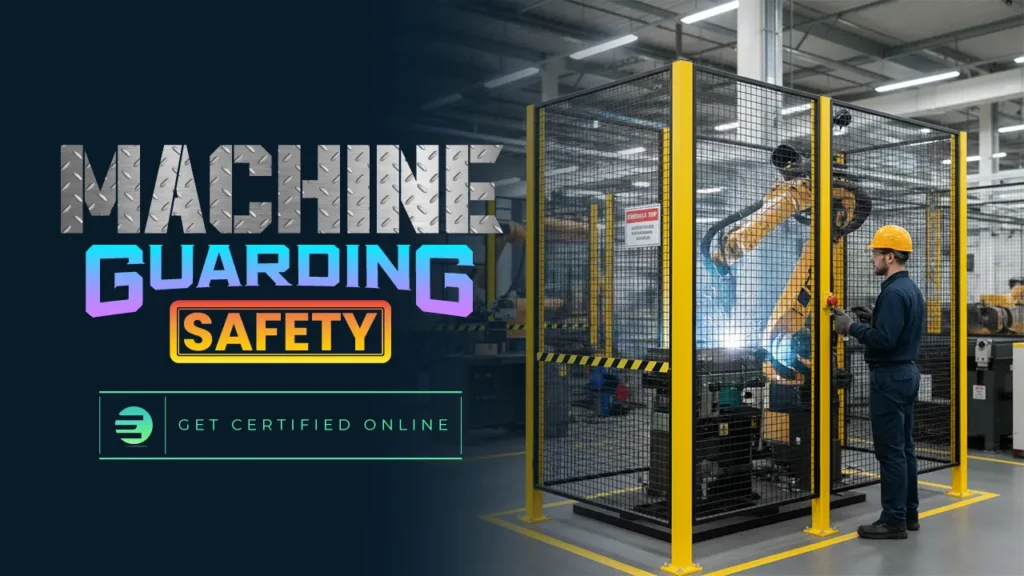
- Machine Guarding Safety. You are on it. The general course, built to 29 CFR 1910.212, which applies to every machine in the building: saws, lathes, drill presses, mills, grinders and anything else with moving parts.
- Machine Guarding for Mechanical Power Presses. The same thirty minutes spent entirely on power presses under 29 CFR 1910.217, which has its own rules that 1910.212 does not carry. Buy it on top of this course, not instead of it. View the Machine Guarding for Mechanical Power Presses
- Lockout Tagout. One hour on 29 CFR 1910.147, the energy control side. A guard protects you while the machine runs; lockout protects you once you have to open it up. View the Lockout Tagout
- Hand Protection Safety. Thirty minutes on gloves under 29 CFR 1910.138. Worth knowing that this course says plainly a guard comes before a glove, and a glove near a rotating part is its own hazard. View the Hand Protection Safety
If your floor has presses, take both guarding courses. If it does not, this one covers the machines you have.
What Does OSHA Require a Machine Guard to Do?
29 CFR 1910.212(a)(1) requires one or more methods of machine guarding to protect operators and others from hazards such as the point of operation, ingoing nip points, rotating parts, and flying chips and sparks.
- It goes on the machine if it can. 29 CFR 1910.212(a)(2) says guards shall be affixed to the machine where possible, and secured elsewhere if attachment is not possible. A guard leaning against a frame is not a guard.
- The point of operation is the part that must be covered. Under 1910.212(a)(3)(ii), the point of operation of machines whose operation exposes an employee to injury shall be guarded, and the guarding must keep the operator out of the danger zone during the operating cycle.
- OSHA names the machines by type. 1910.212(a)(3)(iv) lists guillotine cutters, shears, alligator shears, power presses, milling machines, power saws, jointers, portable power tools, and forming rolls and calenders as needing point of operation guarding.
- The guard cannot become the hazard. A guard that creates a new pinch point, blocks the operator's view of the work or makes them reach around it has traded one hazard for another. The course treats that as a failed guard, not a compliant one.
Four tests, one question: does it stop contact, stay put, add nothing new, and let the job still get done? A guard that fails any of them will not survive an inspection or a shift.