

Power Press Training or General Machine Guarding?
eTraining has a course for machines in general and one for the machine with its own OSHA standard.
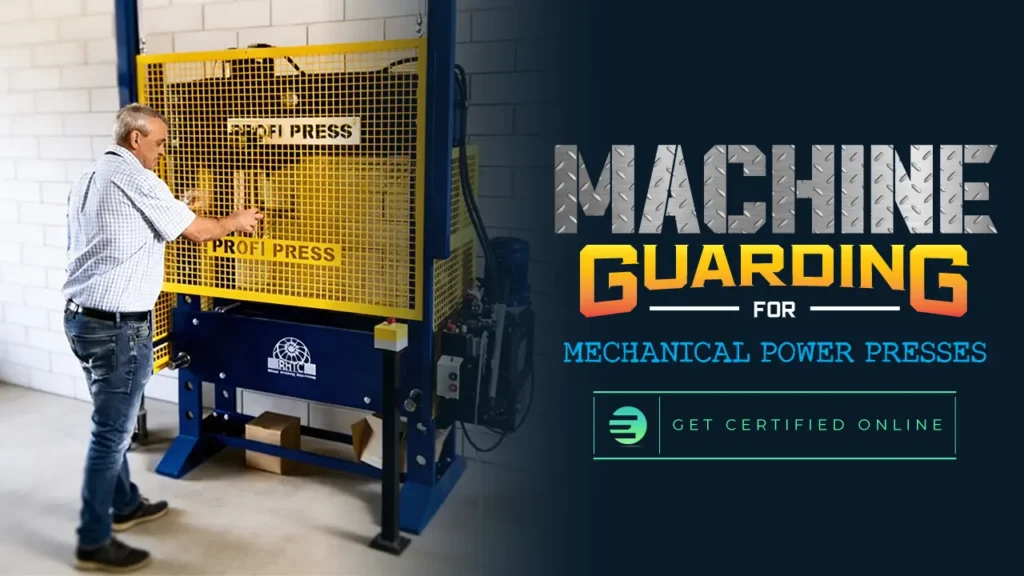
- Machine Guarding for Mechanical Power Presses. The page you are on. Mechanical power presses under 29 CFR 1910.217: clutch types, point of operation devices, safety distance and press inspection.
- Machine Guarding Safety. The general course under 29 CFR 1910.212, covering guarding for machines of all kinds: nip points, rotating parts and flying chips. View the Machine Guarding Safety
Shops that run presses usually need both: the general course for the floor, this one for the press line.
What Does OSHA Require for Mechanical Power Press Safeguarding?
29 CFR 1910.217 sets the rules for point of operation guarding, and the clutch type decides which ones you can use.
- Guard the point of operation. The employer must provide and ensure use of point of operation guards or devices on every operation performed on a mechanical power press (1910.217(c)(1)(i)).
- Single stroke and anti-repeat. Manually fed presses need a single stroke mechanism and an anti-repeat feature so one actuation gives one stroke (1910.217(b)(7)).
- Keep the hands away. Two-hand trips and two-hand controls must be far enough from the point of operation, using the 63 inches per second hand speed constant (1910.217(c)(3)).
- Check it before each shift. Presses must be inspected and tested regularly, with records kept, and worn or damaged parts repaired before use (1910.217(e)).
Presence sensing devices are only allowed on part revolution presses with a brake monitor, which is why the course separates the two clutch types.