
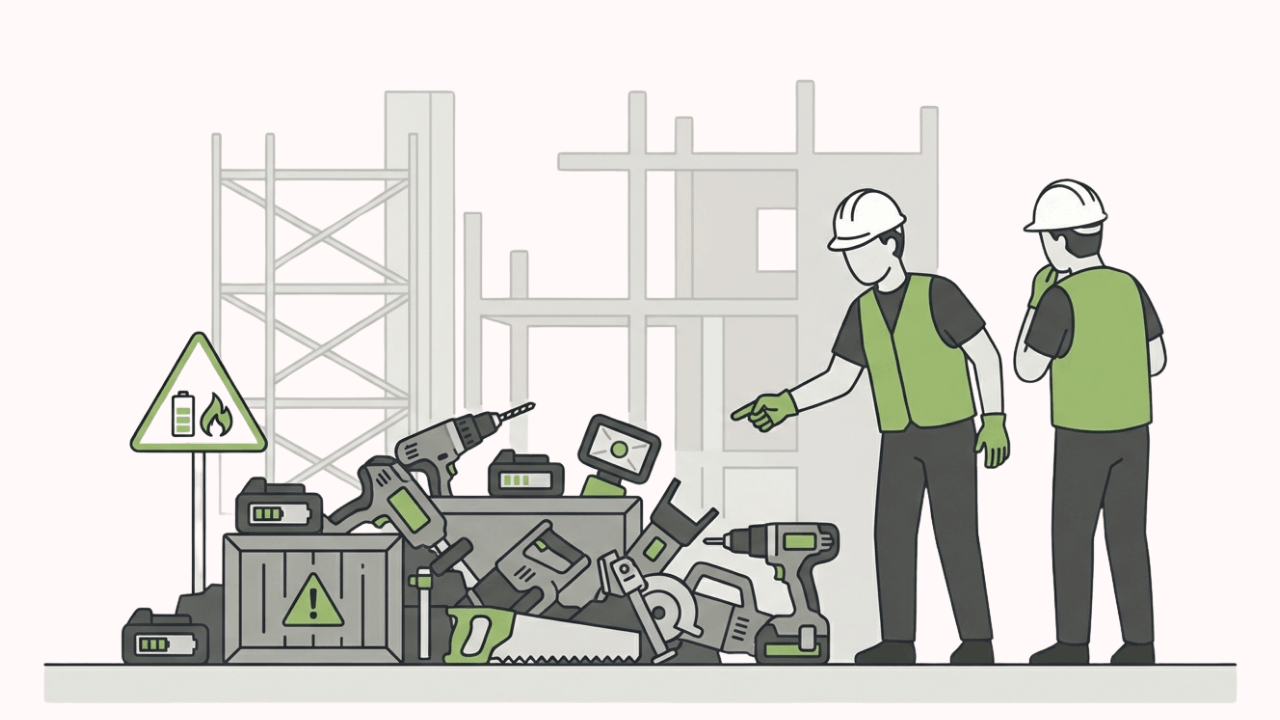
Construction sites check every box for lithium battery failure. Heat exceeding 100°F. Constant vibration. Impact damage. Dust in charging ports. A typical 20-person crew handles 40 to 60 batteries every shift, and most workers have never been trained to recognize when one is about to go into thermal runaway.
The U.S. Consumer Product Safety Commission (CPSC) documented more than 25,000 fire or overheating incidents involving lithium-ion batteries across the United States between 2017 and 2022 spanning over 400 types of battery-powered consumer products.
In February 2026, OSHA issued a Letter of Interpretation clarifying that lithium battery injuries, even from personal devices brought to the jobsite, must be recorded on OSHA Forms 300, 301, and 300-A when they meet general recording criteria under 29 CFR 1904.7. The specific scenario involved an employee’s personal e-cigarette battery sparking a fire. OSHA’s position: if the worker was at the workplace during assigned hours, the injury is recordable regardless of whether the battery was employer-provided.
Construction Sites Are Powder Kegs for Lithium Battery Incidents
Every industry that uses lithium batteries has risk. But construction sites concentrate the exact conditions that accelerate battery failure and thermal runaway through heat exposure, vibration, and impact damage. Most workers cannot identify damaged batteries.
Heat. Gang boxes sitting in direct sun regularly exceed 120°F. Lithium-ion batteries begin degrading above 100°F, and the risk of thermal runaway climbs sharply above 130°F.
Impact. Batteries get dropped from scaffolding, knocked off work surfaces, and bounced around in truck beds. Internal cell damage from impact may not be visible externally — but it can trigger a short circuit hours or days later.
Vibration. Hours of continuous vibration from operating tools stresses internal battery connections over time.
Dust and debris. Charging ports clogged with construction dust can cause arcing or improper connections during charging.
Volume. A 20-person crew easily handles 40-60 lithium batteries per shift — drills, impact drivers, circular saws, grinders, work lights, laser levels, tablets, phones.
None of these conditions are unique individually. But construction sites combine all of them, all day, every day. That’s what makes them different from a warehouse or an office. Unlike controlled environments like warehouses or manufacturing facilities, construction sites expose batteries to exactly the conditions that trigger thermal runaway, the self-sustaining chain reaction that can reach temperatures exceeding 1,100°F in seconds.
But environmental exposure isn’t the only problem. The operational gap is worse.
The Lithium Battery Training Gap
The Lithium Battery Training Gap construction workers have never been trained to recognize when a lithium battery has become dangerous. They don’t know:
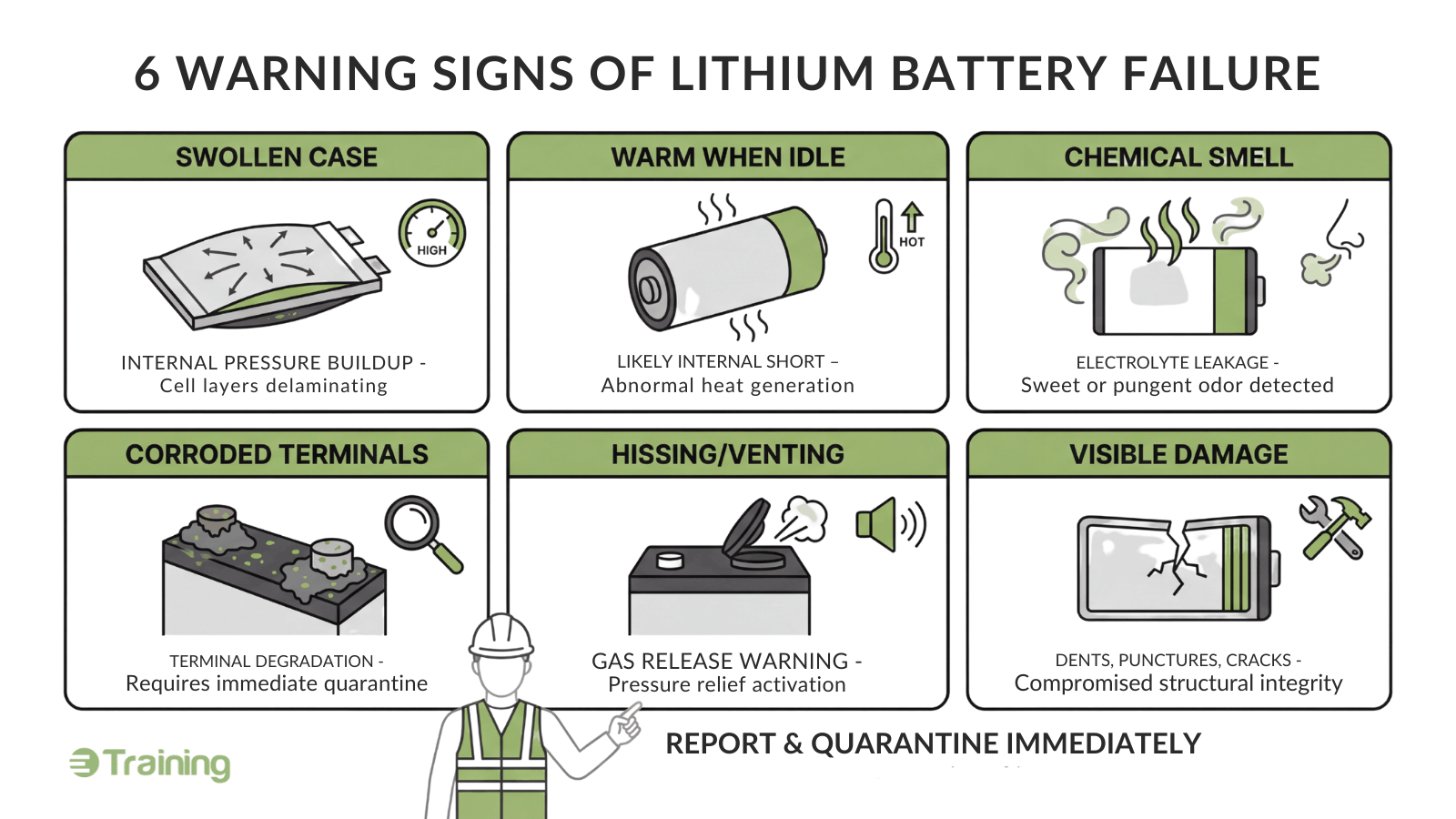
- A slightly bulging battery case = internal pressure buildup
- Battery warm when not in use = likely internal short circuit
- Chemical odor = electrolyte leakage
- Visible corrosion at terminals = requires immediate quarantine
- Hissing sounds = gas venting before thermal event
So damaged batteries stay in rotation. They get charged overnight, unmonitored, in enclosed gang boxes. Multiple units, side by side, next to flammable materials.
The Overnight Charging Crisis
Workers plug batteries into chargers at end-of-shift, leave the site, and those batteries charge unsupervised for 10-12 hours. Multiple chargers running simultaneously in enclosed spaces. No smoke detection. No fire suppression. No monitoring for warning signs. When thermal runaway occurs during overnight charging, there’s no one to catch it early. By the time alarms trigger, fire has often cascaded to adjacent batteries.
Unlike conventional fires that require oxygen, lithium battery thermal runaway generates its own oxygen as part of the chemical reaction. Water and standard fire extinguishers are largely ineffective. The fire can reignite hours or days after appearing extinguished.
The Gateway Energy Storage facility fire in San Diego (May 2024) burned for seven consecutive days with periodic flare-ups, required an EPA-ordered cleanup, and involved nearly 15,000 lithium-ion battery units. In January 2025, the Moss Landing battery facility in California, one of the world’s largest, burned through 80% of its battery storage, forced evacuation of 1,200 residents, and released heavy metals into the surrounding environment.
These are industrial-scale incidents. But the chemistry is the same as the 20V battery on your worker’s drill.
What Needs to Happen
Lithium batteries aren’t going away, and they shouldn’t. Cordless tools transformed productivity and eliminated real hazards (extension cord trips, generator fumes). The solution is treating lithium batteries with the same systematic approach we apply to other recognized hazards.
Lithium Battery Safety Training Training
Train workers on hazard recognition. Every person handling battery-powered equipment needs to know the warning signs of battery failure, what to do when they find a damaged battery, and basic safe charging practices. (Lithium Battery Awareness Course)
Train supervisors on damaged, defective, and recalled (DDR) battery handling. Tool room managers and site safety personnel need to understand DOT packaging requirements (49 CFR 173.185), quarantine procedures, Special Permit requirements, and how to work with certified disposal contractors. (COMING SOON: eTraining: Lithium Battery DDR & Thermal Runaway Events)
The courses satisfy OSHA-recommended training (Bulletin 4480), DOT requirements (49 CFR 172.704) and were developed in Partnership with a EPA Superfund site expert, built on real incident cleanup experience, not academic theory.
Build physical controls
Designated charging areas with ventilation and fire suppression. Daily battery inspection protocols. Quarantine procedures for batteries that fail inspection. Clear signage. Emergency response plans that account for lithium fire behavior, specifically, the massive water volumes needed and the reignition risk.
Document everything
With OSHA’s 2026 recordkeeping clarification, battery incidents now have direct compliance implications. Insurance auditors and OSHA inspectors are increasingly asking for proof of battery safety training. If you can’t produce documentation, you have a gap.
Frequently Asked Questions
1. What OSHA regulations cover lithium battery safety on construction sites?
No specific OSHA standard exists. OSHA Bulletins 4480 and SHIB011819 provide guidance. DOT regs 49 CFR 173.185 and 172.704 govern damaged battery disposal. In Feb 2026, OSHA clarified battery injuries must be recorded on 300 logs. IATA now mandates ≤30% charge for batteries shipped by air.
2. What are warning signs of a damaged lithium battery?
Bulging case. Warm when idle. Chemical odor. Corroded terminals. Hissing (gas venting). Rapid discharge or charge failure. Physical damage – dents, punctures, cracks. Discoloration or leaking fluid. Remove from service immediately. Quarantine away from flammable materials. Never charge.
3. Can you put water on a lithium battery fire?
Lithium battery fires generate their own oxygen during thermal runaway. Standard extinguishers are ineffective. Massive water volumes, thousands of gallons, can cool the fire. Temperatures reach 1,100°F. Reignition can occur hours or days later.
4. How should construction sites dispose of damaged lithium batteries?
Damaged batteries are hazmat under DOT 49 CFR 173.185. Quarantine, package in DOT-compliant containers, label, transport with special permits when required. Never put in regular trash or recycling. Improperly discarded batteries are a leading cause of waste facility fires. Work with certified disposal contractors. Document everything.
References: CPCS, OSHA, DOT