
Safety retaliation is a systematic culture failure that makes your reporting data a lie. When workers fear backlash, they hide injuries and hazards. The March 6, 2026 Union Pacific finding confirms that OSHA whistleblower protection is a top enforcement priority. These eight concrete systems move beyond legal theory into manager behavior and rigorous documentation. Use these points to ensure reporting remains safe and defensible.
The scale of enforcement underscores why this matters now. In FY 2023, OSHA received 3,243 whistleblower retaliation complaints, a nearly 15% increase over the prior year. Roughly 71% of those complaints were filed under Section 11(c) of the OSH Act. These are not hypothetical risks. They are active, growing caseloads that affect every industry represented in this article.
8 Systems to Strengthen OSHA Whistleblower Protection
1. Separate Injury Reporting from Disciplinary Decisions
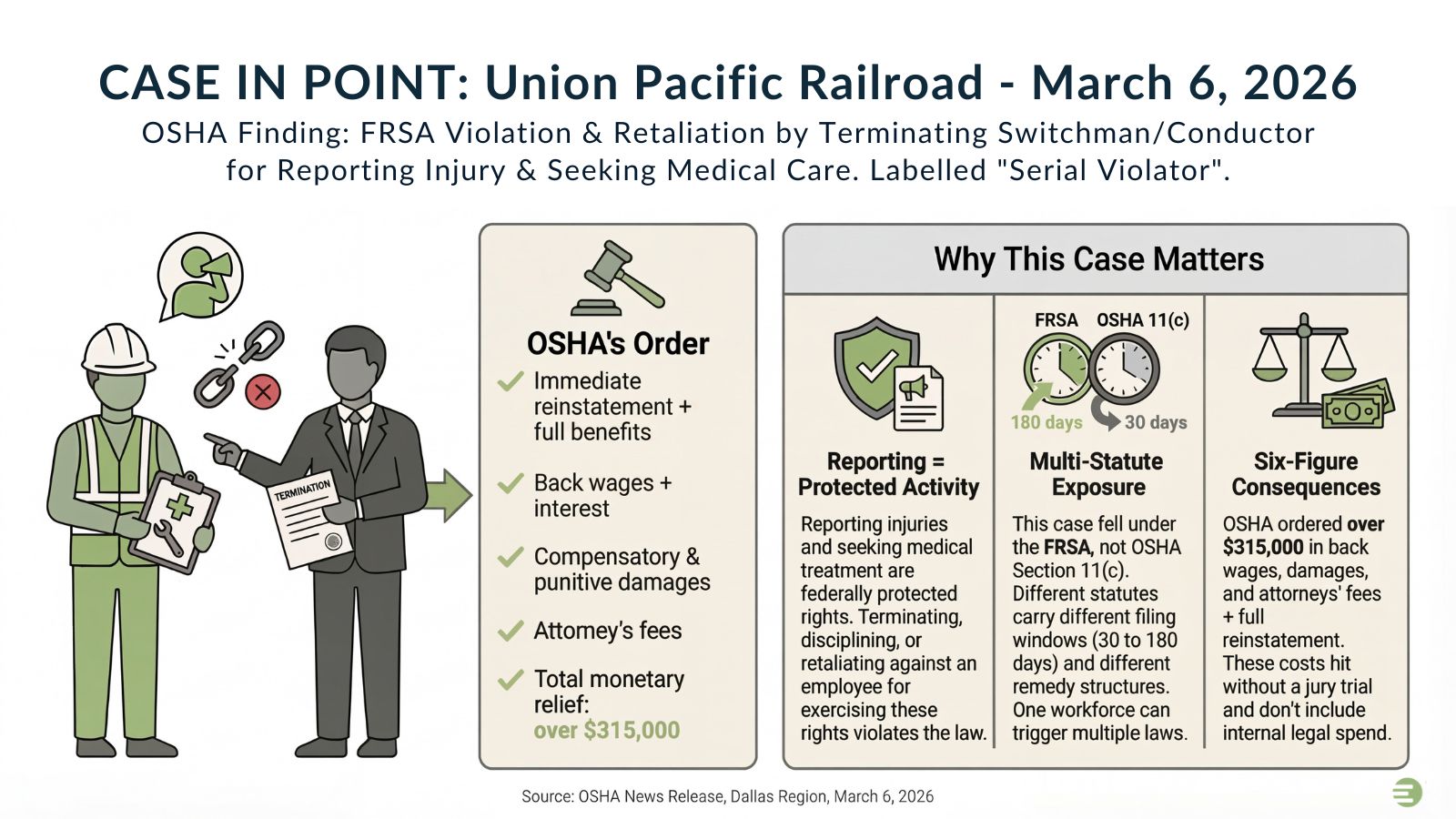
The Union Pacific case illustrates why routine injury reports become six-figure liabilities. OSHA found the company wrongfully terminated an employee following an injury report, ordering immediate reinstatement and six-figure monetary relief.
This enforcement posture highlights a critical risk: reporting injuries or seeking medical care are core protected activities. To strengthen OSHA whistleblower protection, treat every report as a high-risk operational flag. You must enforce a strict “firewall” between incident investigations and HR disciplinary decisions.
Retaliation Red Flags:
🚩 Sudden attendance discipline shortly after a report.
🚩 Performance write-ups following an injury claim.
🚩 Increased scrutiny of historical conduct post-incident.
Retaliation creates a chilling effect that destroys safety culture. When workers see peers penalized for reporting, the entire team stops flagging hazards, hiding risks until they become catastrophic.
2. Enforce a 30-Day “Protection Risk Hold”
Most OSHA 11(c) retaliation complaints must be filed within 30 calendar days of an adverse action. This tight window makes “temporal proximity” between a safety report and a firing look suspicious to investigators. However, it also creates an operational advantage: controlling the clock for just one month allows you to effectively strengthen OSHA whistleblower protection.
Prevent reactive manager decisions by implementing a 30-day protection risk hold following any protected activity. This requires a mandatory second-level review for any discipline, termination, or schedule changes during this period.
Internal SOP Snippet:
- IF: Protected activity occurred < 30 days ago.
- THEN: Escalate discipline request for second-level HR or Safety review.
Reinforce these expectations during Safety Awareness for New Employees to ensure reporting rights are part of your baseline culture. By the time the filing window closes, your documentation should be ironclad.
3. Map Your Defense to the Four-Part OSHA Intake Logic
OSHA uses a four-part logic gate to determine if a retaliation complaint has merit. Understanding this sequence allows you to audit supervisory behavior before a subpoena arrives. An investigable claim requires four specific elements:
- Protected Activity: The employee reported a hazard or exercised a legal right.
- Employer Knowledge: Management knew or suspected the report existed.
- Adverse Action: The employer issued discipline, a demotion, or a discharge.
- Motivation: The protected activity contributed to that action.
You can lose on process even if your facility is perfectly safe. Maintain “decision-maker hygiene” by ensuring the supervisor issuing discipline is unaware of any safety reports. Always document performance or policy violations before protected activity occurs. A write-up appearing three days after a hazard report creates an easy retaliation narrative. A consistent coaching trail proves legitimate intent.
4. Spot and Audit “Quiet Retaliation” Patterns
Reddit worker narratives reveal a pattern where managers rarely fire whistleblowers outright. Instead, they “squeeze” employees via scheduling until they resign. OSHA identifies these moves as adverse actions that undermine whistleblower protection, including:
- Reduced hours or overtime
- Harassment and intimidation
- Negative performance evaluations
- Threats
To mitigate risk, implement a protected activity log tied to scheduling and discipline data. Run an 8-week diagnostic comparing the reporter’s hours against their peer group. Divergent trends against a stable group signal high-risk liability. Use this data for supervisor coaching. Explain that while frustration is human, schedule manipulation is a legal trap. You cannot build a reporting culture if employees face quiet punishment for honesty.
5. Protect “Good Faith” Reports (Even When They’re Wrong)
Most managers assume they can fire employees for filing incorrect safety reports. They are wrong. Equating a factual error with a lie is the fastest way to weaken OSHA whistleblower protection in a case you will likely lose.
Protection hinges on “good faith,” not accuracy. If an employee genuinely believes a hazard exists, they are protected. To stay defensible, move from a punitive reflex to a systematic response:
- Train supervisors on “good faith vs. knowingly false” distinctions.
- Implement a “thank you + close the loop” protocol for every report.
- Provide technical data when allegations are unsubstantiated.
- Publicize system fixes and near-miss learnings without assigning blame.
This approach prevents a minor safety complaint from becoming a high-stakes retaliation case through impulsive managerial reactions.
6. Audit Your Risk Across OSHA’s Multi-Statute Portfolio
OSHA enforces 25 whistleblower statutes beyond the OSH Act. Consequently, OSHA whistleblower protection claims often involve laws with distinct filing deadlines, such as the Federal Railroad Safety Act (FRSA) seen in the Union Pacific case.
Industrial leaders often assume a claim is invalid if it lacks a direct workplace safety component. However, logistics hubs and rail-served sites operate under multiple jurisdictions where different statutes apply to different segments of the workforce. To reduce liability, map your organization’s exposure across these sectors:
- Construction
- Commercial trucking
- Rail transport
- Environmental services
Standardize your internal behavioral controls to be statute-agnostic. When a report involves a specialized sector, require a review by counsel familiar with that specific statute before taking adverse action.
Federal statutes are only part of the picture. Twenty-seven states and U.S. territories operate OSHA-approved State Plans with their own anti-retaliation provisions that must be at least as protective as federal law. Some state plans carry longer filing windows or broader definitions of protected activity. Employees can file whistleblower complaints with the State Plan, federal OSHA, or both. If your workforce spans multiple states, your compliance program must account for the most protective standard in each jurisdiction.
7. Redesign Incentives to Stop Reporting Suppression
Tying supervisor KPIs to recordable injuries makes reporting a financial liability. This is the primary driver of weakened OSHA whistleblower protection because managers often suppress reports to protect their own bonuses. Eliminate these self-inflicted wounds:
- “Safety streak” bonuses that incentivize hiding injuries.
- Attendance systems that penalize medical visits.
- Over-indexing on lagging indicators.
Shift focus to leading indicators. Reward the volume of near-miss reporting and the closure rate of hazard fixes rather than just “zero accidents.” Most importantly, decouple injury reporting from disciplinary systems or performance bonuses to remove the motive for silence.
Audit your system with one question: “Would a reasonable worker believe reporting an injury costs them money or status?”
If so, you have built a suppression engine that invites federal scrutiny.
8. Separate Whistleblower Rewards from Safety Remedies
Does an OSHA whistleblower get a “cut” of the fines your company pays? Some industry content suggests safety reporting is a lucrative “bounty hunting” game. This conflates two very different legal frameworks.
Unlike the False Claims Act (qui tam), where relators receive a percentage of recovered funds, standard OSHA 11(c) cases are strictly remedy-driven. There is no percentage-based reward for flagging a hazard. Instead, OSHA pursues “make-whole” relief. This typically includes:
- Reinstatement to their position.
- Back pay with interest.
- Compensatory damages and attorney’s fees.
The Union Pacific monetary order shows these costs are substantial. However, these payments cover actual losses rather than providing a “lottery” payout. Smart leaders focus on systematic risk management instead of assuming employees are trying to “cash in.”
How to Implement an OSHA Whistleblower Protection Program
Whistleblower protection fails when companies treat it as a compliance poster instead of a deployable process. Use this roadmap to build a decision firewall that assumes manager behavior will drift without structural controls. Before starting, review the 30-day clock, the four elements of intake, signs of quiet retaliation, and incentive redesign.
Step 1: Define Protected Activities and Adverse Actions
Define protected activities and adverse actions on a single page using OSHA’s broad framing. Document site-specific examples for your team that go beyond termination. Include actions such as schedule cuts, overtime denials, and the assignment of undesirable tasks.
Step 2: Publish a No-Retaliation Standard
Publish a standard that managers cannot misread. List prohibited behaviors like social isolation or excessive scrutiny. Provide an escalation path for supervisors who believe a report is stalling valid performance management.
Step 3: Deploy Dual Reporting Channels
Maintain an anonymous hazard reporting system for technical safety issues. Establish a separate, named channel for retaliation concerns managed jointly by HR and Safety. This ensures these sensitive claims receive immediate visibility from leadership.
Step 4: Create a Decision Firewall
Require a second-level approver and a full documentation packet for any employment action involving an employee who performed a protected activity in the last 90 days. This control stops reactive or heat-of-the-moment terminations.
Require document retention for the full duration of any OSHA inquiry. Incomplete or missing records create adverse inferences during investigation, and spoliation of evidence can independently support a retaliation finding. Centralize all records related to protected activity, discipline, and scheduling in a single case file that legal counsel can access immediately upon notice of a complaint.
Step 5: Conduct Scenario-Based Training
Scrap legal definitions during supervisor training. Focus on role-playing common failures like sarcasm or calling an employee “not a team player.” Layer a manager-specific module on top of the Safety Awareness for New Employees baseline.
Conduct this training annually, at minimum. A single onboarding session does not account for manager turnover, evolving case law, or the behavioral drift that occurs over time. Annual reinforcement keeps retaliation prevention front-of-mind and gives your legal team a defensible training record.
Step 6: Audit Incentives and Lagging Indicators
Remove any bonuses that punish injury reporting. Replace these with leading-indicator metrics that reward the volume of identified hazards and the speed of their resolution.
Step 7: Standardize the OSHA Inquiry Response
Preserve all relevant records immediately if you receive an inquiry. Centralize the response through a single point of contact and involve legal counsel. This ensures your narrative remains prompt and consistent across all departments.
Frequently Asked Questions (FAQ)
1. Can a worker file an OSHA whistleblower complaint anonymously?
Technically, no. While OSHA maintains confidentiality during the initial intake, the agency must eventually disclose the complainant’s identity to the employer so the company can respond to specific allegations. Instead of launching a search to identify the reporter, focus your resources on investigating the safety hazard itself. Attempting to unmask a whistleblower often creates more legal liability than the original safety concern. Workers can file complaints online at whistleblowers.gov, by phone at 1-800-321-OSHA (6742), or by visiting any OSHA regional or area office.
2. What is the deadline for filing an OSHA 11(c) complaint?
The filing window is extremely short. Employees must file an 11(c) complaint within 30 calendar days of the adverse action. Note that other statutes OSHA enforces, such as the Surface Transportation Assistance Act, allow up to 180 days. Leaders should treat the first month following any safety report as a high-risk period where all disciplinary decisions require mandatory second-level approval.
3. What qualifies as retaliation if the employee was not fired?
Retaliation includes any “adverse action” that could chill a reasonable worker from reporting hazards. Common examples include reduced hours, denial of overtime, sudden negative performance reviews, or reassignment to less desirable tasks. To mitigate this, implement a systematic review of scheduling and discipline data for any employee who has recently engaged in protected activity.
4. Is it retaliation if the employee reported a hazard that was not actually a violation?
Yes. Legal protection hinges on the employee’s “good faith” belief that a hazard existed, not the technical accuracy of the report. Even if an inspection finds no violation, you cannot penalize the worker for speaking up. Focus on maintaining a clean internal process and professional managerial reactions regardless of the report’s validity.
5. Do OSHA complaints overlap with other agencies like the NLRB or EEOC?
Claims frequently overlap across multiple jurisdictions. A safety report might involve “concerted activity” under the NLRB or allegations of discriminatory treatment under the EEOC. Maintain a unified documentation system and consistent non-retaliation protocols to defend against these multi-agency risks.
6. Do state whistleblower laws provide additional protections beyond federal OSHA?
Yes. Twenty-seven states and U.S. territories operate OSHA-approved State Plans with anti-retaliation provisions that must be at least as protective as federal law. Some states provide longer filing windows, broader definitions of adverse action, or additional remedies not available under federal statutes. Employees can file retaliation complaints with the State Plan, federal OSHA, or both. If your organization operates across state lines, build your compliance program to the most protective standard in each jurisdiction.
Ready to scale your compliance systems? Standardize your training and oversight with an eTraining Business Account →
Sources: OSHA, Whistleblower Protection Program, FRSA