
If you generate hazardous waste and store it temporarily, you probably need RCRA hazardous waste training, not HAZWOPER. If you clean up contaminated sites, operate a treatment/storage/disposal facility, or have an emergency hazmat response team, then yes, HAZWOPER applies.
This is the most misunderstood OSHA standard in the safety industry, and getting it wrong costs companies thousands of dollars in unnecessary training or non-compliance penalties.
- 1,343 Superfund cleanup sites are currently on the National Priorities List (NPL) across the U.S.(July 2025).
- EPA ECHO lists ~700 operating hazardous waste treatment, storage, and disposal facilities (TSDF) facilities nationwide.
- Only a fraction of facilities generating hazardous waste actually need HAZWOPER training. Superfund/NPL sites are one common example where HAZWOPER-covered cleanup work occurs, but HAZWOPER is triggered by the type of work being performed, not the label on the site.
The confusion stems from one fact: HAZWOPER and RCRA hazardous waste training are different requirements that people constantly conflate. Companies either waste thousands of dollars training their entire team in unnecessary 40-hour HAZWOPER courses, or they skip required training entirely and expose themselves to serious violations.
Operations Covered Under OSHA’s HAZWOPER Standard (29 CFR 1910.120)
OSHA’s 29 CFR 1910.120(a)(1) is very specific about when HAZWOPER kicks in:
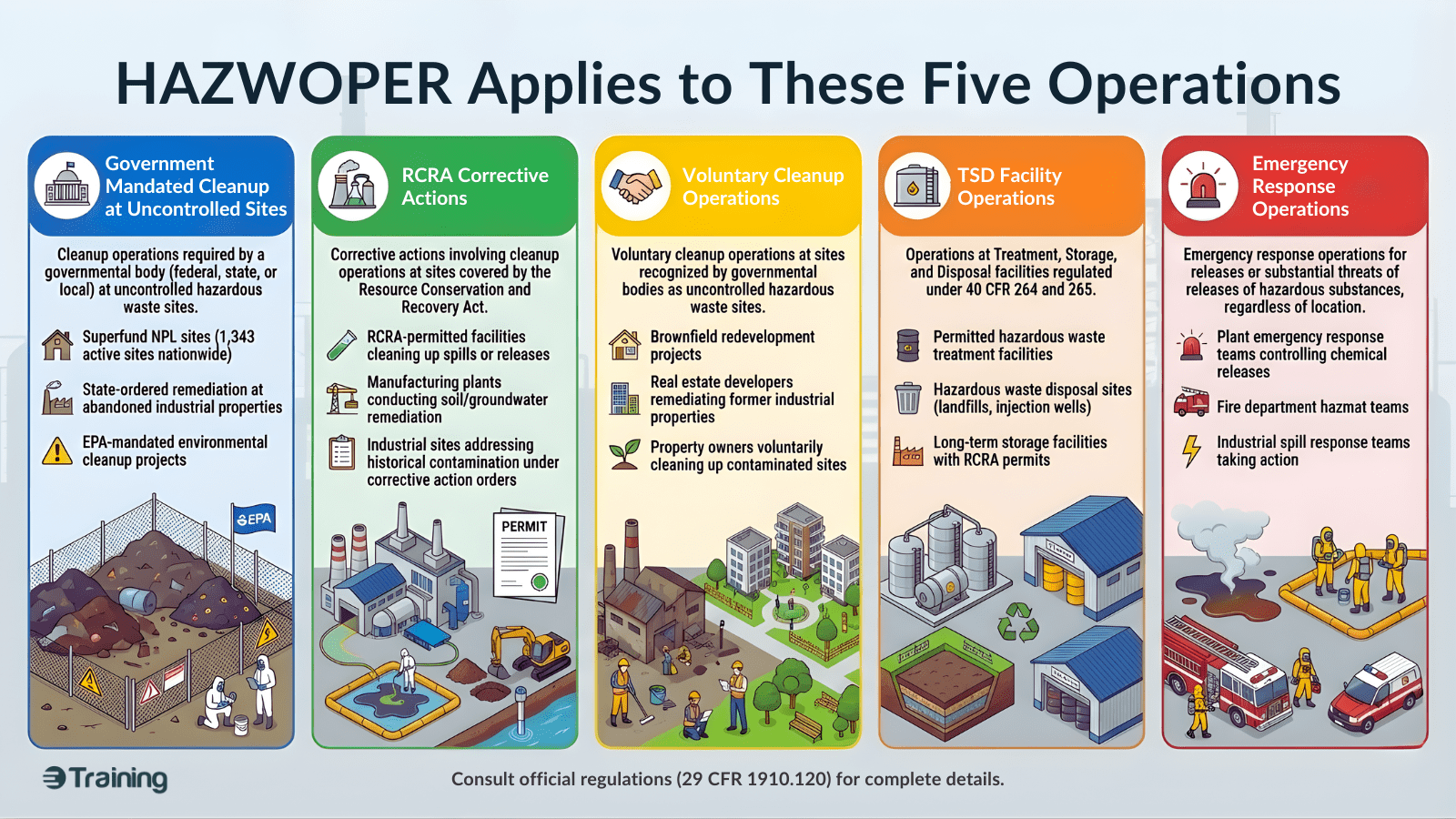
1. Government-Mandated Cleanup at Uncontrolled Hazardous Waste Sites
Cleanup operations required by a governmental body (federal, state, or local) at uncontrolled hazardous waste sites.
This covers:
- Superfund (NPL) site cleanup operations
- State-mandated remediation at abandoned waste sites
- Government-ordered environmental cleanup at contaminated properties
- Initial investigations of government-identified sites before characterization
1,343 Superfund cleanup sites are currently on the National Priorities List requiring HAZWOPER-trained workers. Since the CERCLA program began, hundreds of sites have been fully cleaned and deleted. As of 2024, 718 Superfund sites are in productive reuse, hosting 10,622 businesses that employ 242,187 people.
2. RCRA Corrective Actions
Cleanup operations at sites covered by the Resource Conservation and Recovery Act where contamination requires corrective action.
You’ll see this at:
- RCRA-permitted facilities cleaning up spills or releases
- Manufacturing plants conducting soil or groundwater remediation under corrective action orders
- Industrial sites addressing historical contamination under RCRA authority
3. Voluntary Cleanup Operations
Cleanup at sites recognized by governmental bodies as uncontrolled hazardous waste sites where cleanup is voluntary (not mandated).
Examples include:
- Brownfield redevelopment projects
- Private property owners cleaning up contaminated sites voluntarily
- Real estate developers remediating former industrial properties
4. TSD Facility Operations
Operations at Treatment, Storage, and Disposal facilities regulated by 40 CFR parts 264 and 265.
These facilities include:
- Permitted hazardous waste treatment facilities
- Hazardous waste disposal sites (landfills, injection wells)
- Long-term storage facilities with RCRA permits
Key distinction: Temporary storage (less than 90 days for large quantity generators) at the point of generation is NOT a TSD facility and does NOT require HAZWOPER.
5. Emergency Response Operations
Response to releases or substantial threats of releases of hazardous substances, regardless of location.
This includes:
- Plant emergency response teams who actively respond to and control chemical releases
- Fire department hazmat teams
- Industrial spill response teams
- Facility emergency coordinators who take action (not just evacuate)
“Incidental” spills cleaned up by the worker who caused them don’t require HAZWOPER (explained below).
HAZWOPER Does NOT Apply to These Common Scenarios
✗ Routine Hazardous Waste Generation and Management
If your facility generates hazardous waste from manufacturing, you need RCRA Hazardous Waste Training (40 CFR 262.16-17) instead.
This applies if you:
- Generate hazardous waste from manufacturing processes
- Accumulate waste in satellite accumulation areas
- Prepare waste for off-site disposal
- Manage waste storage areas (less than 90 days for LQG)
- Ship hazardous waste off-site
You need EPA’s RCRA hazardous waste personnel training, not OSHA’s HAZWOPER training.
✗ General Chemical Handling and Safety
Workers who use chemicals but aren’t involved in waste cleanup need Hazard Communication (HazCom) Training (29 CFR 1910.1200).
This includes workers who:
- Use chemicals in manufacturing processes
- Handle raw materials or finished products containing hazardous substances
- Work around chemicals but aren’t involved in waste cleanup or emergency response
These workers need HazCom training, not HAZWOPER.
✗ Incidental Spills
Small spills that workers clean up themselves don’t require HAZWOPER. You just need basic spill response procedures in your Emergency Action Plan.
An incidental release is one that does not pose a significant safety/health hazard and does not have the potential to become an emergency.
Example: Lab technician spills 500mL of acetone, uses spill kit to clean it up. This is incidental, not emergency response requiring HAZWOPER.
The Critical Confusion: HAZWOPER vs. RCRA Training
This trips up more safety managers than anything else. Here are the key differences:
| Feature | HAZWOPER (OSHA) | RCRA Hazardous Waste Training (EPA) |
| Regulation | 29 CFR 1910.120 | 40 CFR 262.17 (LQG: ≥1,000 kg/month); 40 CFR 262.16 (SQG: 100-1,000 kg/month) |
| Who needs it | Cleanup workers, TSD employees, emergency responders | “Hazardous waste personnel” at generator facilities |
| Focus | Worker health and safety during cleanup/response | Proper waste management to prevent environmental releases |
| Initial training | 24 hours + 1 day field OR 40 hours + 3 days field (cleanup sites); emergency responders: trained to competency level | Job-specific (varies); within 6 months of hire |
| Refresher | 8 hours annually | Annual (LQG); as needed to maintain familiarity (SQG) |
| Covers | PPE, decontamination, exposure control, site safety plans | Waste identification, storage requirements, DOT regulations, emergency procedures |
| When it applies | Cleanup sites, TSD facilities, emergency response | Facilities that generate hazardous waste |
Real-world scenario that clears this up:
Your manufacturing plant generates 5,000 kg of hazardous waste monthly. You have:
- Warehouse workers who label drums and prepare manifests → Need RCRA training
- Production staff who use chemicals in processes → Need HazCom training
- Emergency response team (5 people) trained to contain chemical releases → Need HAZWOPER training
- Everyone else → No HAZWOPER requirement
Wondering What HAZWOPER course applies for your job role?
Answer 3-4 quick questions about your operation type, role, and exposure scenarios and we’ll provide an accurate recommendation based on OSHA regulations for the training that applies to you. Takes 2 minutes, saves thousands in training costs or penalties.
About eTraining Inc.
We’ve delivered OSHA-compliant HAZWOPER training for 14+ years and help hundreds of facilities every year answer this exact question: “Do we actually need HAZWOPER?” Our courses meet 29 CFR 1910.120 requirements when you need them, and we’ll tell you honestly when you don’t.
References: OSHA, EPA, Government Accountability Office