


You’re managing five sites and 500 workers alone. If you think your physical presence is your primary safety tool, you’ve already lost. Scaling multi-site EHS management isn’t about more travel; it’s a system design problem. You must triage risk, standardize the essentials, and delegate responsibility to site champions. This playbook translates proven enterprise-level best practices into a practical, high-leverage system for solo operators. Success starts with triage. Your calendar should follow risk, not geography.
According to the Bureau of Labor Statistics, the construction industry consistently accounts for the highest number of fatal occupational injuries, reinforcing why triage systems are not optional for multi-site operators.
This article gives you the six systems. We also built every document referenced below into a free Multi-Site EHS Operating Toolkit → so you can implement them immediately.
Here’s how to manage safety across multiple sites when you’re a one-person department.
1. Build a Triage System for High-Leverage Risk Management
Most multi-site managers fail because they treat all locations as equal. High-leverage EHS management treats time as a finite asset and uses a calculated triage system to dictate your movements. Every Monday morning, you must answer one question: “Where do I spend my next four hours to maximize risk reduction?” If you can’t answer this in five minutes, you are reacting, not managing.
Triage Inputs: Effective triage requires monitoring two specific input streams to identify where your presence is required:
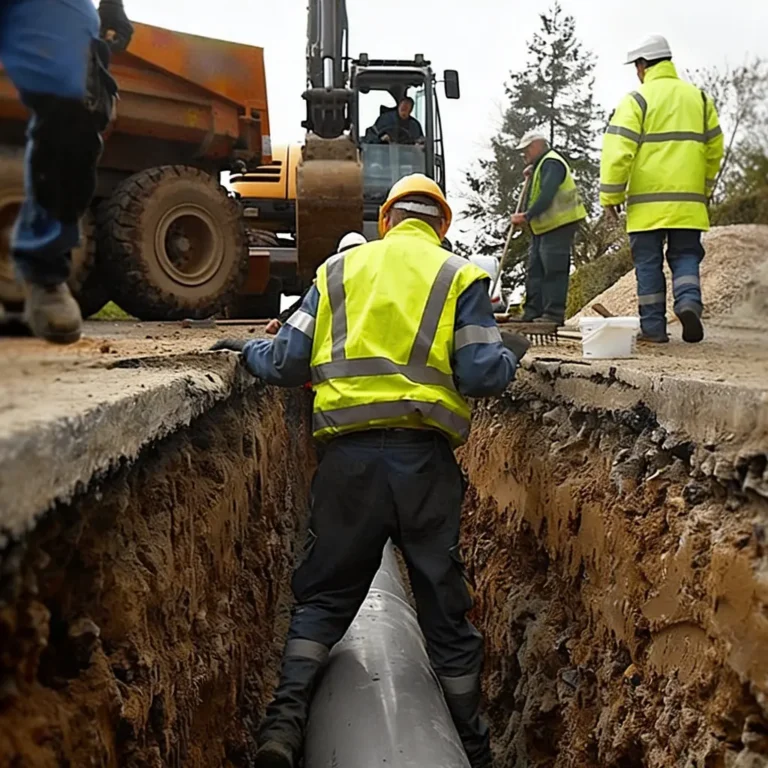
- High-Risk Activities: Monitor work at height, heavy lifts, trenching, or energized work. Pair these with “chaos variables” like new crews or extreme schedule pressure.
- Leading Indicators: Track overdue corrective actions, near-miss spikes, and missing training logs to spot systemic trouble before an incident occurs.
The 3-Tier Priority List: Map these inputs into a 3-tier system to drive your weekly calendar and remote check-ins:
- Red (Critical): Immediate site visit required. Reserved for high-risk work involving new subcontractors or sites with multiple indicator failures.
- Amber (Watch): Remote check-in or video walkthrough. Best for routine work with minor procedural lapses or maturing safety cultures.
- Green (Stable): Standard digital reporting only.
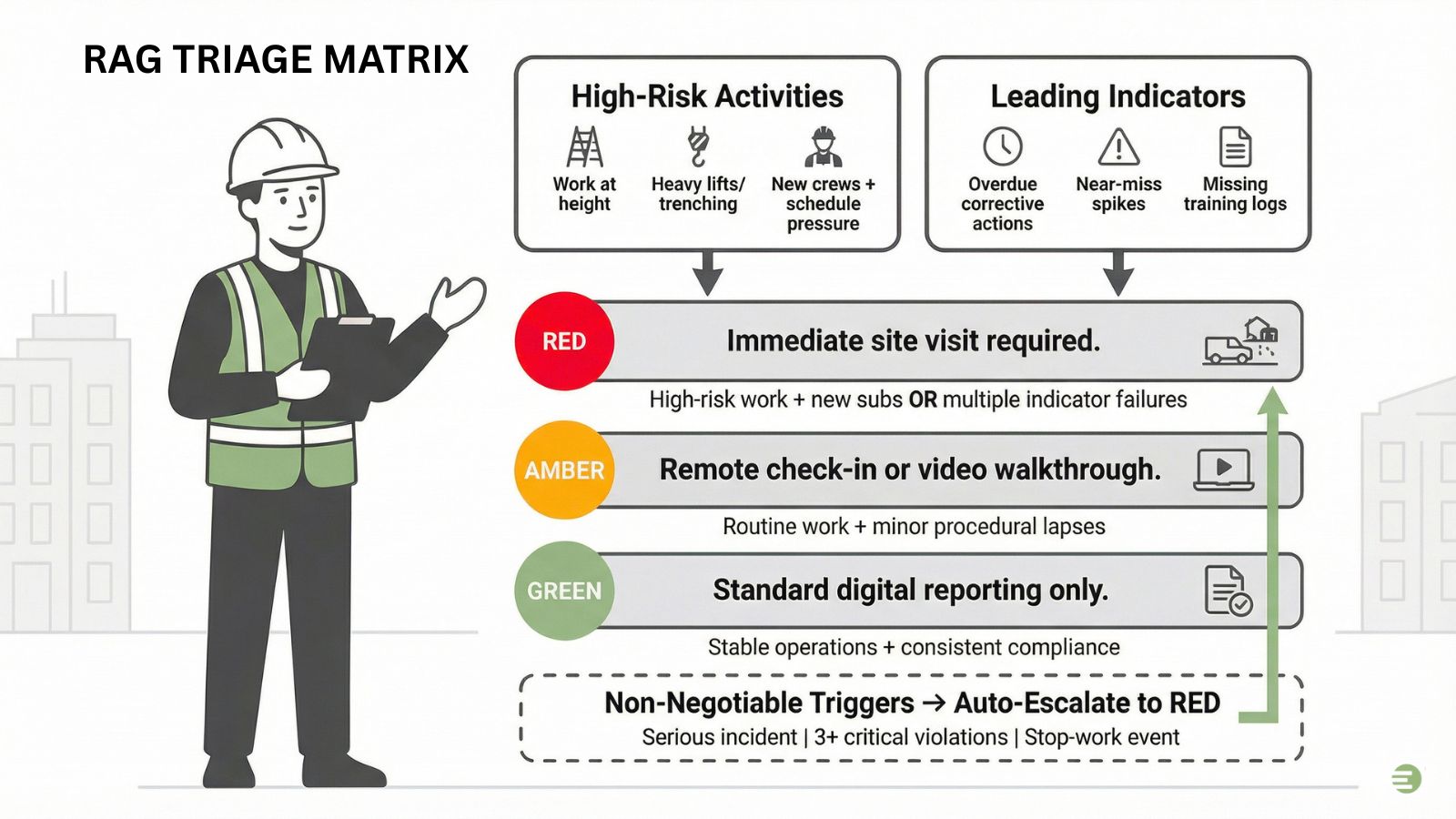
Practical Implementation: Maintain a one-page site profile for every location tracking scope, site leadership, and “non-negotiable triggers.” These triggers include serious incidents, three or more repeated critical violations, or any stop-work event initiated by the crew. Any trigger event results in an automatic escalation to the Red tier.
Triage is not neglect; it is defensible prioritization. When you manage multiple sites with one set of eyes, deciding where not to be is as vital as choosing where to stand. This system replaces reactive travel with a strategy that places you where the risk is highest.
2. Formalize Authority with a Written EHS Charter
In multi-site EHS management, local production pressure often collides with centralized safety expectations. When site leaders ignore corrective actions, it is usually because your authority is informal or ambiguous. Without a signed document, safety becomes a suggestion that managers override to meet deadlines. This friction is a human dynamic that software alone cannot solve.
The solution is a one-page EHS Charter signed by executive leadership. This document clarifies decision rights and accountability before conflicts occur. You are not asking for permission to manage safety; you are codifying the rules of the game. It ensures that safety standards are treated as operational requirements rather than personal favors.
What the Charter Includes: A high-leverage charter defines the rules of engagement across three specific areas:
- Scope: Explicitly states your authority as the program owner and the final word on regulatory compliance.
- Site Responsibilities: Defines site leader obligations, including mandatory time for training, toolbox talks, and closing corrective actions within set windows.
- Escalation Ladder: A predefined, non-negotiable path for stalled progress (Supervisor to PM to Ops Leadership to HR/Executive).
Operational Execution: Reference the charter during monthly scorecard reviews to shift accountability from the individual to the system. If a site leader misses inspections, you are not making a personal request. You are highlighting a failure to meet a signed corporate commitment.
Consider a scenario with repeated fall protection non-compliance. Instead of arguing with a supervisor, trigger the escalation ladder. If the PM fails to resolve the issue within 24 hours, the charter moves the ticket to the Ops Director. This systematic approach transforms you from a policeman into a high-level system auditor.
Multi-Employer Liability and the Charter’s Legal Weight
On multi-employer worksites, which are the norm for most construction and industrial operations, your charter carries additional legal significance. Under OSHA’s Multi-Employer Citation Policy (CPL 2-0.124), general contractors and employers with supervisory authority can be classified as “controlling employers” and cited for hazards created by subcontractors, even when their own employees are not exposed. Your charter should explicitly define subcontractor safety obligations, verification protocols, and escalation procedures for sub-tier non-compliance. This creates a documented “reasonable care” trail that OSHA evaluates when determining controlling employer liability. For a detailed breakdown of how multi-employer citations work and how to verify subcontractor training credentials, see our guide: How to Verify Subcontractor Training and Avoid OSHA Multi-Employer Citations.
3. Use a “Core Plus” System to Kill Policy Drift
Multi-site EHS management often devolves into a “choose your own adventure” version of safety. When one supervisor follows the manual while another ignores it due to “project differences,” you lose the ability to measure performance. This inconsistency creates a management bottleneck that forces you to reinvent the wheel every time you cross a site boundary.
The Core Plus architecture solves this by standardizing the high-leverage 20% of your program while permitting explicit local addenda. One core standard plus controlled local variation beats eight inconsistent versions of safety. This avoids “one-size-fits-all” failure by defining exactly what stays fixed and what stays flexible.
The Core (The Non-Negotiables): Universal systems allow you to aggregate data and maintain control from a central office. Your core 20% must include:
- Incident and near-miss reporting workflows.
- Universal JSA/JHA templates.
- Global stop-work authority and PPE baselines.
- Minimum inspection cadences.
- Subcontractor onboarding and vetting criteria.
These core elements map directly to the General Duty Clause under Section 5(a)(1) of the OSH Act and the general safety provisions at 29 CFR 1926.20.
The Local Addenda: Use addenda for jurisdictional or operational requirements that do not apply globally. These include state-plan differences like Cal/OSHA, site-specific client rules, and unique equipment hazards. If a requirement is not in the core, it lives here.
Governance Mechanics: Governance requires strict version control. You must be the sole owner of one digital repository containing dated revisions. OSHA’s Recordkeeping Policies and Procedures Manual (CPL 02-00-135) reinforces that standardized record formats are essential for regulatory defensibility across multiple establishments. Apply a single master rule: if a policy is not in the core standard or a signed addendum, it is not policy. This prevents “shadow safety programs” and ensures all site-level deviations are documented and defensible.
Most competitors fail by trying to force a single, massive manual onto every site. By explicitly permitting variation, you gain the compliance you actually need while eliminating the inconsistent rules that confuse crews and increase incident risk.
4. Define Your Delegation Architecture for Auditable Control
Trying to personally execute every safety task across multiple sites creates a bottleneck and invites burnout. Scaling multi-site EHS management requires a system that provides visibility without your physical presence. You must distinguish between operational execution and strategic oversight to ensure delegation remains safe and auditable.
Define what site leads handle versus what stays on your desk. High-frequency, low-complexity tasks belong in the field, while high-stakes strategy belongs to you.
Delegate to Site Leads:
- Routine inspections and PPE stock checks.
- Pre-task brief verification and photo documentation.
- Follow-ups on low-risk corrective actions.
Keep Under Your Control:
- Program design and regulatory strategy.
- Serious incident investigations and high-risk work approvals.
- Trend analysis to identify systemic risks across all sites.
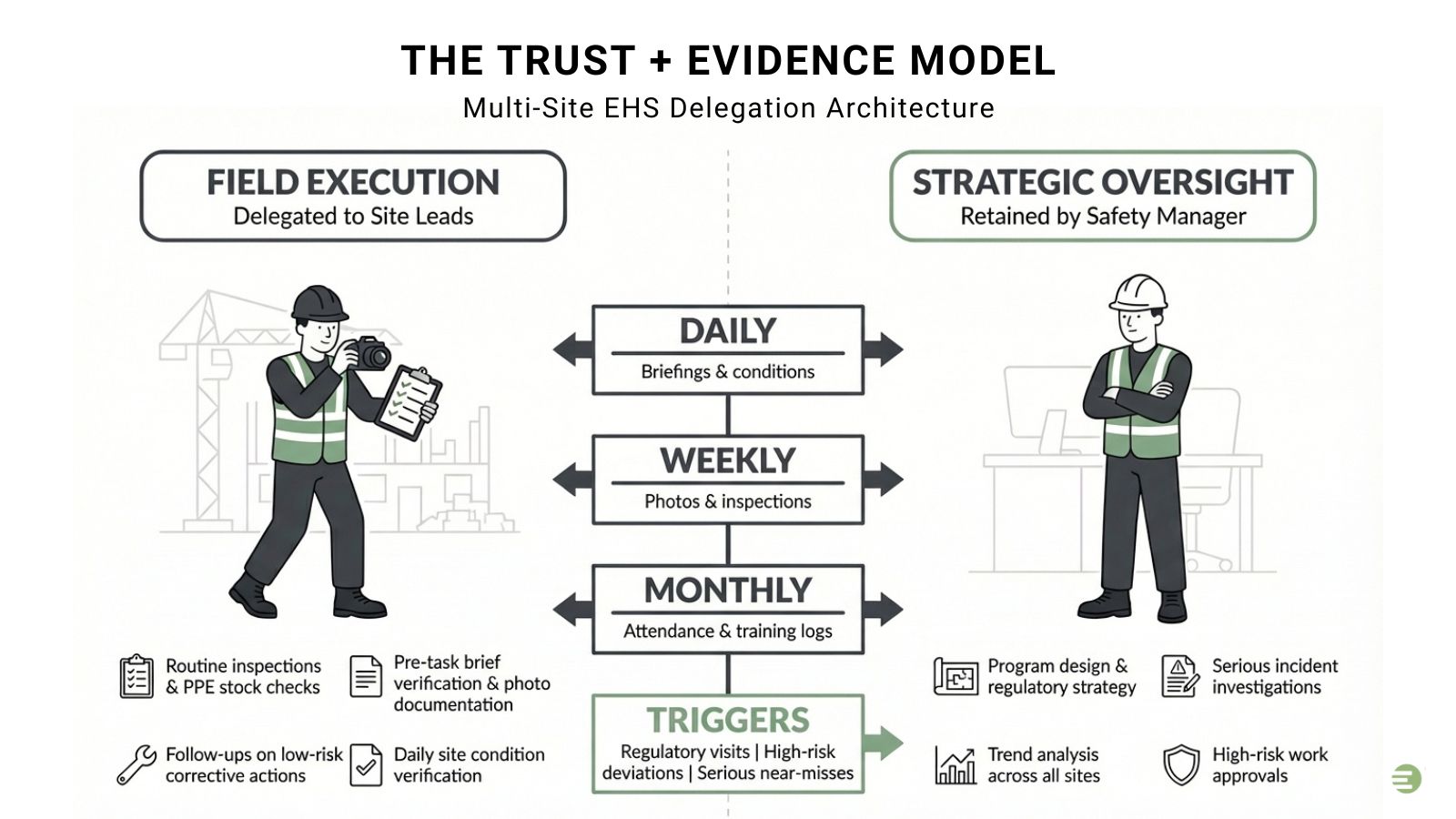
Build a supervisor checklist to standardize evidence submission. This ensures you are not just “handing off safety” but managing a predictable reporting cadence.
- Daily: Verify briefings and site conditions.
- Weekly: Upload timestamped photos and completed inspection forms.
- Monthly: Submit attendance logs and training records.
- Triggers: Mandate immediate alerts for regulatory visits, high-risk deviations, or serious near-misses.
Ensure competence through cross-training and one-page SOPs. These short job aids are more effective for busy supervisors than 50-page manuals. High-leverage programs use these aids to make correct execution the path of least resistance.
Delegation without verification is how solo programs fail. Move to a “trust + evidence” model where the system provides proof of compliance even when you are not on-site. If a supervisor cannot produce a timestamped photo or a signed log, the task effectively did not happen. This auditable trail protects the business and your professional reputation.
5. Build a Site Champion Network for Daily Visibility
Multi-site EHS management fails when you appoint a “mini safety manager.” Without authority, these roles become frustrated bottlenecks that crews eventually ignore. Use a site champion instead: a peer-level facilitator who maintains system visibility when you are absent. They act as the point-of-contact and facilitator, never the person legally responsible for safety.
Selection and Scope: Selection is the primary failure mode. Avoid picking the loudest person or forcing a supervisor into the role. Identify a volunteer who is respected by crews, calm under pressure, and a consistent communicator. Limit their scope to high-leverage activities to prevent burnout:
- Running weekly 15-minute micro-inspections.
- Validating that daily toolbox talks actually occurred.
- Flagging emerging hazards before they become incidents.
- Tracking the completion of open corrective actions.
- Assisting with safety onboarding for new site hires.
Maintaining the System: Sustainability requires a low-friction operating system that respects their primary job. Host a 30-minute weekly check-in to review findings and provide monthly recognition to maintain buy-in. Always train and rotate backups to ensure the system survives vacations or employee turnover.
Provide two templates to lower the barrier: a 10-point inspection checklist and a pre-written escalation script. The script allows champions to report issues to site leadership without the social friction of “snitching” on peers. Champions report task completion to local leadership while you retain total program ownership. This prevents compliance drift and ensures consistent site-level ownership during your absence.
6. Centralize Your Safety Data to Eliminate Shadow EHS
Managing multi-site compliance through Excel files and email threads creates a “data graveyard.” This “shadow EHS” pattern allows each site to maintain siloed records, hiding systemic risks until a major incident occurs. To scale oversight, you must replace scattered spreadsheets with a single source of truth that makes visibility the default.
Centralize your data in this specific order to maximize immediate leverage:
- Incident and near-miss reporting: Capture high-stakes data to identify immediate hazards before they escalate.
- Corrective and preventive actions (CAPA): Track the “loop closure” to ensure identified fixes actually reach completion.
- Digital inspections and audits: Standardize how you verify site conditions and regulatory requirements.
- Training compliance: Verify that every worker on every site has the necessary certifications.
Field tools must be mobile-first and offline-friendly. Construction sites frequently lack reliable Wi-Fi, so reporting workflows require clear fallbacks that sync data automatically once connectivity returns. Use role-based access so local supervisors can manage their own crews while you maintain the high-level dashboard and basic analytics filters for cross-site comparisons.
Scale your time by replacing manual orientations with self-paced digital courses. An eTraining business account provides a centralized dashboard to track multi-location compliance in real time. This system should include Spanish-language availability to ensure your entire crew is actually protected rather than just checking a box for documentation.
Finally, enforce strict governance through standard templates. If Site A uses different fields than Site B, your data is incomparable and useless for identifying broader trends. Consistent fields turn raw numbers into actionable leading indicators that reveal where to look before the next accident happens. This prevents fragmented information from undermining your ability to prove due diligence across the organization.
OSHA 300 Log Consolidation
Multi-site recordkeeping has a regulatory dimension that many solo operators overlook. Under 29 CFR 1904.30, employers must maintain a separate OSHA 300 Log for each establishment expected to operate for one year or longer. Short-term establishments can share a single log, grouped by division or region. Each employee must be linked to one establishment for recordkeeping purposes: if the injury occurs at one of your sites, it goes on that site’s log; if the employee is off-site, it goes on the log of their home establishment. You may centralize records at headquarters, but you must be able to transmit them to any site within the timeframes required by 29 CFR 1904.35 and 29 CFR 1904.40. Build this logic into your centralized data system from day one. Getting it wrong turns your single source of truth into a compliance liability.
How to Build a Multi-Site EHS Operating System
Multi-site safety fails when you treat it as a list of best practices instead of a functional operating system. When you manage five or more locations, ad hoc decision-making becomes your greatest liability. If you decide where to drive while drinking your Monday morning coffee, you are already behind the risk curve. You need a playbook that dictates your movements based on data. This systematic approach ensures that multi-site EHS management remains proactive, even when you are off-site.
Phase 1: Establish System Prerequisites
Before you execute a weekly schedule, install the foundational elements from the previous sections. Without these, your operating system lacks the logic required to function.
- Deploy the Triage Matrix: Define a specific set of leading indicators to rank sites as Red, Amber, or Green.
- Activate the Authority Charter: Secure signed executive backing that grants you the power to halt work or escalate failures across the portfolio.
- Appoint Named Owners: Assign a designated Supervisor Owner for accountability and a Safety Champion for daily facilitation at every site.
Phase 2: The Monday Triage Framework
Monday is for high-level strategy. Perform a digital sweep of your entire portfolio before leaving your office. Your goal is to re-rank every site and define your must-win actions for the week.
- Review Leading Indicators: Open your central dashboard and check for overdue corrective actions, sudden near-miss spikes, or gaps in training logs.
- Update RAG Status: Re-rank your sites based on the latest data. Move a Green site to Red immediately if they start a high-risk operation like trenching or demolition.
- Define Must-Win Actions: Select one or two high-impact tasks to define success for the week. An example is closing all open electrical findings at a specific high-risk site.
Expected Outcome: You will have a data-backed roadmap for the week that prioritizes high-risk environments over low-risk routines.
Phase 3: The Mid-Week Site Rotation (Tuesday to Thursday)
Your physical presence is a finite resource. Use your triage rankings to dictate a tiered visitation cadence that maximizes your impact where risk is highest.
- Set the Tiered Cadence: Visit Red sites weekly, Amber sites biweekly, and Green sites once per month.
- Execute Deep Audits: Use Tuesday and Wednesday for thorough audits on Red sites. Perform full site walkthroughs and comprehensive record reviews.
- Perform Drive-By Inspections: Use Thursday for shorter visits at Amber sites. Verify that specific corrective actions from previous reports are implemented.
- Adjust for Project Phases: Increase frequency for any site entering high-risk phases such as structural steel erection, regardless of its previous RAG status.
Expected Outcome: This rotation ensures you are physically present at the locations most likely to experience an incident.
Phase 4: The Friday Supervisor Delegation Checklist
Friday is for reinforcement and accountability. Use this day to close the loop with site supervisors and ensure the system remains operational over the weekend.
- Collect Completion Evidence: Confirm that supervisors have uploaded photo evidence for any corrective actions due that week.
- Follow Up on Stalled CAPAs: Identify any corrective and preventive actions that have stalled. Trigger the escalation ladder defined in your charter if deadlines are missed.
- Plan the Following Week: Schedule the toolbox talk topics for the coming week. This ensures site champions have the necessary materials before Monday morning.
Phase 5: Remote Compliance and Champion Onboarding
A solo operator cannot be everywhere at once. You must leverage technology and peer-level support to maintain visibility between physical visits.
- Implement Remote Monitoring: Use a centralized dashboard to monitor real-time inspection completion and training percentages.
- Set Up Offline Fallbacks: For sites with low connectivity, use offline digital forms that sync automatically once the user reaches a signal.
- Execute the 30-Day Champion Onboarding: Follow a strict plan for new Safety Champions. Provide micro-training in week one, conduct shadowed practice runs in week two, and run escalation drills in weeks three and four.
Expected Outcome: Your site champions will handle daily facilitation autonomously, reducing the need for your constant manual input.
Scale Your Impact with the Multi-Site EHS Operating Toolkit
Systematizing your EHS program is the only way to move from reactive firefighting to proactive risk management. This article gives you the framework. The toolkit gives you the actual documents to install the system Monday morning.
Download the Multi-Site EHS Operating Toolkit →
This is a working system, that includes:
- Weekly Triage Scorecard (Excel): Pre-built spreadsheet with Red/Amber/Green logic. Input your site leading indicators and get an auto-calculated RAG status and visit priority ranking every Monday.
- Site Profile One-Pager (Word): One per site. Tracks site leadership, safety champion contacts, escalation triggers, RAG history, key hazards, and applicable OSHA standards.
- EHS Charter Template (Word): The one-page authority document referenced in Section 2, ready for executive signature. Includes scope, site leader obligations, and the full escalation ladder.
- Supervisor Delegation Checklist (Word): The daily/weekly/monthly evidence submission schedule from Section 4, formatted as a printable checklist with escalation triggers built in.
- 30-Day Safety Champion Onboarding Plan (Word): The week-by-week ramp-up from Section 5, including the 10-point inspection checklist and the pre-written escalation script.
To further leverage your time, move all site-level training to a centralized eTraining business account. This allows you to track compliance across all locations from a single dashboard. You will ensure every worker on every site meets core safety standards without ever having to manually check a training card.
Frequently Asked Questions (FAQ)
1. How many sites can one safety person realistically cover?
The number of sites you can manage depends on system maturity and the risk profile of each location. A solo operator can typically manage 5 to 10 sites effectively by using a triage system to prioritize visits based on high-risk activities. If sites are in a chaotic phase, your coverage area must shrink to maintain control. However, with active site champions and digital reporting, you can scale your impact without increasing travel. See the section on building a triage system above for the full breakdown.
2. How do I enforce standards when a site manager prioritizes production?
Shift the dynamic from personal confrontation to a systematic process by using a signed EHS Charter. This document clearly defines an escalation ladder and decision rights so that safety is treated as an operational requirement. When a manager ignores safety for speed, follow the predefined path to executive leadership rather than arguing. Using monthly scorecards and leading indicators makes safety a measurable business metric. This approach forces site leaders to answer to the system and corporate commitments rather than just answering to you.
3. How do I handle different state requirements without creating 50 versions of the program?
Adopt a Core Plus architecture to keep your documentation manageable across different jurisdictions. Standardize the high-leverage 20% of your program that must remain universal, such as incident reporting and PPE baselines. For specific regional rules, such as those found in Cal/OSHA jurisdictions, create controlled local addenda. This allows you to maintain one master version while documenting necessary deviations in a central, versioned repository. It prevents policy drift while ensuring you remain legally compliant without managing dozens of entirely separate safety manuals.
4. What if a site has poor or no internet?
Implement offline-friendly workflows that allow for data capture without a live signal. Use EHS software that caches inspection forms and photo evidence locally before syncing once connectivity returns. For sites with zero connectivity, establish a 24-hour window for supervisors to upload paper records or digital files from a location with Wi-Fi. You should also prioritize physical visits for Red-tier sites that lack reliable digital visibility. Defining these fallbacks early prevents lack of internet from becoming an excuse for missing safety documentation.
Sources: OSHA, BLS